Tag Archives: Neo-Liberalism

The Faustian Bargain that is the British Housing Market

When economic issues are discussed in parliament they are rarely those that matter. Issues that really matter are also almost absent from the media. There are economic issues that are not spoken of in polite society or parliament, One such problem that is continually swept under the carpet is the horrendous balance of payments deficit, the largest of any developed economy. This debt is subject to constant revision so it is hard to give accurate figures, but the for last quarter of this year it reached 7% of GDP. A figure a third of that caused a financial panic in 1967, whereas today far worse figures provoke no reaction.

Gordon Brown when questioned about this problem, said the world had changed and it was no longer a problem. What he meant was the government of the time could fund the enormous trade deficit from the large inflows of cash coming into the UK from abroad. To put it simply we were using the money invested in the UK to pay our debts to the rest of the world. This particular economist thinks that it is very poor policy to remain the perennial debtor nation that relying on the goodwill of others for the means to pay its debts.

The government has to take extraordinary measures to ensure that this money keeps flowing into the country. This is achieved by introducing policy measures to ensure that property prices keep on increasing so making commercial and more particularly residential property prices continue to rise. Falling property prices the week as a result of Brexit caused a panic in government. Action was taken immediately to slow or halt the fall in property prices. The government increased the amount of money banks would have available to lend to the property market. Simply by ensuring that there is plenty of cheap money around to buy property will tempt buyers into the market hoping to pick up bargains, which in turn keeps up property prices

However the government has made what is a Faustian deal with the property market. The deal is quite simple, the government will sacrifice the rights of the young, the low paid and those resident in London to accommodation in return for the massive inflow of cash from foreign investors into the property market. All these investors want is ever rising prices and the government is prepared to acquiesce even if it means denying the young, Londoners access to adequate housing. If large parts of London are subject to significant depopulation due to rising house costs that is acceptable to the government, as the alternative is much worse. The much worst alternative is admitting to the horrendous trade deficit and reducing the import bill through imposing strident cuts in the standard of living for the nation’s people, better to lie and fantasise about the strength of the economy than admit to some painful truths.

One of the most effective ways of pushing up house prices is to reduce the supply of housing relative to demand. This is perhaps the most objectionable part of the Faustian deal, that is deliberately pursuing a policy that will leave millions living in substandard accommodation. Governments no longer build social housing, the once thriving council house building programme has ceased. The consequence is house building has fallen to the low levels ever seen in modern Britain. House building is now left to private developers and the underfunded housing associations. The various right to buy schemes have resulted in the large scale transfer of local authority housing to private landlords. Consequently market power no resides with the private landlord they can constantly increase rents, often charging higher and higher rents for what is increasingly inadequate accommodation. This increasingly profitable private rental sector attracts foreign investors, the people whose money is needed to finance the balance of payments deficit.

Various denial of truth strategies are used by politicians to excuse their inaction in what is an increasingly worsening housing crisis. One of the worse is that if the government intervenes in the private sector it will worsen the crisis. They claim that if the government intervenes by increasing security of tenure or controlling rents, private landlords will leave the market in droves reducing the amount of accommodation available and making many more homeless. This is nonsense as too many landlords have invested too much money to withdraw from the market. Legislation could be introduced to ensure that existing landlords did not withdraw from the market, through the compulsory registration of landlords.

What our political classes are unaware is that Faustus had to pay a high price for the help of Mephistopheles, he had to surrender his soul. Similarly the new Mephistopheles in the guise of international finance requires a high price for its support, the surrender of the integrity of the political classes. To keep the cash following into our economy this new Mephistopheles demands that policy be structured meet to its needs. What it requires are two things the first is constantly rising property prices and the second that in the event of a price crash the government takes measures to stabilise prices, so ensuring that the investors do not suffer too big a hit. The governor of the Bank of England in fulfilling this promise, this week announced a whole series of policy measures to stabilise the property market. The fact that these measures would also protect the house owner  from the threat of increased mortgage costs and possible repossession was only of secondary importance. Even George Osborne (Chancellor) admitted that his new policy to support new house buyers was a measure whose primary importance was to keep up house prices.

What skills does a good economist need?

Humility and the willingness to change their minds

Winston Churchill when speaking of Maynard Keynes (the greatest British economist of the 20th century) said that when four economists are gathered together you will get five opinions and two of them will be from Keynes. What this  illustrates is that what the good economist recognises is that economics is dogged by uncertainty. The economy and its host society is so complex that any unexpected change can result in the policy measures undertaken producing contrary results. When Nigel Lawson in his budgets in the 1980s cut taxes he overstimulated a rapidly growing economy. All that extra money from the tax cuts had no outlet except in for investment in the property market, causing a housing boom that ended in a crash in 1990.  Policy recommendations should be made in the spirit of cautious optimism. With the recognition that policies might need to be changed if circumstances change, as there is no certainty in the practice of economics.

When Mrs Thatcher said, ‘that the lady is not for turning’, she made a terrible mistake. Her policy  of using high interest rates to squeeze inflation out of the economy through depressing demand had the unfortunate consequence of driving the exchange rate. This high exchange rate made large sections of British manufacturing industry uncompetitive. The consequence of this was that British manufacturing industry lost 20% of its capacity, which had the long term consequence of Britain developing the largest trade deficit in the developed world. A problem that still persists today.

A capacity for scepticism

There is no ‘economic cure all’ that can solve all problems, although many economists and politicians foolishly believe that there is such a policy. The latest ‘economic cure all’ is Neo-Liberal economics. In the 1970s the post war economic settlement seemed to be falling apart. In 1976 inflation hit the unheard of high of 27% in Britain. A group of economists the Chicago School claimed to have the answer, they diagnosed the problem as being one of excessive government borrowing to finance its spending programmes. This borrowing increased  demand to a level beyond that which the economy could meet and as supply could not be increased prices rose, as consumers entered into bidding war to get these relatively scarce goods and the consequence was rising inflation. This problem was made worse they said by all the restrictions on the market which prevented industry responding to change by increasing supply to meet increased demand. These restrictions were such as the managed exchange rates, trade unions, employment protection laws and health and safety legislation. If government spending was cut and the restrictions to the market were removed, inflation would fall and the economy would grow ending what was a period of ‘stagflation’. What these economists ignored was the massive increase for the world’s oil etc caused by the American participation in the Vietnam war. There was such a massive expenditure of material in this war that it seriously distorted the world economy.  More bombs were dropped in this short war than during the whole of World War II. When Nixon negotiated an end to the Vietnam War that decision did more than any economic policy measure  to end the malfunctioning of the world economy.

Whether its called the monetarist or the Neo-Liberal economic school of economics, it has failed.There have been three world wide recessions since 1990 each one worse than the previous one. Growth remains minimal, the growth in incomes has stalled yet economists (the majority in the universities and those employed by government and international institutions) and politicians refuse to change their policies. They have invested too much prestige in the Neo-Liberal revolution to abandon it now. A little scepticism about the policies of the present would not come amiss. There are plenty of alternative policies that can be used, it’s only stubbornness and ignorance which prevents them being used.

When politicians and economists state ‘that things have changed’ and that we are in a new economic paradigm, it a sign things are  going badly. It’s a weak defence offered for a policy that is failing and for which no better defence can be thought of. It is the wisdom of parrots as politicians repeat this mantra endlessly without understanding that these phrases are completely meaningless.

A good economist will be well versed in literature, in fact English literature should be an essential part of the course of study undertaken by a trainee economist.

Economics has the potential to be the dullest of subjects. I remember that in the second year of my university course all the second year students had to attend a series of lectures given by one of the world’s greatest monetary economists. They were so boring that students did all kinds of things to distract them from the tedium of the lecture. One particular incident sticks in my mind and that was when a group of bored students launched a giant paper plane from the balcony which soared over the lecture hall.

Literature should be an essential part of the course, because a great novel can better than anything else explain the impact of economic and social change on a people. One of my favourite novels is “The White Guard” by Mikhail Bulgakov. This novel details the impact on one Ukrainian family of the Russian civil war. The play on which the novel was based was Stalin’s favourite play, even although he was on the opposite side of the conflict. The reading of such novels will hopefully lead to the development of some sensitivity towards the human condition in the trainee economist  and hopefully led them when qualified and employed by government to hesitate before recommending policies that cause unnecessary economic and social hardship. One cannot impose a test on economists for the possession of those essential qualities that go to make a wel rounded human being, but hopefully immersion in a course of literature will be a good substitute.

Milton Friedman the Chicago economist provides an example of the extreme insensitivity of which economists are capable. General Pinochet launched a coup to overthrow the socialist government of President Allende. The aftermath of the coup involved the torture and killing of many of those people opposed to the coup. Milton Friedman lauded the actions of Pinochet as necessary for the greater good of society, as the imprisonment and killing of these socialists made possible the introduction to Chile of the free market economy. Only a person of extreme insensitivty would applaud the killing of people as the best means to achieve some ultimate end. I tend to agree with Ivan who at the end of the novel “The Brothers Karamazov” asks God why does he permit the death of a child. (when being shipped of the Labour camps of Siberia he witnesses the pain and a suffering of a woman holding her dead baby). Any economist should ask does my policy proposal cause unnecessary suffering and is there a better alternative that will minimise human suffering. Killing may be necessary in fighting a war but never in imposing economic change on a society.

It may also hopefully prevent economics students suffering from too many dull and boring lectures, as the lecturer will have a better grasp of the English language and human nature than would otherwise be the case.

A good economist will be schooled in philosophy

Any economist must recognise that any policy proposal will be flawed or wrong in some measure. J.S.Mill in the 19th century stated that there could be no science of the humanities because human society was so complex. There were so many possible causes of a particular social or economic event and so many possible unintended effects of a policy measure that the one essential requirement of a science could not be fulfilled and it was impossible to have a science it which it was impossible to demonstrate cause and effect. Mills’ words seem to have been forgotten in the twenty-first century. It is believed that computers that can overcome this problem, as they can make calculations involving thousands if not millions of variables. However what politicians and economists at the world’s Treasuries fail to recognise is that the output of the computer findings are only valid if the calculations on which the predictions are based are valid. What politicians fail to recognise and economist ignore, is that the model of the economy used in the computer does not work, there is something missing. Treasury economists have to insert an ‘x’ factor into the calculations,  a reality factor to enable the computer to deliver a realistic prediction. This x factor is little more than an informed guess. This is why the Treasury computer can only make a correct prediction about economic growth after the event when the necessary corrections can be made to the computer model.

Any student of philosophy learns the limits of human knowledge in the first year of their course. It was a shock to this particular student that philosophy provided few of the answers to the questions that he wanted answering. One such question is what is good, Plato tried to answer this question in this question in his book ‘The Republic’ written in 380 BC and it is a question which philosophers ever since have struggled to answer. Now analytic philosophers tend to think it is an unanswerable question and not one contemporary philosophers should waste time on answering. Instead the quests of past philosophers to understand the nature of the good are to be seen to provide a good schooling in the techniques of philosophy but little else.  Students such as myself had instead to look to theology to provide some answers. The point that I am trying to make is that philosophers understand the frailty of human nature and its limitations. A true philosopher can only laugh at the claims of Neo-Liberal economists who claim to understand the workings of the economy, as the evidence from philosophy demonstrates the continued failure of man to have a complete and full knowledge of  human nature let alone human society. The problem with so many economists today is that although they have studied PPE, they compartmentalise the philosophy they learn and think that its findings do not apply to economics.

Diogenes Laertes in his history of the philosophers recalls how visitors to Democritus frequently  found him laughing in his garden. A thing he frequently did when considering the follies of mankind. If the effects of the wrong economic policies were not so disastrous, I would join Democritus in his laughter.

A good economist is aware of the past and does not think today’s events are unique and without parallel in the past and is prepared to recognise the similarities between today’s events and those of the past.

One extreme example springs to mind, both the governments of the Roman Empire and contemporary Britain regard the provision of cheap food for the people as a priority. Rome was able to supply cheap bread to its people through conquering the countries that were the bread baskets of the Mediterranean and then by  supplying low cost labour for the farms in the form of slaves. Contemporary Britain by contrast encourages the production of cheap food through the provision of subsidies to farmers, one estimate is that now 50% of farmers incomes now comes from EU subsidies. Most of this money goes to towards subsidising what is termed industrial farming, which produces large quantities of food at low cost, but in an environmentally damaging manner. Unfortunately there is evidence that British food suppliers are adopting some of the practices of the Romans. Some of migrant workers on Uk farms  adopted in work in slave like conditions.

What the government could learn from Rome is that using low cost labour methods of production discourages investment and innovation in industry. If there are endless supplies of cheap labour employers see no compellilng reason to invest in expensive machinery, if there are endless supplies of cheap labour. Studies of slave labour have demonstrated how slave labour acted as a deterrent to industrial innovation. A government and business class that believes the only solution to problems in the economy is to make labour as cheap as possible have a lot to learn from the slave economies of the past.

While the one lessons that can be learnt from Rome’s history are negative, much that is positive can be learnt from the actions of the government in the 1930s. This government tried to stimulate an economic recovery after the devastating crash that was the Great Depression. The government then recognised the importance of getting new investment into manufacturing industry so as to kickstart a recovery. Recognising that the banks were unwilling to do this, it set up an industrial investment bank which would lend money to manufacturing industry. Today one of the issues that is delaying the recovery is the comparative lack of investment in industry and manufacturing industry in particular. A recent study showed that only 15% of bank loans went to investment in industry most when into speculative trading in property etc.  There is nothing to be lost and much to be gained by setting up a new industrial investment bank and it could be financed through a levy on commercial banks, as happened in the 1930s.

This list of criteria for judging what is a good economist is not intended to be exhaustive but suggestive.

History has it wrong the Soviet Union won the cold war (at least in Britain)

One of the commonplaces of history is that the communists and in particular the Soviet Union lost the Cold War. This victory was exemplified in the pulling down of the Berlin Wall in 1990. However this is a misreading of history. There are two ways of winning a war, one the most obvious is the conquest of the enemies territory, the other less obvious is when the loser takes on the ideas and practices of the winner. A more subtle form of conquest but just as real. Recent history demonstrates in Britain at least there is an enthusiasm for the ideas and practices of the former Soviet Union.  As a teacher I always spent at least one lesson teaching communist economic practice, as I found it fascinating and I thought that the students would benefit from the knowledge of an alternative economic system. Imagine my fascination when recent events recorded in the media demonstrated that he practices of the Soviet Union had been adopted wholeheartedly by the department of education.

The leaders of the communist state realised that they had taken over a country steeped in capitalist values and their major task would be to re-educate the people in the values of communism. In the early years of the Soviet regime trains carried artists and other propagandists from town to town to teach the people communist values and practice. Without this programme of re-education the communist state would fail as the capitalist enemy from within would undermine all the efforts of the communist state at reform.  There had to be  in tandem with this programme of re-education active policing to root and destroy those enemies of communism. Just last week the latest schools minister just like any good communist politician he was claiming that saboteurs were seeking to wreck his programme of educational reforms. In this case it was a small group of rogue examiners and teachers, all of whom he was determined to root out of education system.

The Soviet State believed that schools would play a key role in re-educating the population into the correct mores of the communist state. Not only school students but those at university were expected to study the thoughts of the communist leaders. In addition they to follow courses of the approved and correct ideological content. Marxist studies were a key element of both the school and university curriculum. There was a certain paranoia in the thinking of the Soviet leaders as they saw themselves as the enlightened minority constantly threatened by the actions of the mass of unbelievers; it was the same attitude that prevailed in the Conservative government elected in the 1980s. They saw a failing nation corrupted by the anti capitalist values of social democracy and socialism. Just as their communist predecessors had, they employed the law and aggressive policing to destroy the power of the enemy within, that is the trade union movement. They also realised that the success of their conservative counter revolution depended on the re-education of the populace into the right ways of thinking. Obviously the start was be made with the easiest to re-educate the young that is those at school. This would be achieved by changing the curriculum and by re-educating the teachers.

I was one of the first teachers to be put on the programme of re-education. It was obvious to the government that we were imbued with the wrong thinking and one of the best ways of eradicating this was to introduce teachers to the right way of thinking. When a communist state wanted to re-educate the population they were sent to the camps in their thousands for re-education. When the South Vietnamese State fell to the communists all the army officers and government functionaries were sent to the camps for re-education in the values and ways of communism. In Britain the government made a half hearted attempt at re-eduction, was rendered ineffective hampered by their commitment to spending to cutting government spending so their was only a minimal amount of money to be spent on re-education. I as one of the selected few for re-education attended on training session given by a manager from the private sector in the values of business and free enterprise. Then I had to follow in my own time a modular course of re-education and produce a portfolio to demonstrate my commitment and willingness to teach the new ideas. I guess like many in the old Soviet system I was very sceptical about its value of this programme but I completed the it because it was the only way of saving my job. This made me less than an ideal ideologue for the cause.

Rather than continue with this programme of ineffective  re-education the government resorted the negative tactic of weeding out unsuitable teachers. They created a new inspectorate who role was to ensure that school worked in conformity with the new rules and values. This body weeded out many staff who were resistant to the new ideas. Many creative and talented teachers left the profession, rather than be forced to teach the new orthodoxy with it series of box ticking exercises. A flight similar too but much smaller in numbers than the flight of intellectuals from Russia in 1920s. Now as in much of the old Soviet State promotion is gained by adherence to the values and practices espoused by a series of government ministers. Promotion now is largely dependent on a display of the toadying factor.

Teachers are still regarded as potentially the enemy within and are subject to a series of punishing controls, usually in the form of inordinate amounts of paper work. Just as a worker under the Soviet system was expected to attend regular party meetings to demonstrate their commitment to the system, so a teacher is expected to produce mountains of paper work to demonstrate their commitment to best new system.

What as an economist struck me was the similarity of the economic models they employed. In the old Soviet Union Gosplan Moscow decided on the targets for all Soviet Enterprises and there were a series of Gosplans at different levels of government that added more and more detail to the plan to ensure that the central directives were met. Not only that but there were Gosfinance and Gosresources, that decided the money and resources to be allocated to the education sector. Since there were at least three separate bodies in Moscow deciding upon targets, finance and resources it was inevitably that these directives issued by these three bodies were often in conflict. Also it must be added that these detailed central plans always specified quantitive targets to be met to demonstrate that the planned targets were being met. Managers of local public enterprises struggled to meet these targets set by these different bodies so they often resorted to all kinds of practices in an effort to appear to be meeting these targets. Since it was easier for a shoe factory to meet the target to make by making only shoes of one type, a factory would often turn out only right or left handed shoes.

The similarities with the education system in Britain today are striking. The department of education set targets for schools to achieve. These targets are always expressed in quantitive terms, as they are easier to measure and check. Quantitive targets such as a setting numbers to pass tests in English and Maths. However the Education Minister and his planner set the targets  independent of the Treasury which controls funding and resource allocation. The consequence is targets being set that are impossible to achieve with the funding and resources available. This has led to the development of a new profession the private consultants who teach how to achieve the impossible targets.

Just as in the old Soviet Union the performance of individual schools is measured against a set of targets set by the central government. This means the emphasis in schools must now be on achieving government targets and so teaching practice is changed to enable the school to score as high as possible in tests, as high scores earn score additional scarce funding and resources.  In the Soviet Union factories made only left handed shoes, so schools similarly  turn out students with only the left handed education. Right handed education that is creative thinking cannot be measured so it is increasingly left out of the curriculum. Creative subjects such as art and music are downgraded within the system so the most able are encouraged to do the book ticking knowledge based subjects. In the Soviet Union what mattered was the quantity not the quality, the same is true of British education. What matters is the attainment of government targets not the quality of the educational students receive. Many of the targets are of have little real educational value but what matters is appearance, these statistics that can produced to show how successful is the minister of education and his latest reform programme.

What demonstrates most clearly the success of the Communist model is that Britain is eager to emulate the methods of teaching used in the schools of Communist China. Britain invariably lags behind China in the PISA tests. These are supposed to be impartial means of assessment by which the performance of a nation’s school students are  judged. Everybody outside the Government and the Department of Education knows that Chinese score highly in such tests because only students at the best selective schools in Shanghai are entered for the Pisa them. What matters to the Chinese is prestige and they would never think of entering students from those schools whose relatively poor performance  who would drag down the nations scores. Given that in a Soviet type education system all that matters is the appearance of doing well, rather than the more difficult task of actually doing well, in Britain the government is now importing Chinese teachers to help remodel our schools to be more like those of the Chinese.

Note. Despite their claimed difference between the Communism of the former Soviet Union and the Neo-Liberalism of the West are vastly overstated. They both claim to be ideologies of freedom but are in fact authoritarian ideologies that intend impose their limited understanding of freedom on their host societies. Under Neo-Liberalism we should all have the freedom to buy and sell without hinderance. One hinderance is what are regarded as the bedrock of democratic society, the freedom of association.  Political movements that intend to enact a reform of society, will according to the Neo-Liberals hinder the workings of the free market. They wish to impose restrictions and costs on business that will increase costs and reduce the supply of goods available to consumers. Therefore such movements should be discouraged or prohibited as they interfere with the workings of the free market to the detriment of all. It is the increasingly authoritarian nature of the British Neo-Liberal model of society that means that British society increasingly resembles that of the Soviet Union.

The Economics of the School Playground or Free Market Economics

Recently I met a group of friends who like me are nearer to seventy than sixty. What surprised me was that the ethics of the school playground still prevailed amongst us. As we had not met for several years, there was an immediate struggle within the group for supremacy. One particularly made a determined effort. First through trying to put down what he saw as the weakest member of the group, by making a slighting references to his speech impediment. Once having demonstrated his superiority to over him in his mind, he went on to list his recent achievements to demonstrate his superiority over the others. This competitive behaviour is apparently typical behaviour of men in any social situation. Once he felt that he had achieved top dog status he calmed down and returned to a more normal conversational mode. This is little more than a grown version of the  playground behaviour we indulged in as children. In my primary school it  was superiority in the traditional sports of marbles, conkers or any athletic activity that counted.  There was inevitably one boy who excelled at all things and who had the admiration of all, the alpha boy (male). What struck me was that if the behaviour and the ethics of the playground still governed the behaviour of this group of near seventy old men, surely these playground behaviours must come to the fore in all spheres of activity in which men participate.

Obviously it is possible to overstate the influence of the learnt playground behaviours on adult males; however there do seem to be striking similarities between behaviours of boys in the playground and those of adult males.  Is this not demonstrated in the male obsession with competitive sport? Men are taught from their earliest age that life is a competition in which its necessary to win or at least do well. Losers are beneath contempt, I still remember with horror the way us boys treated the designated loser in the playground. The vital social skill of co-operation is placed well below that of competitive ability. Until very recently economists were men, the Cambridge economist Joan Robinson (1903-83) being one of the exceptions. Does the dominance of men in economics with their competitive behaviours influence there understanding of the economy? The answer is a probable yes. Economists see the competitive market as the infra structure upon which the economy is grounded. All sectors of the economy are nothing more than competitive markets in one guise or another. Economic theory is a theory of winners and losers. Losers play an essential role in the economy as through their failure they remove from the market those producers that are inefficient, those that produce the wrong products and those workers that are less efficient. Unfortunately the losers suffer the penalty of unemployment, but they have a function in that they provide an incentive to those in work to try harder to avoid the penalty of unemployment.

Co-operation rarely gets a mention in economic textbooks, except in negative terms;  trade associations and trade unions are seen as nothing than barriers to the efficient working of the market. However this ignores the fact that society as a whole is largely a co-operative enterprise,in which people co-operate for the greater good. Education and healthcare in this country are  examples of collaborative enterprises. Even in the commercial market the rival traders see the benefits of collaboration. When I worked for a London insurance broker, my employers and others collaborated in the financing of the Lloyds insurance market and its management. They co-operated because they knew a regulated and well organised market would attract more business as people with place their money with businesses they trusted. Unfortunately with the deregulation of the market in the 1908s there has been a falling away of standards and trust particularly in regard to the life assurance companies.

There is one example from the playground that male economists seem to have forgotten. Rules are needed to make the games boys play work. One game that we used to play at the Scout hut was British Bulldog. There would be two teams of boys, one trying to stop the other team from  reaching the other side of the room. The easiest way to stop the members of the team trying to cross the room would have been  through extreme violence, such as a punch. To prevent this game degenerating into a fight rules were imposed which prohibited any contact apart from the grabbing and tackling of opponents. Just as British Bulldog needed rules to make the game work, so does the economy needs rules as without them bad practice thrives.

Seemingly economists have voiced their approval of the actions of the playground bully, he who but for rules would have got his pleasure from hurting others. All influential economists are of the Neo-Liberal school which sees government regulation hampering the legitimate activities of business entrepreneur (bully).  Their mantra is that business knows what is best for business. The malign impact of this abandoning of all rules is demonstrated clearly in the food market. There successive governments have since the 1980s weakened or removed much of the legislation governing food hygiene, In tandem with this they have reduced to an almost insignificant number, the number public health and food inspectors. One consequence of this has been shown in the recurrent food scandals, most recently the beef scandal in which supermarkets were found to be selling horse meat instead of beef in many of their processed meat products.  Criminal gangs have also found that lax food and healthy regulation make it possible to relabel and process food that unfit meat to the supermarkets for sale to the public. Food writers write of a food mafia that is exploiting lax food and hygiene regulations to the detriment of public health.

There is hope for change as there are now many more women becoming economists. I don’t want to make the suggestion that women are any less competitive than men, having two daughters I can testify that women can be extremely competitive. However women value co-operative behaviours more highly, they learn from an early age the value of supportive groupings. One example of this co-operative behaviour is the support that mothers offer each other with childcare. All the pre-school child care groups in my locality were organised and run by local women with or more usually without government support (funding). What I am trying to suggest is that the different life experiences of women make them value collaborative behaviours more highly than men.

Many of these new economists reject the  social darwinism of the mainstream, one economist such economist is Ann Pettifor. She has warned of the dangers of the unregulated financial markets in her book ‘The Coming First World Debt Crisis’. These unregulated market she explains are in danger of bringing about an economic crash greater than that of 2008/9. In the UK private sector indebtedness amounts to 2000% of GDP, the highest in the developed world. This level of debt is a threat to the future viability of the economy, yet the government persistently ignores their problem. Lord Oakshot described the British Treasury as the bastion of free market fundamentalism. It almost goes without saying that the senior economists at the Treasury are male and are so wedded to the idea of competitive markets, that they refuse to consider any other than the most minimal of regulation in the financial markets.

This is not to deny that some of the new women economists are of the orthodox persuasion, as a number of them work for that centre of economic orthodoxy the British Treasury. What I suspect is that a greater percentage of female economists are of the non-mainstream variety, than is true of their male colleagues. If men tend to see the world as nothing more than a series of competitive interactions, they will have a preference for those economic practices that encourage competition and they will see any regulation of the competitive market as anathema.  Unfortunately despite its public statements to the contrary, the male dominated Treasury sees little reason to do other than minimally regulate the financial markets, despite the likelihood of an unregulated financial market repeating the experience of the crash of 2008/9.

Ugly economics an explanation of why we are in a mess

Plato developed the theory of forms which stated that all the virtues such as good and beauty were but mere copies of their ideal forms that existed beyond the sphere of life inhabited by humanity. In Plato’s creation myth the demigod who creates mankind makes mankind from the only material available, clay. A being made up of inferior materials unlike the Gods could never see the virtues in their true forms and would never able to appreciate true Good or Beauty. These inferior beings could only apprehend what were in effect rough and ready copies of the true virtues. Men could only know an approximation of the virtues. Although Plato was writing two thousand years ago his theory of the forms describes accurately the state of current economic knowledge, it is but a very imperfect copy of what might constitute true economics.

When I read economics what is striking is the lack of beauty in the subject, unlike for example physics there is no beauty in its formulations. Physics reveals the beauty of the universe, whereas all economics does is to reveal the ugliness of human society. The words of Gordon Gecko that ‘greed is good’ can be taken as the principle from which all current economic analysis derives. Our current Chancellor of the Exchequer believes that rewarding greed through  tax cuts for the wealthy is good, whereas helping the poor through welfare payments is bad, as it merely rewards a group of losers who are deprived of the incentive (compulsion) to work to provide for themselves and their families.

As a NeoPlatonist I recognise that although all the human sciences cannot be one or another form of moral philosophy; I do believe that a good social science should be informed by at least some of the virtues. Whenever I read an economic text it is very rare that I am grabbed by the beauty of the writing. All too often it is a struggle to get through some poorly written text.  A text that is peppered with difficult to understand economic terms, words that disguise the emptiness of the written text.  I believe that a text that is ugly in its construction can only create something that is ugly.

Good writing is that which contains understanding of beauty and as such moves the reader bad or ugly writing lacks any of the other virtues and as such has lost  touch with humanity. The government by constantly referencing ugly economics to justify all forms of unpleasant policy measures. One of the hidden scandals is the number of disabled and ill people who have succumbed to sudden death, as a consequence of sudden and unexpected benefit cuts. There are those ill and disabled who have resorted to suicide in consequence of the sudden loss of the income on which they depend.  Normally in such situations policy measures that have caused death would produce some contrition within political classes. The harsh welfare polices of the past few years have produced no such reaction. Instead ugly economics gives the justification to such measures, as what counts is the effectiveness of the whip that compels people to work. Government policy seems to a perverted inversion of Plato’s theory of forms. The supreme good is the balanced budget and subordinate policies such as welfare cuts are intended to make possible the attainment of this supreme goal. If this is the supreme good of human society it must be a very poor or mediocre society that sees this as its supreme good, a society which has rejected any sense of the grand vision that society’s of the past embodied. Athen’s with the construction of the Parthenon is one example of the grandeur of the human vision, contemporary Britain in which the only large constructions are shopping centres or malls sense to represent the very rejection of the grandeur that is humanity.

If Britain is to be judged by it’s leaders it is a nasty society bereft of any of the virtues that make a great society. A society which uses hunger as a scourge to make the poor work lacks any of the virtues that make a great society. All it’s leading politicians are like Socrate’s Alcibiades, a physically beautiful young man in appearance but in an inversion the Silenus dolls were ugly only on the inside he was ugly on the inside. Physical beauty concealed an ugly soul. It is not a true demonstration of the ugly society that politicians take great pains over their appearance, maintaining their youthful image through jogging or other forms of exercise and cosmetic surgery, What matters is their image, how they appear on the media. All our leaders tend to exhibit that fatal Alcibiades trait, beautiful on the outside ugly on the inside.

Perhaps it is being too unfair to blame the proponents of ugly economics for the mess that we are in. Could it not be equally possible that it is the ugly society which has created an ugly economics to match its essential ugliness. If economists are merely responding to the demand from the major power holders in society for a theory to justify their existence, they are culpable of devising a message that enables the ugly society to thrive. Their privileged role as the sanctioned intelligentsia serve to suppress any alternative voices. They are like the garden weed that denies those food plants we desire the space in which to grow and thrive.

The Economic Devil

There is one great flaw in economic analysis and that it that it has no theories that explain generalised wrong doing within the economy. Instead it recognises that there may be individual wrong doers but that wrong doing can be systemic throughout a particular sector the economy. Unlike Christianity it lacks a devil, Christians can account for wrong doing by referring to the malign influence of the devil, whereas in economics the assumption is that there are only occasional examples of wrong doing. There is on earth an economic Garden of Eden that is the free market system ensures no evil practices will prosper. Competition will force all businesses to adopt the highest standards of conduct through fear of losing sales to more ethical competitors.

Christians would have no difficultly in understanding that the greed of bankers was a key factor in precipitating the crash of 2008/9. It was their desire to accumulate larger and larger bonuses that encouraged them to undertake increasingly risky investments, investments that offered the possibility of greater and greater profits and bonuses. Self restraint was a characteristic absent from the traders and bankers money in the City of London. When it is phrased in these words the Christians seem to have a better explanation for the crash of 2008/9 than do economists. Fundamentalist Christians might suggest that the devil who had corrupted the behaviour of bankers and that this corruption directly led to the crash. Faust sold his soul to the devil in exchange for the love of Helen of Troy and as such was committed to a life of sin. It could be argued that the bankers sold their souls to the devil in exchange for untold wealth. Certainly there behaviour in that time suggested that they were little more than the servants of the devil.

Fortunately economists don’t have to re-invent the devil to explain the wrong doing that takes place within the economy. The corruption of the spirit comes from the belief that the main purpose of all human activity is the accumulation of wealth. It is the quest to maximise income and profit that will lead to the adoption of unethical behaviour. Adam Smith (The Wealth of Nations 1776) stated that when a group of businessmen are gathered together their purpose is not to promote the common good but to further their own selfish interests. He was familiar with the practices of 18th century merchants who would divide a market between themselves; where each would be guaranteed a local monopoly so they could charge the highest possible price for their goods without having to worry about being undercut by a low cost rival.

Today there is a report in the newspapers that house builders are restricting the supply of houses so as to force up the price of houses. The former Mayor of London Ken Livingstone produced a report that claimed that house builders in London made a profit of 26% on each house sold at a time when the average company profit was 10%.

While there is no devil in economics but there is the devil like ethos which is summed up in the words profit maximisation. Any behaviour is deemed acceptable if it results in increased profits for the business. A practice demonstrated when international firms operating in the developing countries hire mercenaries to eliminate local politicians and trade unionists that might campaign for better wages or environmental protections that would increase their operating costs.

Bad behaviour amongst business executives is not unknown to economists, its just that the current generation of economists assume that such behaviours have only a small impact on the economy and its host society. Yet a recent writer on the Italian mafia asserted that London was responsible for facilitating the activities of the various Italian drug cartels through money laundering, which gave the gangs clean money with which to finance their corrupt practices in Italy and other European countries. The very opaqueness of the banking system makes it impossible to know the extent to which such bad practices are common in the London financial markets, whether it is one or two bad apples or the whole barrel that is rotten.What evidence there is suggests the latter.
What I am arguing for is a recognition that there is a devil in the economy, there is an ethos that perverts its workings so as to favour the selfish interests of small groups at the expense of the majority. I would suggest that Gresham’s law needs updating, in its original form it states that bad money drives out good. Gresham was thinking of Henry VIII and his constant debasement of the currency. A contemporary Gresham’s law would state that bad economic practices drive out the good. I do have some experience of this as when I worked in the City of London in the 1960s, new sharp practices began to creep into the city. At first the old established city firms resisted employing these sharp practices, but when it was clear that these new practices were very profitable the old ethical behaviours were soon abandoned.

The old city insurance firms were very conservative in their practices they never employed aggressive selling techniques, such as cold calling. New comers to the market employed much more aggressive tactics and took an increasing share of the insurance market forcing the old established insurers had to follow suit. This had one unfortunate consequence as life insurers competed with each other by offering more and more generous end of term policy benefits. To finance these generous payouts the insurers had to raid their cash reserves. This had two effects the first was to reduce the viability of the company forcing a wave of mergers as these firms sort tried restore their viability through consolidating into a few large companies so building up their depleted reserves. The second was that the life insurance industry was unable to pay such large end of policy benefits and were guilty of overselling their products. This led to the pensions scandal when it was revealed that the many millions who had on exchanged their occupational pension for one provided by an insurance company believing that their promises of a much higher pension, discovered that their private sector pensions generated a pension far less than that offered by their former occupational pensions. What has happened is that the old conservative but financially sound companies of the past have been replaced by more aggressive but less viable businesses. The trusted figure of the man from the Pru is now a figure from the past as he has been replaced by the salesman eager to win your custom.

Christianity has another lesson for economics, according to Christianity mankind is tainted by original sin and only an outsider untainted by human corruption can save them, that is God. Similarly the market system is tainted by an original sin, greed or perhaps more accurately original greed. The economic devil an integral part of the free market, this devil is ever ready to corrupt the participants in the market with the promise of riches. The business ethic, that is the desire to maximise profits is all too often little more than a disguise for this primal greed. Personalising the faults of the market system in form of the devil (even if it’s a metaphor for greed) has one important role it will constantly reminds politicians that the free market is not the solution to all problems, but is yet another flawed human creation that is corrupted with all the sins of its makers. The unregulated free market is a threat to social order as all manner of unethical behaviours are made possible, if there are no laws or regulations to prohibit them. The behaviour of the bankers and traders in the financial markets in 2008 and since demonstrates the folly of leaving the market and its members to set their own rules. Once this is accepted the government will return to its former function of legislating to stop powerful players in the market from abusing their power at the expense of other members and outlaw the most undesirable of economic behaviours. What politicians fail to realise just are there are crimes against the person and property, there also the economic crimes, which are also a threat to the person and property.

Note. A more sophisticated version of the threat that an unregulated market poses to the social order is to be found in Michael Polanyi’s ‘The Great Transformation’.

Astrologers, soothsayers and pseudo economists

All political leaders share one common weakness and that is desire to know the future so as to be one step ahead of their rivals. This makes them susceptible to the practitioners of the various pseudo sciences that can give them both a knowledge of future events and how to use that knowledge to their advantage. These pseudo scientists that in the past practiced this spurious futurology were the astrologers and soothsayers, today these people are more likely to be economists and psephologists. It is the lust for power that makes politicians so susceptible to the machinations of soothsayers of various kinds. There is not one political leader today who does not have an in house psephologist on hand to read the political runes. This is a common practice that runs through the ages, as one contemporary leader Tony Blair had the psephologist Phillip Gould to hand while Elizabeth I had  the astrologer and alchemist John Dee.However I intend to focus this essay not on psephology but on the new pseudo economics.

Soothsaying and astrology as with pseudo economics claim to know the future and can offer policy prescriptions to obtain the best possible future outcomes. These economists claim to possess a unique knowledge of the world, a knowledge that only they understand. Soothsayers or astrologists could state from there understanding of the future when it would be a propitious time for action. There knowledge of the future and future events came from they understanding of the fundamental forces that determined the course of human history. Pseudo economists also claim a knowledge of those planetary forces of economics that will determine the future. In this case it is rather than the movements of the planets determining history it is the movement of market forces that determine history. They will claim that communist leaders wilful ignorance of these market forces will resulted in the collapse of the Soviet Union. Following the lead of these economists historians began to see the future as being one in which the capitalist liberal democratic model was dominant. Possibly the most notable was Francis Fukuyama was perhaps the most notable with his essay and book entitled ‘The End of History and the Last Man’. In both the essay and book he predicted that history would end in all countries becoming capitalist liberal democracies.

Nostradamus pales into insignificance in comparison with these pseudo economists, he could only predict the collapse of great empires in the most elliptical and obscure of terms, he was not granted the knowledge that enabled him to name those empires that would collapse. Economists had a more secure knowledge they knew exactly which empires would collapse, that is the Soviet Union and the China of Mao. If economists know the future and they have the means of introducing the future now, they will do so. They have persuaded politicians throughout the Western World that the future is the free market capitalism system and their role is introduce the reforms that will make the future happen now. This all political leaders have done through a series of measures known as supply side reforms. All regulations such as employment protection laws have been removed because they prevent the free operation of the labour market, similarly health and safety regulation has been emasculated because that also prevents businessman doing what is best. There is an underlying and naive assumption that businessman are well intentioned and will work for the good of all. However the various scandals in the food supply industry show that this is not true.

The apparent success of those societies economists that follow the new free market system as compared to the old communist command economies has led to an over claiming of the success of the new economics and their over confidence has resulted in the practise of the worst kind of pseudo economics. These new economists and the politicians are guilty of creating a new economics that is almost childlike in it’s understanding of the economy and the wider society.

Evidence of this child like science is the introduction of simple moral terms into economics analysis. In its most simplest this new economics states that all government actions are bad, while all action of the free market are good. Obviously it is usually disguised by more complex language, as is demonstrated by the economics of the British Treasury. All economists of my generation that is the ‘Old Keynesians’ understood that all spending by the government increased demand in the economy and the level economic activity. Therefore in a recession the obvious policy was to increase government spending to stimulate economy. Old economists called this process by which spending increased the multiplier as government spending would lead to an increase in spending which was a multiple of the original sum spent. Now the Treasury has decided this no longer happens as it cannot conceive of any situation in which government spending is beneficial, instead it has decided that all government spending reduces overall demand and the level of economic activity. The Treasury has given the multiplier a negative value of 0.6 so if the government spends an additional £100 million pounds it will instead of increasing spending reduce it by £40 million, the Organisation for Economic Development gave the multiplier a value of 1.5, so that the same spending would increase demand by an additional £50 million. When economic policy is determined by such a child like morality such as this it becomes bad economics.

Why I prefer to call bad economics pseudo economics is because it is science that is as fallacious as astrology.

There are some disturbing consequences of the practice of pseudo economics, perhaps the worse is the belief is that governments should give up on most areas of governance in society and transfer their role to the private sector and the market. A belief that the economy works best when left free of government controls and regulations had disastrous consequences the manifested themselves in the great crash of 2008/9. Banks by this time were no longer subject to controls that required them to hold large reserves to protect themselves against a possible bank run that could occur in a financial crisis. Consequently when the crisis happened the banks held such small reserves of cash that they struggled to pay their customers who wanted to withdraw their money. Northern Rock was the first to fail and only a massive injections of government money prevented the failure of two of the big four banks, that is NatWest and Lloyds. Now eight years after the crash the banks are still largely unregulated and hold cash reserves that are again likely to prove inadequate in the event of another financial crash, so that they are likely to again need government cash to fund bail out. Their reserves are now 3% of assets as opposed to 2% of assets at the time of the crash.

Banks have resisted increasing their reserves to what many would regard as a safe level, that is 5% of assets, because money held as cash earns nothing for the bank. Keeping their reserves as low as possible enables them to maximise their profitability but at the expense of security of the institution.

When the government withdraws its governance from the various sectors of the economy it allows bad behaviour to flourish. The banks are not alone in behaving badly, many other sectors of business show evidence of wrong doing.

Despite the evidence politicians remain believers in the new pseudo economics, whenever its suggested that the imperfect markets of the real world need regulation the politicians throw their collective hands up in horror and resist any attempt at regulating these markets. They seem to be in thrall to the contemporary economic Nostradamus’s that believe they have discovered the secret to the future well being of the country is in free market system. If we want a good tomorrow all we have to do is let the markets work unhindered and they will deliver the good tomorrow. However as housing provision is increasingly being transferred to the private sector, the market seems increasingly distant from delivering that good tomorrow. The economic soothsayers are the many consultancies that advise the government. Unfortunately our political leaders are unable to see that these soothsayers and astrologists of the economic world are as misguided and ill informed as their medieval predecessors.

There is a hint of bitterness in my essay as I am a believer in good economics, the practice of which brings benefit to society not the pseudo science of today for most creates insecurity, misery and impoverishment in the name of creating a better tomorrow.

Why does our government seem to be determined to increase the levels of criminality in our society

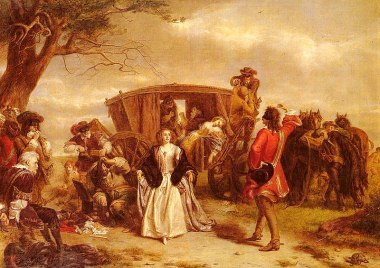
claudeduval

The famous incident in which Claude Duval the notorious highwayman tells a lady  whose coach that he has just held up that in exchange for a dance he will refrain from robbing her.

Our current government claims to be one that is tough on crime, yet in practice it seems to being doing the opposite. What I am going to suggest that the government through its policies is reverting back towards an earlier model of society, one similar to that of the 18th century. In that century policing was massively under resourced. Crime prevention and detection was in the hands of the Parish Constable. A man who had to rely on the support of his parishioners to arrest criminals. Policing was so ineffective that the government had to resort to the extreme measure of making most offences capital offences as a means of deterring crime. The Black Act of 1723 tried to compensate for the lack of an effective police force by making some 50 offences punishable by hanging, for example the punishment for breaking a farmer’s gate was hanging.The only way the to keep one’s household safe was to ensure that all the doors where secured by good locks and a variety of loaded guns where at hand to fend off any intruders. Ominously I was told by a member of the police force that his recommendation was to secure one’s house with good locks and stay in at night, he thought the policing levels were inadequate to guarantee the public’s safety. One senior police office ventured the opinion that he would not go into the centre of Manchester at night because it was not safe.

The combination of weak governments and under resourced policing is all to evident in Eire. Even before the financial crash and the austerity programme that forced large cuts on the Garda (Eire’s police force), this force was struggling to cope with the criminal activities of both terrorist groups and criminal gangs. These gangs were then so powerful that they could shoot a campaigning journalist at a busy cross roads and get away unhindered. Now an even more depleted police force is unable to prevent tit for tat killings that are occurring between these criminal gangs. Yet in spite of the evidence of the evident dangers of relying on an under resourced and undermanned police force to contain these dangerous criminal gangs the government is insistent on following the unwise path already trodden by Eire.

There is ominous evidence from my home city that this is already happening. Cuts to the number of the police have meant the ending of an effective pro active drugs strategy. The teams that were used to break up and disrupt the drug dealing gangs have been disbanded and the remaining police officers used to street patrols. The police will now only react to evidence of drug crime and only if it is thought that the individual in question has drugs in excess of a street value of £10,000. This means that the street dealers which are the bread and butter of the organised drugs trade are given a relatively free hand.

Why despite all the evidence of the dangers of allowing the drugs gangs to flourish has the government adopted policies that will encourage these gangs to flourish.

Why?

There are several possible answers but the most likely is the change in the philosophy of the government. The adoption of the brutalist philosophy of Neo-Liberalism, which emphasised the supremacy of free market, competition and the end of regulation. Regulation it was argued did not prevent wrong doing so much as impose additional and unnecessary burdens on business. However Hayek (The Road to Serfdom) who was the founding father of Neo-Liberalism did not argue for the extreme Neo-Liberal system of today. He believed in the good society, a society in which all paid tax for finance those items that made up the common good. He never once in his writings claimed that the ideal state is one in which the tax authorities collaborated with the rich in a programme of tax avoidance. He would have been horrified at the programme of tax cuts that reduced the effectiveness of the police and other public services.

Rather than looking to Hayek it is the writings of a novelist and minor philosopher called Ayn Rand that are the inspiration for the new Neo-Liberal State. In her influential novel “Atlas Shrugged” she wrote that the billionaires are the saviours of society. It is their energy and drive that moves society forward. Any restrictions on the activities of these people negatively impact on society as it prevents them fulfilling their primary purpose which is wealth creation. Therefore in her good society there are to be few regulations imposed on the billionaires or the businesses they run. Regulations that protect workers at their place of work are no more an unnecessary increase in costs as they disproportionately increase the costs of labour far beyond the contribution labour makes to wealth creation. All these high labour costs do is reduce the number of goods and service produced as what might have been produced if labour was fairly priced is now uneconomic. Similarly high rates of taxation on the rich do little more than reduce the amount of money that they have available for investing in the economy. In contrast the poor and the great majority contribute little to the economy, they are merely the simple tools that the billionaire uses to create wealth. Only if the billionaire class is freed from all restriction will they be able to use their energies creatively to add to the wealth of society. It is this author who is the inspiration behind the new Neo-Liberal State, that is the Britain of 2016.

Although her books are widely read amongst students at our elite universities, there has to be another reason as to why she has been adopted as the political philosopher of choice by our political classes. I think part of the answer is that they identify with her billionaire class. They see themselves as much victims of society as the billionaires of Ayn Rand. These leaders are continually frustrated in their great schemes for change and reform by the opposition of the little people. People of little worth, who lacking the skills or even intelligence for government think they have to right to a say in how policy is made. This contempt for the little people is demonstrated in the distain our leaders show for them. One former leader spoke of constantly being stabbed in back by public sector workers who failed to understand that the policies he was introducing were for their benefit and the good of society. Another continually referred to his opponents as the ‘blob’, abusive terms are the common currency of politicians who want to minimise the role of the people in a democracy.

It must also be mentioned that the political classes believed that the political and economic reforms espoused by Ayn Rand would if adopted would lead to a new political and economic dynamism in what they saw as a moribund society and economy , too rooted in the practices of the past.

Rather than continue with a psychological analysis of the political classes, what I want to demonstrate is the impact of what I shall call ‘Randism’ has on society and crime in particular. If the billionaires and their proxies the great business corporations are to be freed from almost controls and regulations, there are other greater predators the will benefit, which are the organised crime networks.

Changes in the legal system, in that is company law and tax law have created a situation in which the big corporations are largely outside the law (at least in the UK). What has been created is an opaque system of company organisation the will frustrate any attempt at regulation or control. However such a system is open to abuse and it offers possibilities for criminal organisations that had not previously existed. Formerly in the UK criminal groups used small businesses as a front for their illegal activities, such as scrap metal dealing, now they have the opportunity given the opaque nature of company organisations to move into large scale legitimate business. What is to be feared that the change or weakening of company regulation could result in a similar situation to that in southern Italy where the criminal gangs have penetrated legitimate businesses.This has already happened in the meat processing trade, there was a recent scandal in Britain where it was discovered that criminal gangs had infiltrated the food processing industry and were able to pass off horse meat as beef. While a few minor wrong doers were arrested the members of major criminal gangs were never arrested. The abolition of most regulation relating to food production has not freed the large supermarkets from unnecessary regulation but opened up a new field of opportunity for organised crime.
Perhaps the fate of the National Crime Agency illustrates best the dangers of an opaque legal system. The National Crime Agency was set up to tackle organised crime or more particularly the large drug gangs. It was to be a British FBI, with some of the best detectives seconded to it. However it has been largely ineffective in its main purpose which is to seize the assets of the big criminal gangs as a means of rendering them ineffective. Its ineffectiveness is a consequence of legal changes designed to minimise the impact of regulation on the big corporations and it is this lack of legal powers to intercept the flows of cash within big business that means this agency is unable to disrupt the large organised crime enterprises. It is not only in Britain that the law enforcement agencies are unable to confiscate the income of these criminal empires but also in Eire where the crime lords can amass their ill gotten gains without any apparent interference from the legal authorities.

Governments know that the lack of effective financial regulation means that the large income flows that enable the criminal gangs to prosper. What prevents them taking effective action is the corporate interest which is opposed to any stricter regulation of international finance. They see any change as a threat to them, what they want least of all is to be liable for their fair share of taxation. They will continue to work against any effective control of financial transactions, even if it means tolerating the growth of large scale criminal empires.

The political classes in Britain with the belief in Ayn Rand’s Neo-Liberal dream would never countenance any change in law which might disadvantage the billionaires or their proxies the large business corporation. Their rigid adherence this extreme ideology or dogma means that effective action will never be taken against these criminal empires as the consequence of any such actions may have what the big corporations see as negative consequences for them.

This belief is all to clearly illustrated in the actions of the British Treasury who believe that any government spending reduces national income and so the minimum should be spent on public services such as policing. Newspaper columnists can continue to write horror stories about the iniquities of the trades trade but the Treasury would never countenance any increase in spending on the police as they believe it would negatively impact on the nations wealth. They believe that if the price of greater wealth is increased criminality, that is a price worth paying, as its better to live in a dynamic society that has high growth and crime than in one that is the reverse.

In Memoriam – a tribute to a feminist sister

Awesome-Yellow-Rose
The Yellow Rose a symbol of joy and gladness
A recent personal tragedy made aware that philosophies of kindness are regarded more highly than is widely assumed, many remain impervious to the worse excesses of our materialistic culture. The values associated with a more traditional culture still exist within contemporary culture, values such as friendship, compassion and caring. The respect shown towards my sister by her many friends demonstrated how these highly these values are still regarded. The turnout at her funeral and the grief expressed showed how much people value this individuals whose life demonstrated these principles in practice. She was a woman who worked in the caring services, most recently teaching children that had been excluded from school because of behavioural problems. Even accepting back into her class a violent teenager who had made an attack on her. She was a central figure in many friendship groups and social activities such as the book club. These friends all supported each other through the problems that life throws up, illness and death for example. Men seem to lack these support groups as we seem much more one dimensional in our relationships.When I started my last job I made friends with Keith, yet it was a number of years before I knew he had two children in their teens. We just talked about work, philosophy and politics, never our families. One sociologist made a study of language use and she came to the conclusion that women make much more use of relational language. Going back to my example if we had been women, we would asked each other about family and known almost immediately how many children each had. I think one writer wrote that it is woman kind that civilises mankind. Perhaps illustrated by a remark made by my wife. When hearing that the British army was to allow women to engage in combat on the frontline, who said that, ‘I thought we were capable of better than that’. What the life of my sister reminded was that there is a different culture within our society of which I as man was unfamiliar.

Feminist philosophers and theologians believe that their gender gives them a very distinct life, which makes the dominant male oriented philosophies and theologies of our society irrelevant to those who don’t have the male experience of life. Grace Jantzen is one of these writers. She in her book ‘Becoming Divine”,redrafts Hannah Arendt’s philosophy of natality to give it a distinctly feminist context. For Arendt natality is a philosophy of rebirth, a philosophy of revolution and change. There are times when the power exercised by the dominant group in society weakens and falters.This is becomes a time of opportunity, a time when a public space opens up which allows all those feelings and ideas that had been repressed to be expressed. It is a brief moment of time in which change in the social order can occur as new ideas are given the time and space to take root. The Arab spring briefly appeared to be one such moment of natality, it seemed as if Arab societies could be reborn on more egalitarian lines, when fairness established as one of the founding principles of a new society. Unfortunately, in all but Tunisia the old repressive forces reasserted themselves with renewed vigour.

People of mine and my sister’s generation thought the 1960s was such a time of rebirth and the remaking of society. A time of the ‘the Age of Aquarius’, certainly it was for many individuals, who in response to the times entered into the caring professions or adopted an alternative lifestyle. Unfortunately this brief spring time of liberation was crushed by the forces of reaction. Not the cruel reaction of a repressive police state, but the overwhelmingly seductive power of the consumer society. Potential revolutionaries were bought off by the promise of wealth. I can remember conversations between avowed Marxists in which the main topic of conversation was house prices and how they would benefit from the rise in these prices. The wealth on offer was so much greater than any of our parents knew so young people it easily seduced into becoming willing participant in the consumer society. What remained of the revolution of ideas and behaviours, quickly metamorphosed into a revolution of style and appearance. Revolution was to be expressed in liking a particular type of music or through dress, revolution segued into glam rock, it was a revolution of style. This revolution left intact the very fundamentals of the old unequal society, the power of the old order was never really challenged. When the opportunity came in the mid 1970s this group savagely reasserted its claim to wealth and privilege. The welfare state was slowly dismantled, poverty appeared again on our streets in the person of the beggar.
One interview I saw on television encapsulated this change. A representative of a country landowners association said how the fashion for large country houses had changed. In the 1960s these great houses were being knocked down, whereas in the ‘noughties’ there was a renewed interest in building great country houses. He failed to mention that this was a consequence of increasing inequality of wealth and income in the country.

Grace Janzten was part of new rising group of feminist thinkers who reacted against the philosophy of the times, that of Neo-Liberalism in its many forms. These new patriarchal philosophies were as the old male religions the philosophies of anti-life given new guises. These old new philosophies for her sprung from the inability of men to directly experience the act of creation, that is giving birth. It was the experience of or the potential experience of this that gave women a different understanding of life. Central to women’s lives are the acts of creation and nurture, as without nurturing that created thing, life would not thrive. Masculinist philosophies such as Neo-Liberalism make the nurturing society impossible. Its very Darwinism emphasis on winners and losers is anti-nurture, as in such a society only the winners thrive. Rather than thrive the great majority of society, that is the losers languish and flounder. The number of children in poverty is rising and those malnourished children lose out in the academic race that is now schooling. They cannot compete with their better fed and resourced rivals. Neo-Liberal Britain is the society of the precariat and the underclass, where only the possession of wealth is celebrated. A Jantzenist society would be very different, in that all its children would be nurtured and all have an opportunity to succeed. This would mean the removing of those barriers to aspiration, that is the many barriers placed in the way of the children of the poor by low income and poverty. Motherhood would be the basic principle around which society would be structured, rather than the very masculinist one of power.

Jantzen never really develops how her philosophy/theology in the context of remaking society, her interest is in power. How to grab back power from the patriarchy. Her solution is the development of a feminist philosophy of natality and life as a counterweight to dominant masculinist philosophies of power and violence. She wants equal recognition in society for the very different life experience of women. This in turn brings me back to my sister and I, as our childhood experiences demonstrate the two very distinct philosophies of life. She would work as a volunteer for the St.Johns Ambulance Brigade, which meant giving up her spare time to work in the wards of the local hospital. While I went out with my friends fishing or shooting, more usually the former, inflicting pain and suffering on the local wildlife. Although Grace Jantzen can justifiably be accused of presenting a very idealised view of women’s life experience, it does not diminish her claim for the need for a powerful feminist philosophy of natality to oppose and limit the predatory masculinist Social Darwinist philosophies of today. It is the latter that have wreaked havoc on society reintroducing to it, poverty, insecurity and ill health all the evils of the societies of the past.

The Philosopher and the Economist

Over the last twenty plus years their have been a series of financial crisis each inflicting damage worse than the previous on the world economy. Yet economists see no need to change there understanding of economics as they believe that in the years before 2008/9 they had discovered the ‘holy grail’ of economics, that is the free market economy. The two schools of British economics Neo-Liberalism and its free market cousin, New Keynesian have an enthusiasm for the largely unregulated market system, seeing it as the best possible of all possible economic models. Yet evidence suggests otherwise and as an avid student of philosophy I would say that all understandings of human behaviour and society are imperfect and that no one understanding of the nature of the economy is without significant flaws. 

 
Image taken from drury.edu

John Locke in his discussion of the nature of philosophy (Essay on Human Understanding) makes what I believe the most compelling case for the inclusion of philosophy in the economists tool box. He compares the role of the philosopher to that of the under labourer. The under labourer on the 17th century building site cleared the ground in preparation for the building work to come. Similarly the philosopher clears and tidies up the area of study for others, they clear the intellectual clutter from the site making clear to other, making clear the areas of study and highlighting the key questions to be answered. Their role is to dismiss all those questions that prompt research that hinders or obstructs the progress of research. In the science of the 17th century this would mean excluding astrology from the in study of astronomy, as the study of this distracted from the real science of the universe. While it might be argued by economists there is no equivalence of astrology studies in economics today, their still practise their subject in a way that prevents real solutions being found to the current economic malaise.

As a Lockean philosopher I would ask why do economists not recognise that the economy is an integral part of the wider social organisation that is society. What they should be asking is how does the wider society impact on the economy? What are the consequences for the economy in changes of human behaviours and attitudes, do these changes contribute to the current economic malaise? Why leave the builders out of the study, after all the economy is but a human construct?
Just as with the fashion in clothes it is at affected by changes in people’s tastes and attitudes.

Perhaps the most significant change in people’s attitudes and behaviour is the shared undertandin of the purpose of the legal system. Initially lawsand the legal system were seen as indispensable to the working of society, as they prevented those disruptive behaviours that would prevent a settled society from existing. These crimes when committed could attract severe sanctions, in the most extreme cases a life sentence. However there has developed in recent years a new understanding of the role of law. Law is now seen as a means of facilitating certain approved behaviours which are known by the generic term entrepreneurship. Laws aimed at eliminating bad behaviours by this group have been removed or emasculated, as it is believed that the free market is the best means of regulating such behaviours. The assumption is that competition in the market will drive out bad entrepreneurs and the law that by intervening in this Darwinian market will result in interventions that damage the economy. Consequently laws on employment protection and the governance of companies are either abolished or have their impact minimised. Now the legal profession is tending towards the belief that the free market and not law is the best guarantor of good behaviour in business and that their role is to stop groups such as environmental activists interfering in the market. In Britain there any many legal restrictions that can be imposed on such awkward groups.

One such consequence is that company law has been rendered largely ineffective. Originally the public company was developed as a means of enabling businesses to raise large sums of money from the public to finance large scale business investment. This organisation has now evolved primarily into a means of tax avoidance or for the owners a means of avoiding legal responsibilities and liabilities. When companies go bankrupt through mismanagement ,the directors are free to walk away from the company free from any legal sanction. No blame attaches to them. It is the legal entity the public company that has gone bankrupt, not the directors. The structure of the public company encourages irresponsible and reckless behaviour by company directors, as was demonstrated during the crash of 2008/9 when no senior banker was held to accountable for reckless or irresponsible behaviour.

This widespread practice of wrong doing throughout the corporate sector has had very negative consequences for the economy. Increasingly people come to distrust the large business corporations all they see is a group of greedy individuals exploiting their customers for their own benefit. Such people have achieved the impossible in making people yearn for a return of the once much derided nationalised industries. The directors of the privatised rail industry have been responsible for massive increases in rail fares making British railways the most expensive in Europe. Fares on British trains can be six times the price of their equivalent in Italy. This behaviour is producing a reaction in the community at large, in Western Europe groups such as Momentum in Britain or Podemos in Spain are campaigning to end this abuse of the system.

However my intention is to demonstrate how the tolerance of widespread mismanagement, corporate greed and wrong doing impacts on the economy as a whole.This is most clearly demonstrated in the finance industries. In the days of my childhood one of the most trusted figures was the ‘man from the Pru’. He called every month to collect a small payment from my parents for life insurance, savings and house insurance. My parents knew that a reputable firm such as the Prudential would always pay out whatever the circumstance, they had faith in the company. The first sign that all was not well in the finance industry was when England’s oldest insurance company ‘The Equitable Life’ went effectively bankrupt, as it lacked the funds to pay the pensions it had promised. There then followed a long series of scandals in this industry due largely to a combination of mismanagement, individual greed and irresponsible behaviour. The consequence was the development of a widespread distrust of the financial services industry.

This justified widespread distrust of the financial services sector has led to some unfortunate consequences. People began to look for alternatives to saving their money with these institutions; they looked for investments that would offer far better and safer returns than those promised by the financial institutions. The one alternative for most people was property, asset prices rose more rapidly in the housing market than in any other alternative market, so any investment in property appeared to be a win, win situation. There is no other market in which the value of the initial investment would increase so quickly. Many entered the rental market as the returns on rental properties were astronomic, it was a market in which it seemed nobody could lose, except they did. There is the now forgotten property crash of 1990 and the more recent one of 2008/9. The problem was that the increase in house prices was due to a speculative boom, caused by more and more money chasing an ever more slowly increasing supply of homes for sale. A market based on speculation will always be subject to booms and busts. The supply of money for this speculative investment will always slow at some stage, usually due to some downturn in the economy or the realisation that much of the property in which the money is invested is not worth the money paid for it, as in the sub prime market in the USA. Such as downturn is occurring now and there will be a crash in the property markets in either 2016 or 2017. What cannot be predicted is the scale of the crash.

Unfortunately this rise of the property market has coincided with the decline of the manufacturing sector. Manufacturing now only generates 10% of UK’s national income. In the housing market much of the investment is recycled money as the same properties are sold over and over again at ever increasing prices; whereas the manufacturing industry creates new products for sale, which generates ‘real’ extra’ income. With the decline of manufacturing people could look less and less to an increase in income, as most new jobs created were in the less productive service sector. As people could no longer rely on ever increasing incomes that looked to speculative returns to boost there spending. The market that offered huge speculative returns was the housing market.

There are two negative impacts on the economy from the growth of the housing market. Funds are attracted to the higher speculative returns in that market, rather than the lower returns from investment in manufacturing industry. At the time of the crash in 2008 over 80% of bank loans where made to the property market. A manufacturing industry starved of investment funding can only decline. The consequence is that Britain has become increasingly dependent on foreign manufacturers to supply the goods it needs. Britain now has the largest trade deficit as a percentage of national income for any developed industrial country.

This has resulted in a disastrous change in government economic policy. Now as so many people are dependent on speculative booms in the housing market for extra income (loans secured against the increase in property values), the main role of government economic policy is to support the speculative boom by adopting a series of policies that constantly increase house prices. What never occurs to the government is that this is a foolish policy that can only end in tears,as happens when the market crashes. No government minister or Treasury official seems to have noticed that each successive crash requires greater and greater sums of government money to bail out the losers in the crash. Figures for the money used to bail out the bank’s etc in 2009 are notoriously opaque. One figure I came across was that in 2009 the government pledged £1.2 billion to support the bank. This figure was about a 100% of national income, fortunately it was no called on, it remained just a pledge. If the bank creditors had demanded that the money be paid into the banks coffers, Britain would be in a far worst situation than is Greece.

What I am trying to say is that as a philosopher I look beyond the current economic toolkit to try to understand the nature of our current economic malaise. It is by asking different questions that I arrive at different conclusions to those proffered by orthodox economists. The main solution to our problem is to stop the speculative frenzy that is the property or more accurately the housing market. If the banks and other lends could not increase by astronomic sums the amount they lend to the property market, there would be no money to fuel this frenzy. This could be done quite simply by increasing the reserves the banks hold, one economist has suggested that the bank’s reserves should be increased to 10% of total assets (or loans). If this happened banks would have to go to the market to raise huge sums of money to increase their share capital. It would not happen and banks would be forced to withdraw funds from the housing market. There would be a painful crash in that market, but once that the effects of that crash had receded the economy could be rebalanced towards manufacturing. An increase in manufacturing activity would have many beneficial effects, one of which would be the reduction of our horrendous trade deficit, as people rather than buying imported goods bought domestically produced ones.

There would be a price for making this change, there would be a fall in the incomes of many people, as they could no longer rely on loans to boost they’re spending. It is quite likely that there are a number of senior politicians that are aware of this and for that reason they are afraid to end the speculative housing boom. Conventional knowledge states that any government that presides over falling house prices is committing electoral suicide. Instead they hope the great crash will happen on somebody else’s watch. To put it another way fear of electoral suicide makes cowards of all politicians.

What I am saying is that while economists fail to consider factors such as a change in the attitudes and behaviours in the population at large and in particular that of the political and cultural elites, they will never come up with solutions to the current economic malaise. This type of thinking that does take into account these cultural changes was known as political economy, yet this school of economics has long been abandoned by practising economists.

Returning to my initial thoughts on Locke and the under labourer, perhaps what really needs to be cleared away is the current economic orthodoxy, which acts as an intellectual road block to prevent the development of any new approaches to solving the current economic malaise.