Why economists should be banned from public life; it’s for the good of us all

Can economists ever do good for human kind? If its contemporary economists that the question is asked of, the answer must be no. There are a few exceptions but generally speaking economists support the most inhumane of political experiments on mankind. With very few exceptions they have been the cheer leaders for the programme of austerity that has been inflicted on societies in Western Europe and the USA. Possibly there is some poetic justice in this turn of events. The leader of the IMF is always a European and the IMF has wreaked havoc on the economies of the developing world over the past decades. Whenever a developing country has turned to the IMF to finance its debts, the money has only been given on the condition that the country adopts the harshest of austerity policies. Health and education services are always the first the IMF insists on cutting, its a kind of perverse morality that believes the inhabitants of poor countries are deserving of poor health and education. Now the EU has adopted the same austerity policies to protect the debt holders (in this case German banks) who over invested in the Greek economy. The loans that saved the Greek banks from bankruptcy was only given on condition that Greece adopted the policies that turned the country into a basket case.

What I would like to suggest that governments adopt a ten year moratorium disbarring them from employing economists for that period. Society would be far better governed if politicians took responsibility for their actions instead of outsourcing the decision taking and blame to others. Perhaps if Tony Blair instead of sending his shadow cabinet on a business consultancy course but one on moral philosophy the horrors of the Iraq war may have been avoided. Infra structure products are hopelessly delayed as government invariably outsources decision making to think tanks, such as ‘The Adam Smith Institute’ or in the case the Third Heathrow Airport to an economist called Howard Davies. Stanley Baldwin when under pressure from the press barons to reverse his policy giving self governance to part of the British Empire spoke of them wanting the prerogative of power without responsibility, this is the prerogative of the harlot. The current generation of politicians want neither the power or the responsibility, just the opportunity to enjoy the trappings of power. The British government will not make the final decision on the High Speed 2 railway, that will be left to others.

20140613-112910-41350460.jpg

There is a striking counter example which both throws light on the poor political governance of the UK and that is the Senate of Republican Rome. The Senate before it authorised any major action by the Roman State, asked the Pontifex Maximus (High Priest) to read the auspices to assess the prospects for success. This involved divining the attitude of the Gods to the enterprise by examining the entrails of a sacrificed animal. If the enterprise failed it was because the priest reading the entrails had made an error and had failed to recognise the hostility of the Gods to this enterprise. Today economists are asked to perform the a similar ritual, it is the economic report into the viability of the project. They read the auspices by examining the entrails (statistics) of the economy. While it is not hard for a minister to find a tame economist who will divine the government’s intention and predict the success of the enterprise, our system has one major flaw and that is the divining the auspices rarely delivers a single definitive reading. There are several economists who claim to perform the economic ritual better than the chosen government economist. They will deny that the government economist gave the correct reading of the economic auspices which generates confusion as to what is the correct reading and hesitancy in decision making. Their are too many high economic priests.

George Osborne the Chancellor of the Exchequer is the driving force behind proposal to build a new town at Ebbsfleet in Kent. What I can predict is that is that there will be numerous other economists claiming that the entrails were read incorrectly by the Treasury and that a new town is not needed or that Ebbsfleet is the wrong location etc. Putting a measure in the Queen’s speech does not guarantee that the town will ever built, as it depends on the agreement of that quarrelsome collective the economists to sanction it. With the government having outsourced decision making to the economists, I cannot see the new town of Ebbsfleet being built. Rather it will be a project whose merits will be debated into the indefinite future.

20140613-113834-41914863.jpg

Despite the Roman system of decision taking appearing to depend on the whim of a supernatural deity, it was far more effective than ours. Firstly the Roman Pontifex Maximus (High Priest) was a senator and was always a powerful figure , unlike in Britain where the equivalent of the Pontifex Maximus is an outsider and is not regarded as an authoritative figure by other priests (economists). In Rome the reading of the auspices was merely confirming what the most powerful group in the Senate had decided. Murder was not an uncommon way of eliminating one’s opponents, as eliminating one’s opponents either ensured that only your supporters remained in the a Senate or it cowed the opposition into acquiescence. Mark Anthony was initially a gangster used by Caesar to intimidate his opponents in Rome. Our political leaders have rarely decided in advance what the policy will be, even if they favour one decision over another, they still outsource the decision to others. Economists the chosen group of outsiders lack the authority of the Pontifex Maximus, they all claim to be the Pontifex so there is no authoritative policy statement. What makes the Roman Senate a superior policy making body to the British Parliament was that the ritual was subordinate to art of decision making, whereas it is the reverse in the UK. The Senate unlike the British Parliament could make decisions even if they were bad ones. A similar phenomenon can be observed in the US congress which also appears incapable of decision making. One of the few policies Congress agreed on was designating the tomato sauce on pizzas as being one of an individuals five a day portions of fruit and vegetables. Congress can agree on meaningless acts but avoids difficult decisions.

20140613-114331-42211783.jpg

Another advantage of the Roman reliance on the Gods providing supernatural policy sanctions is that such authority is far more persuasive than that conferred by economists on government policy. If the Senate wanted to oppose a particular policy, usually one that favoured the lower order the plebeians, they could claim the opposition of the Gods. Threatening natural omens would be reported such as cows with two heads all suggesting that the Gods were angry. Claiming a policy that you don’t favour will make people worse off, does not carry the same threat as a policy that angers the Gods.

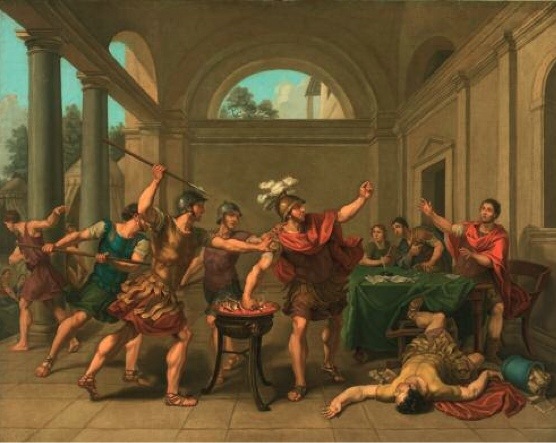
It may seem strange to state that the decision making process of the Roman Senate is superior to that of the UK government, when it has access to a wealth of economic statistics and computers to aid decision taking. I argue that the Roman system was superior because the Senate’s decisions were made on qualitative grounds not quantitative. A boldness of vision comes naturally to individuals who celebrated virtue. Their moral exemplars were men such as Lars Porsena who burnt off his right hand to demonstrate Roman courage and steadfastness to the enemies of Rome, who held him captive. British politicians schooled in the world of cost and benefits are incapable of any grand vision. It breeds a kind of modesty in decision making and with it a desire to avoid big difficult decisions. There was a heroic generation of British politicians it was those who had guided us through a Great War. It was that generation that gave us a National Health system, free legal aid so the poor would be on an equal footing with the rich in court. Both of which our modest generation of pseudo economists want to end because of their supposed ‘unaffordability’ . The grandest vision any contemporary politician could envisage, is cutting the cost of a public service. In these modest time the hero is the cost cutting politician. Certainly there is not one contemporary politician who venture any project as grand as a national health service.
20140613-114546-42346041.jpg

This is why this particular economist wants all economists banished from government and all forms of public service. I want to take away that prop politicians use to avoid making decisions, that is the economy, when everything is deferred due to economic considerations. University education is too expensive so the pseudo economists increase university fees to £9000 pa. The consequence is that a black hole develops in university funding into which the government is having to pour more and more money. Stupidity rules in Westminster/Whitehall masquerading as economic good sense, if higher education is really that unaffordable why not just cut the number of university places, instead of using the economic fudge of pretending it will be solved by increasing fees.

One further observation the contemporary Lars Porsena would not be the one who resisted the over mighty enemy, but the one who capitulated to the enemy and who facilitated their aims. Successive British governments when faced with the problem of tax evasion and avoidance by the rich and powerful, rather than taking action to end this abuse of power and offend these powerful men instead took action to make tax avoidance easier.

20140613-114708-42428813.jpg

Demonic or Nietzschian Economics

20140604-131852-47932324.jpg

Nietzsche is perhaps the most misunderstood of philosophers, he is remembered for the praise of the ‘blood beast’ of his declining years, not the insights of his philosophy in his early years. As a skeptic philosopher he criticised his fellow philosophers for failing to understand the subject the nature of the subject they studied, man. His most potent criticism that all grand philosophies were fallible as they went contrary to the nature of man. One of his most trenchant attacks was on the notion of free will, he demonstrated that so many acts of criminals were predetermined so to punish them as if they had freely committed a criminal act was wrong. Similarly I want to conduct a skeptical or Nietzschian analysis of economics

What I want to contribute to the study is ‘satanic or demonic economics’, a new reading or interpretation of economics. The devil or Satan offers a wonderful tool for explaining the true nature of economic analysis. While I prefer to believe that we as individuals have sufficient potential for evil within ourselves; I cannot deny the value of having a demonic figure to explain the evils committed by men. Previously I have written of economists adopting a devil substitute to explain the failure of the perfect economic system, the free market. What I have realised since then is that it is the economist’s failure to recognise the existence of evil that has lead them to blunder into creating the most inhumane of human sciences.

There is a novel which demonstrates all too clearly the problem with contemporary economics. That novel is James Hogg’s ‘The Private Memoirs and Confessions of a Justified Sinner’. Robert Colwan the anti hero of the novel fails to see that his companion and friend Gil-Martin is the devil. He is so blinded by his sense of self righteousness, that is his own sense of goodness, that he fails to see that Gil-Martin is leading him into committing acts that become progressively more and more evil, culminating in the murder of his brother. While James Hogg is poking fun at the intolerant lowland Scot’s Calvinists who would abolish fun if they had the power, his book contains a fundamental truth. Those who don’t acknowledge the existence of evil usually go on to commit evil, because they are blind to the existence of evil. The German bureaucrats who sent millions to the gas chambers could do so because their only concern was to make the German railway system run efficiently. The fate that awaited millions of Jews was irrelevant. What Bauman discovered about the behaviour of German railway officials could not unfairly be applied to the current generation of economists. They as with the German bureaucrats only want to make the system run efficiently, they have no concern about the consequences of their actions for their fellow men.

20140604-132238-48158020.jpg

Economists have always argued that their subject is a social science not a moral science. They claim that by excluding value judgements from their analysis they can offer the objective analysis which delivers the answers to the problems that bedevil mankind. What they fail to recognise by committing themselves to a self declared moral blindness they cannot recognise the inhumanity and evil of their language and practice. The only fair comparison I can make is the psychopath who is unable to develop human empathy because they have been damaged so severely by their dysfunctional upbringing that they are incapable of moral empathy. Economists similarly have so damaged by their study and practice of economics that they are also incapable of moral empathy.

The model that economists wished to emulate was that of the natural sciences. Its success had been due to the adoption of the scientific method and the exclusion of any value judgements that predetermined the answer. Scientific study had progressed little until religion stopped determining the answers to any scientific investigation. Bishop Usher had calculated that the earth was created in 4004 BC from his study of chronology of events listed in the bible. This effectively prevented the development of earth sciences until non-Christian scientists such as Darwin and Huxley demonstrated this was untrue as the earth evolved over millions of years. Economists wished to achieve the same standard of impartial enquiry that prevailed in the natural sciences. What they ignored was that economics is a human science and that if considerations humanity are removed from the study all that is left is a science of inhumanity. The consequences of which can be appalling.

One subject that has been a constant topic for study by British economists has been the low productivity of the British economy. By excluding any considerations of human welfare, they were able to come up with a number of ‘objective’ solutions. They identified the cause of low productivity as an under performing and dysfunctional labour market. There were too many restrictions on the use of labour which limited its efficiency. Employment protection legislation, health and safety legislation together with over powerful trade unions prevented its efficient use. What they saw was not a people who had legitimate rights as regards fair wages and a safe working environment, but a multitude of dysfunctional workers who needed to be subject to the harsh realities of the market to turn them into productive human resources. People are not people, they are the labour and they only right they should have is to be used productively. Fortunately for economists all governments since 1979 have seen the benefit of a utilitarian approach to labour. Employment protection and health and safety legislation have been so effectively emasculated that employers need have little concern about them impeding their exploitation of their workers. Trade unions have been so weakened that with a few exceptions they are of no concern to employers.

What has been created in Britain since 1979 is a low cost flexible labour force that is attractive to business. Consequently Britain has recorded one of the sharpest rises in employment in Europe during the economic recovery that has occurred since the crash of 2009. Labour is cheap to hire and easy to dispose of, so employers are willing to take on staff, knowing that they cost little and can be disposed of easily if the market takes a downturn. All this increase in employment has been at the expensive of productivity as its has lead to the growth of low cost industries, warehousing, call centres that require little investment as plentiful cheap labour is available. Cheap people rather than expensive investment. The misery of zero hours contracts, split shifts or low wages is of no consequence to the economist, as they are merely signs that the market is working efficiently in making good use of unemployed labour. What is most matters for them is that the employer able to use labour as cheaply or efficiently as possible.

Economists never speak of the need for fair wages, security of employment, good housing or free health care. As the value of the sense of well being from a fair income etc. cannot be priced so the
Its ignored. The economic calculus that is calculating the benefit derived from human activity can only calculate benefit in quantitive not qualitative terms. The economist has an opt out from moral judgements, it the market can make decisions about what people want and need, so such decisions about health care provision should be left to the market. However this ignores the dysfunctional nature of the market, as billionaires can pay more for their health care than can the poor, the market will provide excellent health care for the rich and minimal health care for the poor as the latter will make little money. Yet as economics is a subject devoid of morality economists would never be concerned with the poor being deprived of health care, as with the German railway officials human misery caused by their actions are not their concern.

20140604-132553-48353968.jpg

Lacking any understanding of morality economists are prey to a diverse number of Gil-Martins. that economists have no conception of morality, I mean public morality, they lack any conception of the common good. They are not lacking any conception of private morality,I’m sure many economists are good fathers and mothers.) These Gil-Martins are the wealthy businessmen and large corporations that endow university professorships or fund think tanks. As economists lack any moral sensibility they are easy to corrupt, promoting schemes that will benefit their benefactors. While there are numerous economists advocating the benefits of free enterprise, that is a lack of regulation which benefits the large corporations, as treating people well costs money, there are few that argue the benefits of a strong regulatory state.

Perhaps it would be wrong to call economists the ‘devil’s spawn’, such harsh language is not suitable for these civilised times. Yet economics is the ‘demonic science’ as the policy recommendations of its practitioners always increase human misery. Can anybody recall any economist ever speaking out for fair wages or security of tenure for private rental tenants. In fact the latter is anathema to economists as they believe that security of tenure impedes the mobility of labour as people are reluctant to give up the security of their existing tenancy for uncertain accommodation prospects in an area were there is work. If secure social housing tenancies are destroyed in Newcastle, there will be nothing to prevent the unemployed in Newcastle moving to jobs in the prosperous Thames valley, as they will be swapping one insecure tenancy for another. Ever since its inception economists have been campaigning against the National Health Service (NHS) as its providing of free care care at the point of use, which is contrary to the fundamentals of good economics. Free service encourages over use they claim,* if a service is priced people will only use it if they really want it, that way the correct distribution of resources is achieved as only those willing to pay for a service will use it. Services free of price are used wastefully, therefore the NHS must go. Economists are like so many Robert Colwans plotting the demise of a much loved health service, rather than a much loved brother. From the point of view of this theologian any human science that lacks any conception of the good can only practice evil. This is why using the concept of the devil as an explanatory tool is so useful in understanding contemporary economics, as evil infects all its economic analysis, medieval Christians were wiser than use in seeing the devil constantly at work in society.

*It is intriguing that economists tend to view ill health as a product of free service revision at not a risk that occurs naturally to human beings.
.

I am a person not a shopper

20140526-111442-40482965.jpg

Shopping is unfortunately the prism through which the government now views the people. People have one fundamental right and that is to be consumers. What matters is not that the government should provide high quality public services, but to provide a choice of service providers. Changes in education and health are intended to present the consumer with an array of services from different providers so they can choose the service that most meets their needs. Economists are responsible for this nonsense. Having advised governments that choice and competition are the mechanisms best fitted to provide good public service, they forgot to mention that economy theory states that this market mechanism only works if consumers have perfect knowledge. When buying vegetables it is possible to judge what is the best potato but the same cannot apply purchasing medical services. How can I know what is the best possible medical care for what may be life threatening illnesses or even know what illness effects me? When given the choice of five medical providers for my eye surgery, I had no idea which to choose. I lacked the knowledge to be able to choose the best provider. What I did was ask the optician which were the best. All she could say was that a previous patient had been a doctor and he choose this one, and in my ignorance I copied the example of the doctor.

20140526-111632-40592697.jpg

How did this become the accepted public policy? Baby boomers are blamed for many things unfairly, but the economists and politicians of this generation are to blame for this policy nonsense. As a member of this generation I can give an insight into this malaise. The sixties generation are often described incorrectly as the generation of ‘free love’, sexual and social liberation. What is less often acknowledged is that this is the generation that gave up on serious thought. It was not so much that this generation became obsessed with the new sensual delights of drugs and rock and roll, but their dropping of old difficult belief systems in favour of a new simpler techo-scientific belief system. A system that would deliver ‘real’ solutions to the problems facing the world. Unrealistic and unworldly ideologies such as socialism which never delivered on their impossible promises were replaced by a belief in a hard edged social realism. A dogmatic belief system called Neo-Liberalism, as one politician said it is the only game in town.

This hard edged belief system was one disseminated downwards from the social and intellectual elite. The intellectual elite schooled the new and up and coming political elite and the mass media disseminated it into wider society. Usually by highlighting the horrors of the old ways, ‘the winter of discontent’ and by simultaneously giving over column inches to the gurus and prophets of the new politics.

I as a student in London University witnessed the early stages of this new inhumane ideology. The economics professors were teaching that the dominant humane system of social democracy was wrong it gave people an unrealistic expectation of what the state could do. Two of our professors expounded the then shocking view that unemployment was too low and must increase if the economy was to grow. Yet they were part of the generation that lived through the Great Depression.

Unknown to us at the time was that the new theory of cost benefit analysis as taught then would prove a useful tool for destroying social democracy. It would replace the more subtle and complex ethical thinking of the past with the crude simplicities of technical analysis. All the benefits of living in a civilised society are difficult to price, because they are all too often the intangible benefits of the mind. Yet just as real as the material benefits. How can the deleterious effects of the noise nuisance caused by a third runway at Heathrow airport be priced? Only by indulging in a series of thought experiments can such harmful experiences be priced and by any reckoning such reasoning lacks any really sound underpinning in the reality of people’s lives. It is much easier to calculate the benefits in terms of increased passenger flights and cargo deliveries. They can easily be priced and the value of increased air traffic is calculated on a much sounder basis than the cash cost of noise pollution, so it is hardly a surprise that cost benefit analysis usually turns out to favour the proposed development. The benefits of a good life cannot be priced, they can only be part of a moral calculus. Fortunately for the developer cost benefit analysis avoids any such difficult problems.

20140526-112059-40859861.jpg

What was disseminated outwards from the universities was the new culture of ‘not thinking’. Calculation would replace open debate, values were dismissed as distractions that prevented a realistic assessment of the issues. Ostrogorki would shudder to think to his study how the Conservative party of the 19th century used various tricks to manipulate the popular prejudice to win elections would lead change they nature of politics teaching. Political philosophy would be replaced by the study of the means of manipulating the popular vote. The science of calculation would replace the discussion of values. Values other than those as an embodied in an ideology to get out the vote were to be regarded as an irrelevance. Politics became nothing more than the study of the mechanics of politics. As a significant number of the dominant politicians studied PPE at an elite university, it left them ill prepared for the great debates than dominate contemporary politics.

There is a danger of over stating the influence of the ‘new intellectuals’ in shaping the nations thought. Higher education has to a large extent in the UK been part of the interlocking system of social elites that govern this country, educating the members of the new political elites. The new science of ‘realism’ suited the needs of the social elite who felt their interests had been ignored and disregarded by the social democratic settlement of the post war period. A teaching of humanities that regarded calculation as the supreme virtue suited their interests as any course such as philosophy that embodied a teaching of values would expose them as a privileged elite whose position lacked any moral justification. Isaiah Berlin the great political philosopher once wrote that there could be no such thing as a right wing philosophy. No moral virtue attaches to the abuse of power and privilege.

It was no coincidence that when this group achieved overwhelming political power with the conservative governments of the 1980’s they ordered a purge of the universities, the thinking departments were to be closed. Philosophy departments shut in many universities and the liberal arts were starved of resources so as to reinforce their new second class status. Instead the humanities were to be replaced with the new ‘non thinking’ subject, business studies. A subject in which students are to be taught to do business, not to think. It is no surprise that students are beginning to rebel against the dullness and enforcement conformity of thinking that characterises British universities.

North Korea is mocked for the peculiarities of the most authoritarian of systems that cannot tolerate even the most innocuous of dissent. Even to the extent of limiting its barbers to a few approved types of hair styles. What its leaders should instead do is copy the example of the UK, the country of ‘not thinking’. People are not forced to become model citizens of the people’s republic, but have been taught to express themselves as shoppers. A much more complex interplay of forces have made the non critical culture the popular culture. Great cultural events have now become little more than festivals of shopping.

This is demonstrated by the two so called insurgent parties in the USA and the UK, where the dissent or insurgency is more confected than real. UKIP the insurgency party is funded by a millionaire, its leader is a former investment banker, one of the new privileged elite. Its policies are those intended to protect the interests of the privileged elite. The withdrawal from Europe is really a wish to withdraw from the EU regulations that control business, such as the working hours directive. Limiting immigration is a popular policy but immigration has become less necessary for business as the organised labour has been effectively destroyed and employers can now treat the indigenous population as badly as it likes so there is less need for cheap easily exploited foreign labour. Other policy measures such as the introduction of a 10% flat rate of income tax and the privatisation of the NHS are contrary to public interest. What can demonstrate more clearly a ‘non thinking’ culture than one in which the popular party is the one that has absolutely no interest in the welfare of the people, who it claims to represent.

How a knowledge of the devil can aid in the understanding of economics and government policies.

20140508-151239.jpg

Manchester University economics students are campaigning for a change in the teaching of economics at their university. They are discontented with a curriculum whose content is limited to Neo-classical economics and mathematical modelling, a curriculum that fails to adequately address the issues of the day. They have called for a broadening of the curriculum to include other subjects such as psychology and economic history so as to develop a more reality based subject. One subject not included in their list was theology, so as a theologian I am going to demonstrate how theology can contribute to economic analysis. I want to show how using what many consider an out dated concept ‘the devil’ aids our understanding of economics.

Satan or the devil does not really figure in religious iconography until the last century BCE. In the Old Testament Satan is but one of the angels. He is one of the angels that are involved in inflicting pain and suffering on Job. With the rise of the new religious beliefs and practices of the last century BCE, the new religious world view was increasingly at odds with reality. There was the problem of how to reconcile a good God, who created a good world with the cruelties and suffering of the contemporary world. A problem that became more acute with the Roman persecution of Christians in the 1BCE. How could a world ruled by cruel Roman governors who used crucifixion as the punishment for dissent be part of a world created by a good God? The answer they found was in the devil a fallen angel, a malevolent being who introduced sin into creation and worked unceasingly to corrupt God’s good world. The old Olympian Gods who were cruel, licentious and deceitful were redefined as demons. St. Augustine portrays a world in which these demons (whose bodies were made of air) circle around the earth in the atmosphere looking for opportunities to lead men astray. One of the most ruthless persecutors of Christians in the Roman Empire, the Roman a Emperor Diocletian is shown in medieval pictures in companionship with demons. The actions malevolent spirit explained why the world did not fit with the Christian world view.

Perhaps the most compelling picture of the world as imagined by the Christians of the early centuries CE, is the picture of St. Anthony in the desert being tortured and tempted by devils. Frequently a subject for medieval and renaissance artists. Despite its apparent dissimilarity the Christian obsession with the devil and contemporary economic thinking, it does provide the perfect analytical tool for understanding the latter.

20140508-152311.jpg

Economists have created through ‘thought experiments’ the perfect economy. Yet whenever they put their precepts into practice it inevitably fails. Why does the free market economics as practised in the developed West so frequently fail? Why in this perfect world did the financial crash of 2008 happen? Their mathematical modelling of the economy showed that the free markets economic systems were those ideally best suited to maximise human welfare. If there models were correct what was going wrong in this perfectly manufactured economic system? There had to be some extraneous malevolent force interfering which made the system malfunction. Economists needed their own devil to explain the failures of their policies. Fortunately it was not hard to find this new devil, it had to be government. Neo-Liberal economists set about rewriting history to prove their case. There were sufficient horror stories from the Social Democratic era to demonstrate why the government should be excluded any management role in the economy. Perhaps the most striking of these stories of failure is that of DeLorean sports cars. DeLorean persuaded the government to fund the construction of a factory to make futuristic stainless steel sports cars in Belfast. Unfortunately there was no market for these cars and the business collapsed, losing the government millions of pounds. Now not only had economists found their devil they could demonstrate the horrors of his work to unbelievers.

There is a parallel between the preaching of early Christian missionaries and that of modern Neo-Liberal economists. Both could demonstrate the horrors of a life lived in thrall to the devil. For the first it was a life which ended in eternal torment in the fires of hell, for the second it was a life lived in the hell of social democracy as witnessed through the winter of discontent in 1979. Who would not want a life free from the horrors of the winter of discontent 1979 or the Great Society and LA riots associated with Lyndon Johnson’s occupancy of the White Hose.

Once the devil had been discovered a whole host of minor devils could be found to be working to frustrate the free market. NGO’s by campaigning for aid to help the most troubled of developing countries, were through the provision of aid undermining local economies and preventing the development of a local agricultural market that would feed the people. A profitable and thriving farming sector could only develop if they were not undermined by the distribution of free food. Saving lives now was misguided as it only laid up troubles for the future.

Just like the evangelical Christians who have to co-exist with the devil as he is part of God’s creation and economists have the accept the existence of government as it part of society, without which there could be no social order. Evangelicals rely on prayer, missionary work and political campaigns to profit abortion etc, to minimise the influence the devil has over people’s lives. Economists endlessly proselytise on the benefits of the small state on the assumption that the smaller the state the less damage it can do. Consequently there has been the constant privatisations and out sourcing of government activities to make this happen.

Free market economists are similar to fundamentalist or evangelical Christians in the horror in which they regard their own devil. One prominent Christian Republican politician advocated the killing of those who had claimed to have encountered aliens. His reasoning was that as aliens don’t exist they must have encountered devils and the only way to prevent these dupes of the devil spreading corruption in society would be to eliminate them. Grant Shapps the Conservative Party Chairman reacted with horror when the Labour Party suggested some modest regulation of the housing market. The most vile term he could come up with to describe it was ‘Venezuelan’ . For him their could be no greatest horror than living in the socialist state of Venezuela. Similarly in the US Congress a similar revulsion attaches to the word socialist.

Obviously it can be no surprise that there is an overlapping between membership of fundamentalist evangelical Christian organisations and the right wing political parties which are populated by believers in the free market. In the USA the Southern Baptists are Republicans and in the UK those Christians who oppose contemporary mores such as gay marriage are to be found disproportionately in the Conservative Party. What cannot be denied is the popularity of the belief in the devil, perhaps because its offers reassurance. In a world that seems alien or hostile too them it is easy believe that the cause is an external malevolent force, it explains everything.

What I can conclude by saying is that contemporary economists and first century CE Christians share a similar dilemma, how to explain a world that does not accord with their world view. For the Christian it was the Roman government dominated by the Satanic ethos and for the economist it is a malign government dominated by a similarly destructive ethos.

The Insurgent Economy

20140505-173052.jpg

What we call the economy the economy is but a shifting powerhouse of competing and conflicting forces. The two most significant being the dominant and the insurgent economies. The former consists of the most powerful social groups in society, while they are have the power to distort and bend the economy to service their needs, they also through the exercise of power provide those services that hold the wider society together. While the 7% of wealthy public school educated men may hold the most powerful positions in society and abuse their power to serve their own interests, they do give society its system of governance. A system of governance that at its most basic consists of public administration, law and order and defence. No matter how exploitative their behaviour they hold society together. The Mongol warlord’s Genghis Khan and Timur the Lame were cruel abusive tyrants. Timur the lame making mountains of skulls out of his slaughtered enemies . Yet they provided a superb system of administration that held together an empire that stretched from Europe to the shores of the China Sea. However as both empires were over dependent on the the skills of the individual at the centre of government, they fell apart on the death of these men. Or to put it a different way the subject people’s were unwilling to pay a disproportionate share of their incomes to governors who could not provide an effective system of governance.

20140505-174819.jpg

While the social group that controls the dominant economy in the UK are less brutal that the Tatar Emperors, they also use their control of the services essential the maintenance of good society to exact an onerous return for their services. In the 18th century the landed aristocracy effectively controlled the governance of Britain and in return this service they exacted from society huge sums of money with which to build the great country houses such as Blenheim Palace and Chatsworth House. While the landed aristocracy lived in grand houses the impoverished majority lived in hovels of mud and straw, few of which survive until today. When the landed aristocracy of France offered increasing little in return for the disproportionate share of national income that they rewarded themselves, they were overthrown in bloody revolution.

There is opposed to the dominant economy an insurgent economy peopled by those people excluded from the dominant economy. They threaten to take control of the economy from the dominant social grouping. In the 18th century this was the non-conformists, people from outside the dominant Anglican landed hegemony. People such as Josiah Wedgewood and James Watt, industrialists whose rapidly growing factories and the wealth they created enabled them to challenge the landed aristocracy for power.

The one way the members of the dominate economy can control the threat to their position was by denying or limiting resources available to members of the insurgent economy. In a largely agrarian economy of the 17th and 18th century Britain where most wealth was invested in land they were able to minimise this threat as they owned most of the nation’s land and were not willing to allow the control to pass into other hands. However this landed aristocracy while on the one hand tried retaining control of the nation’s wealth through a corrupt political system and by excluding people of dissenting views through from public office or the universities, did through their incessant wars with the French aid the rise of the insurgent economy. The suppliers of war material were the very people they wished to exclude from power. Men such as John ‘iron mad’ Wilkinson, who made the machinery that bored cannon barrels from blocks of iron. These manufacturers were so successful that even the French army that invaded Russia in 1812 wore British made great coats and uniforms. These industrialists benefitted from government largesse put their way. Such a large transfer of wealth inevitably affected the distribution of power in society and in the nineteenth century these industrialists effectively gained their merited share of power.

20140505-175410.jpg

Not all the members of the insurgent economy gained their wealth from government funding. Entrepreneurs such as Josiah Wedgewood created a new market for high class porcelain through developing new technologies and imaginative marketing. He displayed in London for several months the dining service he made for the Tsar of Russia. This public display of his wares won him customers from the middle classes who wished to emulate the nobility. The threat they posed was recognised by the landed aristocracy. Joseph Priestly scientist and friend of Joseph Wedgewod was driven out of his home by a mob (whipped up to a frenzy by the local nobility) who regarded him as a dangerous radical.

What I wanted to demonstrate by my foray into economic history was to give an indication of how the tension between the insurgent and dominant economy affects economic development and growth. Today this tension is demonstrated through the bid by the American pharmaceutical giant for the British pharmaceuticals company Astra Zeneca. It is a deal that will inevitably go through as it will have the support of the City of London. Predatory financiers will buy shares in Astra Zeneca and when they believe the market has reached its peak, they will through manipulation of their dominant shareholding force a sale. In the meantime they would have bought and sold the shares many times to make a profit of millions or for the City as a whole billions.

There can be no doubt that the dominant economy today is that focused on the City of London. Parliament is but a creature of the City, as demonstrated by George Osborne’s opposition to the proposed Tobin Tax from the EU on financial transactions. A position given tacit support by Labour’s silence on the issue. The takeover of Astra Zeneca demonstrates the dominance of the ethos of the financial sector in the economy. Investment in research into new drugs is expensive and the results uncertain, a far more certain way to make profits is to takeover a rival company and realise (sell) its assets. Already there has been talk of the new merged company needed to rationalise research and development by cutting down on duplicate research facilities. Astra Zeneca holds plentiful real estate which could be sold to generate profits for Pfizer. Then there is the cash rich pension fund. Pfizer by cutting back on pension liabilities (reducing pensions or increasing retirement ages) gives Pfizer access to funds that could be used profitably to boost the value of shares through a buy back scheme. There are numerous ways Pfizer could use the assets of Astra Zeneca to increase its profits. All the talk of creating a new mega pharmaceutical company which will use its funds to develop lots of exciting new drugs is just PR guff, needed for the politicians to justify their acquiescence to the purchase by yet another British company by a foreign buyer, who sees the acquisition of a British company a increase profits by selling off its assets.

What matters is the balance between the dominant and the insurgent economy. If the dominant economy is over powerful it can deny resources to the insurgent economy and as the insurgent economy is the generator of economic growth it can diminish, if not destroy the prospects for growth. The members of the dominant economy must be willing as with political parties in a democracy be prepared to see the other side win, not destroy any possibility of that happening. Members of the financial elite must be prepared to cede or share power, as did the landed elite of the 19th century, when they shared power with the industrialists. Cadbury’s, Astra Zeneca are all witness the dominance of government by the financial elite. The hedge funds, investment banks that have financed the Conservative party will not be wiling to let government veto the opportunity to make vast profits on the proposed Astra Zeneca deal. It is no coincidence that the decline of manufacturing industry has coincided with rise to dominance of the financial elite. Perhaps the clearest example of this the closure of Rootes Hillman factory at Linwood and the car making machinery sold to Teheran. It was a standard joke that if you wanted to buy a Hillman Imp, the place to go was Teheran. There must be hundreds of factories using machinery formerly used in British factories worldwide having been sold at knock down prices by the city. Former manufacturing giants such as Dunlop (tyres) and Pilkington (glass) have been sold by the city to foreign owners.

20140505-175615.jpg

The old manufacturing industries in UK would probably have declined but the actions of the city accelerated their decline. Unfortunately the dominant ethos of the financial sector is for short term speculative gain. Possibly this is why 80% of all bank loans are made to the property sector. This means the growth of the new rising insurgent industries have been choked off. Briefly Britain made computers but the only large scale manufacturer of them ICL was sold to the Japanese firm Fujitsu. The city having no interest in long term uncertain investments. This is why in the UK development in the new technologies has been confined to small software companies mainly based in the Thames valley area. Businesses that don’t require large scale city funding. There is hope that these new industries are beginning to make sufficient funds to finance expansion through reinvesting their own profits. Something that the iron masters and mill owners of the 18/19th century were forced to do, as all the traditional sources of finance went into land investment or the colonies.

A successful economy maintains a creative tension between the dominant and insurgent economies. The dominant economy is committed to social stasis to preserve the wealth of its members but in so doing it provides the social stability necessary for social order. Without that social order the insurgent economy would find it hard to develop. While the dominant economy is committed to no change, the contrary is true of the insurgent economy. Within the dominant social order there must be scope for the development of the insurgent economy, as that it the mechanism for future growth. This means the members of the dominant economy must be prepared to accept change and the loss of power. Not as in the UK where the city has systematically destroyed any threat to its power by disposing of new technology companies to foreign rivals.

There is hope in the new internet funding schemes which by-pass the banks. Crowding funding on the internet may hopefully develop as did 19th century joint stock company as a way getting funding for new businesses which are denied funds from the traditional sources.

A New British Industrial Renaissance or hope for the future with the demise of the banks

20140419-183409.jpg

Never have I written an optimistic piece about the UK economy, that is because I believe its immediate future prospects are not good, however there could be a better future. This I believe because there are startling similarities between contemporary Britain and that of the 18th century. It was the beginning of the industrial revolution when the British economy grew at a faster rate than at any other time. Society in the 18th century was dominated by a landed aristocracy who opposed any change that would threaten their interests. Their interests being the taking a disproportionate share of national wealth for themselves. This was possible because anybody not of their social class was excluded from parliament, senior offices in the judiciary and armed forces. Laws could be framed to protect this group’s interests and by controlling the law and judiciary they could enforce these self interested laws. Laws known such as the infamous ‘Black Acts’, whereby hundreds of offences against the propertied interest, became hanging offences. Breaking a landowner’s gate and fences, setting fire to hay ricks were for example offences punishable by hanging. Yet despite this monopoly of law making, British society was far too changeable and complex to be controlled by the law makers in Westminster and Whitehall. Not realising it these aristocrats were presiding over a century of rapid social change, which could not be stopped by laws from parliament. There was a social insurgency taking place that would revolutionise society. Wealth was increasingly being created not on the great landed estates, but in the new factories in the industrial town. This upsurge in wealth that was out of reach of the landed aristocracy undermine their political ascendancy.

In contemporary Britain there is a financial aristocracy that is as powerful as the landed aristocracy of the 18th century. Government has been subject to what is known as ‘institutional capture’, that is the financial sector that is has effectively captured the government and made it a creature of its own bidding. While there has been a shrinkage of the welfare state there has been a tremendous expansion of the welfare state for finance. When the financial crash came in 2008 the government was willing to cut national welfare to finance a bank bail out. Billions were poured into the banks coffers while billions were taken out of the welfare budget. Despite all the public debate about the need to reform the banks, the banks have been able to fight off any meaningful reforms. However it is their very attempts to create a social stasis that makes possible meaningful change. It is relatively easy to manipulate politicians to their will through political funding, but impossible to bend society to their will. Society is far too complex and changeable to be controlled by dictates from bank head offices in London. While it may appear to contemporary Britons that the financiers are in complete control there are changes taking place that will undermine their dominance. Financiers just as with their 18th century forebears cannot keep society confined within their financial straitjacket. They are vulnerable to an industrial insurgency that they cannot control.

20140419-183736.jpg

The National Westminster Bank was once Britain’s largest bank. Unsound investments in the American market forced it into financial difficulties. It was taken over by a smaller but more soundly managed bank, ‘The Royal Bank of Scotland’. However that in its turn was appalling mismanaged and is only kept afloat by vast injections of state money. Eventually its assets will have to be written down to a level that reflects its true value. Then the much diminished bank can be sold off to a much sounder bank. This will mean a large loss for the state, but it is inevitable. When politicians say that the bank will never be sold off at a loss, they are denying reality. What I am trying to say is that in twenty more years time, Barclays, HSBC, Lloyd’s and RBS will be nothing more than medium sized businesses in the UK economy of the future. Their very conservatism will mean they cannot adapt to change and they will be left behind, with a consequent decline in their assets and size. They will be dwarfs not giants of finance and their veto on change will have long been rendered insignificant.

Despite their adoption of the new technologies, the financial services sector remains part of the old economy. They remain wedded to the old ways, income is to be made from speculative investments, not in funding breaking edge technologies. The purpose of the stock exchange should be to enable companies to raise capital through the sale of shares. This purpose has long been rendered redundant by the members focus on speculation in equities as the surest way of making money. All the new developments such as super fast trading are intended to make speculative activities more profitable by spending up speculative trades. Certainly in England when a company goes public it is the death knell for enterprise and innovation in that business. Financial considerations now dominate board room discussions. All such firms acquire a property portfolio as the surest way of making money, risky but potentially high return investments in new technology are discouraged. The conservatism of the finance industries becomes the dominant ethos. It is impossible to think of one company in the top Footsie 100 companies that has a reputation for enterprise and innovation. The story of graphene illustrates this all too clearly. This was a wonder material developed at Manchester University, yet there is literally no British money being invested in developing this material, instead most of the possible applications are being developed in Japan.

20140419-184024.jpg

The new economy is represented by a company such as Apple, not just for because of its high tech products, but its financing. While the company has used the traditional means of finance, it has largely relied on the profits it has generated itself to invest in new technology. How many bank managers would have willing invested in such a high risk venture such as the IPhone? Probably none, it would have been regarded as too risky an investment. This is why Apple has a huge cash pile that it refuses to distribute to its shareholders. It needs this cash for investing in the development and production of new products. The old system of finance is broken and Apple understands this.

However companies retaining profits to fund new developments is nothing new. What is new is the sheer size of Apple’s cash holdings. There has to be a new source of funding for industrial innovation. Just as in the 19th the development of the joints stock enabled businesses to by pass the banks to raise funds by selling shares to the public, so new internet financing schemes such as ‘crowd sourcing’ will enable new businesses to avoid falling into the palsied hands of the banks, hedge funds, stock exchanges etc. There will be the development of internet exchanges to regularise this funding and these new exchanges will gradually replace the older investment banks which are rapidly approaching their sell by date.The great advantage of such internet finance is that it will be cheap and easy to access. The old investment banks will be unable to compete and will eventually be replaced by these newer rivals. Once they are established an industrial renaissance will be possible as cash will flow directly to new innovative enterprises. The insurgency in the finance sector whereby new revolutionary sources of finance replace the old conservative banks is the key factor.

Today viewing the huge monoliths that are today’s banks, it is hard imagine that they have achieved their apogee. However any industry that is dependent on huge state subsidies to survive (or the backing of implicit government guarantee, as are the banks) is not a well run industry, it is failing business waiting to be decimated by newer more efficient rivals. There is also the decimation of the industry that will occur when the next financial crash arrives, as it inevitably will. Governments and more importantly the electorate will not be willing to finance yet another massive bank bail out.

Once the old finance industry’s stranglehold has been removed from the money markets by new insurgent money exchanges there must be a new British industrial renaissance.

I apologise for writing yet again about banks, my next post will demonstrate a different reasoning for there being a better future.

The Great Desolation or the ruin of England’s countryside. Oliver Goldsmith’s deserted village revisited.

20140411-112330.jpg

Whenever I write about economics; I like many writers look to my own experience to comprehend the changes that have taken place in our society. Frequently I look back to my childhood for inspiration partly for reasons of nostalgia, but also because I mourn a way of life that has passed. The rural economy of my childhood has been replaced by the corporate business farms of today. British television with series such as ‘Downton Abbey’ and ‘Heartbeat’ refer back to an England of my childhood. I’m not a hundred years plus but the rural society pictured in Downton Abbey survived well into the 1950’s and ’60’s. However these programmes never make reference to the ‘Great Desolation’ that began then and continued until the population that depended on the rural economy had been largely removed from the land to the towns.

Our rural community was broken up following the decision of the landowner to become a tax exile and pass the land unto his son. His son was one of the new generation aristocrats in whom the tradition of ‘noblesse oblige’ had been replaced by the much harsher one of profit maximisation. In business terms the estate was under performing and his his first priority was to get the costs under control and increase its revenue. As the main cost was wages, this meant the mass dismissal of estate workers. All the forestry workers were given immediate notice. They were to be replaced by contractors who could be used as and when needed. Game keeping staff were reduced from five to two. Pheasant shooting would be restricted to those parts of the estate that could produce the greatest number of pheasants. Rather than the shoot being for friends and family that is the the old nobility, the new guests would be paying guests. These paying guests would expect to get a return on their money, so all that mattered was maximising the number of birds to be shot on shooting days. Consequently there became a curious case of over production with so many pheasants being killed, that many had to be buried on the estate grounds because no market could be found for them. The only group exempt from the staff cull were the gardeners who could maintain the estate gardens, which could be open to the public at a price.

20140411-112916.jpg

Having got rid of large numbers of workers, their houses were now freed up for sale or rent. The mock Tudor dairy from were I collected the family milk was converted into up market bijou residences for wealthy ‘out of villagers’. The working poor were dismissed from the countryside and forced to give up their attractive country cottages for houses on the council estate in the nearby town. Out of sight out of mind. When our family moved to this estate my father said he choose the job because the owners had a reputation for treating their staff well. There were even a row of modern day alms houses for retired workers. However welfare is cash expensive and in contemporary Britain employers only recognise that their obligations go only as far as providing a wage for their workers, welfare is the responsibility of the estate.

There was one further problem, the numerous small family farm tenancies did not earn a sufficient return on their land. Bringing a land agency who were notorious for their ability to get recalcitrant tenant farmers off their land was the solution. Immediately they enforced a rent review on the tenant farmers and the new high rents forced many out of their tenancies. They used even tougher tactics on the few that remained. One such tenant farmer suddenly found that his farm had two owners. Contacting these two new owners was difficult and getting them to agree on any developments on the farm was impossible. The tenant was forced to capitulate and give up his tenancy. This freed up one of the most beautiful farm houses on the estate for sale. Who bought it I don’t know but they paid an extortionate price for a part of one of the most desirable parts of the English countryside.

Strangely enough this new brutal landowner gained a reputation as a local beneficiary. Probably because he was always distant from the cruelties inflicted in his name. He gave money to the local community but this was not sufficient recompense for the devastation he wrought on the estate community which I remember with great affection.

Inevitably the justification for this cruelty was technology. The old high cost labour intensive methods had to go and be replaced by the new low cost technology. Large scale industrial factory type farms have replaced the small family farms of the past. Far more milk is now produced in the new dairy factories than was ever produced in the old milking parlours. There is as a consequence a problem of over supply of milk. This over supply has enabled the super market chains to drive a hard bargain with the farmers who are desperate to sell their milk. It is likely that only the huge low cost agri-business dairies will survive with the few remaining small milk producers being forced out of business. These huge dairy farms impose huge social costs on the community. To keep alive a huge herd of cows that contain many sickly animals requires the abuse of antibiotics. This user use has contributed to the problem of the development of drug resistant bacteria. There is also the attendant pollution problem, there is I believe nothing more unpleasant than a slurry pond.

To keep costs down these cows are kept in large numbers and fed drugs to increase their milk yields. Physically maltreated cows kept in overcrowded unhealthy conditions are a reservoir of disease, it is no surprise that TB is endemic in the British dairy herd. TB as always been a problem for dairy farmers, but it was a manageable problem in the past with small dairy herds of grass fed healthy cows.

What is never questioned in the agricultural community is the real efficiency of the new capital intensive farms. When the EU rewards farmers with a output based subsidy it rewards those farmers with the highest output regardless of the economic costs. Evidence shows that a disproportionate share of EU subsidies go to a relatively small number of agri-business farms, the corn barons of East Anglia are but one example. Without the EU subsidy they would go out of business as they would be revealed as uneconomic businesses over dependent on EU subsidies. Farming is all too often organised to maximise EU subsidies, rather than meet the needs of consumers.

There is also as a consequence of the change in agriculture support industries, that is the demise of the manufacturers of agricultural machinery. Fordson, Massey Ferguson and David Brown produced tractors and equipment ideally suited to the small British farm. When British farming switched to industrial scale production it opened up the market to foreign predators who specialised in making machinery for the new industrial farms. Relatively small in scale all the manufacturers of British farm machinery have since disappeared from the scene.

The drive to exploit all resources whether they be labour, livestock or land has led to abuse of that most precious of resources the English countryside. Fields are overgrazed through the excessive concentration of livestock on individual farms. Rapid growth and replacement of grass is only secured by the repeat applications of fertilisers, this can have the unfortunate effect of poisoning the grass making it unpalatable to cows. Herbicides to destroy non grass plants leads to the destruction of biodiversity and this impacts on the fertility of the soil. Heavy machinery compacts the soil meaning that rain runs off the soil rather than being absorbed by it, contributing to the heavy flooding of the last winter. Unfortunately the mass production of food stocks through the use of industrial farming methods leads to the degradation of the soil storing up problems for the future.

This essay on modern farming has a wider purpose, what I want to highlight is what happens when that most precious of resources, humankind is abused and degraded. The degradation of the English countryside is but one example of the devaluation of humanity in the productive process. It is not a coincidence that British workers work the longest hours, are paid the least and are the least skilled in Northern Europe. It is a consequence of the Anglo-Saxon management practice that regards people a things, just another commodity, a thing to be used in the productive process as cheaply as possible.

Oliver Goldsmith’s poem ‘The Deserted Village’ could be updated to today, I find his words as true as ever.

Where wealth accumulates, and men decay:
Princes and lords may flourish, or may fade;
A breath can make them, as a breath has made;
But a bold peasantry, their country’s pride,
When once destroyed, can never be supplied.

Although unlike Goldsmith’s village, the village of my childhood is not deserted, but populated by well off refugees from the great urban conurbations.

When I pass through one of the landscapes so beloved of ‘The Campaign for the Preservation of Rural England’, I wonder where are the people that should be working this land. The beauty of the landscape is protected at the price of excluding the rural working classes. They are not fit to muddy the view, instead they are to be banished to the impoverished housing estates in the cities exiled from their rural home.

Silly and childish economics, the perspective of a Christian sceptic

20140403-163755.jpg

Perhaps it is less so now, but when I was a first year economics student there was the inevitable lectures and seminars on the nature of economics. What we students were supposed to understand was that economics was a value free subject, a subject whose analyses were not skewed by individual value judgements. The techniques employed by economists offered an objective means for finding solutions to problems not influenced by ideology. In theory economists can offer objective impartial advice to both right of centre and left of centre politicians. Their arguments for example, against legislation to protect workers incomes is not part of a centre right ideology but based on sound economic analysis economists would state. Governments that set artificially high wages are more likely to cause distress by creating unemployment which adds to the misery of the working classes. Most famously demonstrated in Samuelson’s case of the New York tailors who secured legislation to guarantee high wages only to see their jobs disappear to the low wage tailors in Puerto Rico. This can be demonstrated by through the use of marginal revenue product analysis, which is a rational non ideological truth.

However this claim to value neutrality is fallacious as a very strange value laden ideology has been smuggled in through the back door. Underpinning much economic analysis is a simplistic social Darwinism. Darwin states only the fittest survive in the evolutionary struggle and in economics theory only the strongest business best adapted to the market survive. The theory of ‘creative destruction’ whereby only the strongest businesses survive after a period of intense struggle in the competitive market is nothing other than social Darwinism. The pain and suffering caused to humanity by pursuit social Darwinism theories are irrelevant; they are of one mind with the eugenicists such as Chamberlain, who saw the pain of eliminating the undesirable human elements as a price worth paying to save the human race. Yet coexisting with this social Darwinism is a strange Panglossian optimism, which believes that the free market economics and society is the most perfect of all possible societies. These advocates of free market economics believe that like some latter day Leibinz (who believes a good God was incapable of creating a less than perfect world), the market economy is incapable of delivering nothing less than the perfect world

When stated in its barest and simplest form the fundamentals of economics seem just plain silly. Yet as critical thinking is absent in the study of economics, as most economics faculties operate like some latter day religious cult. They reveal step by step the received truths of economics and students become acolytes who preach the received truths to unbelievers. To prevent being swallowed up in this nonsense it is necessary to achieve some distancing from the subject; another perspective that enables you to separate the economic ‘wheat’ from the economic ‘chaff’. What economists need is an ethical standpoint that enabling them to distance themselves from the subject, taking a more objective standpoint.

Christianity has enabled me to distance myself from the subject. It has imbued me with a healthy scepticism towards the follies of trending intellectuals. However my Christianity is not of the usual form. Fortunately the Anglican Church has a tradition of tolerating heretics such as myself.

The starting point for my personal philosophy is two fold. A childhood immersed in the Anglican theology, I was a choirboy at St. Peter’s church and a study of theology at York St. John when I was made redundant in my fifties. This has I think given me two perspectives on Christianity, the child like vision of God as a loving father of his children and a more reflective understanding of a sixty year old negative theologian. I think that despite my sophisticated theological training in times of crisis I tend to revert to my child like faith for consolation. It was perhaps my child like faith that enabled me to hang on to my sense of there being a truth, even though scepticism dominated my philosophy classes a scepticism which repeatedly demonstrated how fallacious were my most cherished longest beliefs.

There is a trite phrase that states something along the lines that each generation creates their own Christianity to suit their own beliefs. This is the belief of the traditionalists who regard many of the contemporary religious practices and beliefs as a passing fancy and that The Old Testament truths such as the condemnation homosexuality are one of the eternal truths to which the church will return once the current fads in religious belief have passed away. They cannot recognise that religion evolves into a progressively more sophisticated forms along with advance of other forms of human knowledge. They would accept that science and medicine have evolved into a more advanced understanding of disease, yet they cannot accept that religion must evolve in the same way. It cannot be locked within the beliefs and practices of the early Christian fathers.

Any starting point for a new Christian interpretation must accept that much of ‘The New Testament’ is nothing more than a series of forgeries. The four gospels were written not by the apostles Matthew, Mark, Luke and John, but by writers writing after the fall of Jerusalem in AD 70.; when it is highly unlikely that any of the apostles were still alive. Probably this is why the four gospels do not agree on the life of Jesus in particular with the details of the crucifixion. Matthew for instance makes only reference to the crucifixion but not the resurrection. The bible we read today is the creation of the Christian Fathers who selected which religious texts to include in the bible. Rather than dismissing the bible as a simple work of fiction, it should instead be recognised as the way of expressing the truths of religion in the language of its times.

The myths that populate ‘The New Testament’ must be seen as Karl Jaspers explains as the only possible way of expressing difficult religious truths. God is essentially unknowable, yet we must have some means of expressing our knowledge of God.

The supernatural should not be taken to mean that there is some religious super being who has powers beyond human comprehension; but simply a being who exists beyond or outside the natural world of human understanding. I accept the truth of Jesus’s miracles not as true stories, but as a person of the 1st century AD struggling to explain the concept ‘Godness’. We all know what the word God means, but struggle to explain it. The religious myths of The New Testament give expression to our sense of what God is and what it means to be God. Christ did not walk on water but he was unique and different from other men. How else could a religious writer explain this difference from other men except by granting Christ miraculous powers?

Negative theologians can be mocked for worshipping an unknown God. Bertrand Russell long ago mocked Christians for believing in an unknowable, invisible God, as he in his experience was unlikely ever to come across such an being. However our answer is that God makes his presence felt amongst us, he pushes himself into our existence and it is this presence that we can know, so this unknowable God can be known.

This I can express through my understanding of the concept good. Everybody knows what good means yet they cannot explain it except through describing good actions. Visiting and comforting an ill house bound neighbour is good, we can describe the good action, but not the essence of goodness. God for me is the essence of what we understand by good, Good is God’s presence within society. A presence which gives the meaning to our moral actions. I am what is more correctly termed a Neo-Platonist; yet I believe than people such as me are part of the Christian consensus.

What is needed is a new set of myths for a contemporary Christianity. How can an ethical language forged in the early centuries AD combat the contemporary social Darwinism of the new economics? A language that is completely at odds with the culture of our times. Even the simplest and dumbest of parliamentarians can understand the simple truths of Neo-Liberal economics. What is needed is a new set of contemporary myths that can counter this ideology, yet simple enough for even the least bright MP to understand.

;

Liars or fools? A pessimistic view of today’s politicians

20140325-130204.jpg

Sometimes I am puzzled, are the intelligent people on my television screen lying or are they really much less clever than I think? Last week two politicians with good degrees from elite universities both made a nonsensical statements about welfare spending, which either they knew to be untrue and in which they both displayed an incredible degree of cynicism and contempt for the electorate. Or more incredible still they believed in what they were saying.

20140325-130400.jpg

George Osborne stated that he will impose a financial cap on welfare spending. Later Ed Balls for the opposition intimated that Labour would support the proposal. Whatever both really thought, it is impossible to guess. It is difficult to believe that either could think that they could predict welfare spending with any certainty in the future. A more sensible approach would be to commit to limiting welfare spending to reasonable levels, without committing to a fixed cash sum. Unfortunately a reasonable rational approach to political decision making makes bad headlines.

If both politicians believe that they can limit welfare spending to a particular figure; they are assuming that little will change in Britain in the five years following the election. They both must be claiming to know what demands there will be on the welfare system in the years 2015 – 20, which is impossible. There are a number of possible events that could occur which would make it impossible to keep within the cap.

There is some evidence that the British economy is running into one of its periodic periods of decline. The most obvious manifestation of this is the growing disparity between earned incomes and housing costs, either rent or purchase price. A recent article I read suggested that a young nurse who lived in Central London would have to pay 75% of their income in rent. Even Islington the former desired choice of home for metropolitan professionals is now being rapidly divested of them as they seek more affordable tenancies in other areas. House purchase in London now prices average £600,000 must be impossible to all but a privileged minority. The UK housing crisis is one of the lack of affordable housing, either for the young, median income families, the disabled, or increasingly the new elderly suffering from draconian cuts to their pensions. Whatever the government does it cannot avoid a spiralling housing benefit bill from the increasing large numbers of people unable to afford the costs of even modest housing.

The government has succeeded in selling a cap on housing benefit, (together with the bedroom tax) as a means of limiting the costs of housing benefit to the nation and eliminating the dependency culture prevalent amongst the work shy. However the line cannot be held as increasing numbers particularly in the South East and London will need help with housing costs, who will obviously not the the work shy inhabitants of the dependency culture. At present an inhumane policy toward benefit claimants has worked, by depicting them as several varieties of scrounger. There will be a time when the hostility towards these claimants abates. It is not inconceivable that this will happen when in the near future the majority of families in London will be claiming help with housing costs. Then it will be no longer an option to put families on the street, as these will be the ‘hard working families’ so beloved of the government. Even the most hard hearted of politicians will be forced to make concessions in face of the popular reaction against the mean spirited housing policy of today.

There is an alternative, governments in the past took action to control house price and rents. However that occurred in the despised 1960’s and none of the current generation of politicians would wish to go back to the time of social democracy.

What could be an endless list of events that could break the welfare cap will be limited to one more, climate change. This year the Thames barrier has had to be raised a record number of times preventing the carrying out of essential maintenance, making a possible failure of the barrier in future likely. The welfare costs of a flood that devastated London would be huge. While the government could afford to be complacent about flooding in the far away North or Somerset. The hysterical reaction of the media and politicians when it was possible that flooding in the Thames valley, threatened both their homes and constituencies demonstrates that there would be no limit to the welfare spending to help distressed Londoners.

One writer whose name I forget (probably Samuel Johnson) said that ‘all politicians are either fools or rogues’ understood all to well the nature of politicians. They either cynically propose solutions which that they know that of no relevance to the numerous crises at hand but which suit their political agenda or seem unable to comprehend their seriousness of these crisis’s and go along with any plausible solution made by their leaders or the media. How many of the political opponents of climate change are paid advocates of the energy industry, who will do anything for money and who are really flat earth proponents it is hard to know. All one can say is that as never before the political classes are overwhelmingly made up of cynical liars and the fools.

>