How to spot a bad economist

What cannot be doubted is that if a mysterious plague had wiped out all living economists twenty years ago, the world would be a better place than it is now. Economists despite their supposed understanding of the economy have consistently failed to predict any of the major crises that have occurred. Just before the crash of 2008/9 economists were speaking of a new paradigm in which the old rules no longer applied. The huge debt or credit mountains that had developed in the financial sector were no a cause for concern but a welcome development. It was evidence of the efficiency of the banking sector in creating credit to meet the needs of industry and consumers. Banks were at the forefront of the technological advance, an example for the rest of the business to follow. The new paradigm was of course no such thing, old fashioned credit bubbles had built up within the financial sector and would inevitably burst as they did causing a near melt down of the banking sector. There were a few economists that spoke against the new paradigm but the majority  were in favour of it. Since the few perceptive economist were ignored by governments it only goes to demonstrate that we would have been much better off without the profession of economists. What is most worrying is that economists have become cheerleaders for the worst economic practices and behaviours instead of being its critics. Very few economists wanted to spoil the party, most choose to go along with the partying.

As one of the few economists (letters published in the national media), who predicted the bust of 2008, I think the role to which I am best suited is to identify those traits in an economist which clearly identify them as a bad economist. While I am not in a position to advise ministers on the choice of economist, what I can hope is that my advice will get wider dissemination and over time and will eventually reach the political classes, so enabling them to make a better choice of economist to advise them.

A bad economist can be identified quite simply, they claim to have the answers, they just know. They never express any doubts ,they are unique in that they always know what will happen in the future. Usually they are one trick ponies, they  have learnt and rehearsed the arguments for their particular brand of economics and see no need to ever change their views. What these economists lacked was what I experienced, student’s on my economics course were pointed in the direction of  J.S.Mill in the 19th century philosopher, who argued for  the impossibility of there being a science of society and in particular a science of economics. His argument was that it was impossible to make sound predictions about what would happen in the future, as there were too many variables (people) who behave unpredictably, unlike the natural sciences where the subjects studied do behave in predictable ways.

The British Treasury as one of the doyens of economic forecasting has spent a century or more proving J.S.Mill correct. The Treasury has never produced one correct forecast about the future of the British economy. They at the best make predictions in line with what has been the trend of the past few years. The only accurate forecasts they make are those that are revised after the event, when adjustments can be made to the forecast on the basis of what really happened. Despite its massive  investment in technology the British Treasury has always been caught by surprise whenever a crisis occurs. It failed to predict the financial crash of 2008/9, the bursting of the dot com bubble in 1999 and the property crash of 1990.

Despite their record of failure the British Treasury has no hesitation about advising the government on economic policy. They never feel any sense of doubt and they have been the driving force behind the adoption of free market economics. They were in the 1980s advocating an end to security of tenure (be it home ownership or lifetime tenancies), they argued that there was a problem of accommodation blocking in the areas of economic growth, as people hung on to their accommodation denying them to those workers needed by the growing businesses. The Treasury believed security of tenure was the enemy of economic growth. They were one of the leading advocates in government that led to those policies that effectively led to the end of security of tenure for the majority of people. It was not so long ago that the Treasury were congratulating themselves on the success of their policies, as they claimed that insecure tenancy system of private rentals system had freed up accommodation for the large influx of the migrants from the European Union. The victims of the housing chaos, that is the young professionals and families being priced out of London would disagree.

The next criteria for identifying the bad economist is a wilful forgetting of their past errors, they can never admit that they have been wrong in the past. There are never any failures in their curriculum vitae. Treasury economists despite their mixed record move to senior positions in the finance sector, where the businesses that hire them foolishly believing that they are buying into their unrivalled expertise in economics.

Another of the criteria for judging whether an economist is bad or not, is do they over rely on economic modelling? Do they have an inability to speak in understandable English or do they rely on incomprehensible economic terminology to convince their listeners of  their expertise? When trying to sell a policy that the purchaser (the politician) themselves could have thought of themselves these economists use baffling economic terminology to dress up what is a very simplistic policy proposal.  I can never forgive the tutor who recommended a book on market economics written by an eminent Chicago professor of economics. A book that for all its use of difficult economic terminology taught me nothing that I did not already know. Not only that it was in hardback and cost far too much; however it was a lesson well learnt. I saw my role as an economics teacher to translate the economic texts I gave my students into comprehensible English. Close reading of the texts showed how authors would use economic terminology to cover up gaps in their knowledge and understanding. Now that I am retired I wonder if this use of unnecessarily complex language was not a deliberate ploy to hide their failings as economists.

One other criteria is does the economist sound like so many others in the profession? All to often rather than analyse a problem and make reasoned suggestions, economists will take short cuts and rely upon repeating what is the common stock of economic knowledge. If they repeat it in their reports they know that they are immune from criticism, as no other economist will criticise them for repeating the mantras from the economist’s creed. While the agreed understandings and beliefs of the profession are not quite the holy writ, no criticisms of it will be tolerated by members of the profession. In conclusion it can be stated that a bad economist is a lazy thinker, someone who relies on the knowledge of the herd, one who follows convention.

Einstein once said that to do the same thing over and over again and yet expect different results each time is the height of folly. This happens regularly at the British Treasury which  insists that public services should be put out to tender and run as private enterprises, each year the Treasury finds new sectors of the public service to be farmed out to the private sector. Most recently it was the prison service, individual prisons are now to function as private companies. These new prisons will be judged on there reoffending figures. Incomes for the enterprise will depend on reoffending rates, those with the best record for reducing reoffending will get the biggest bonus payments. Profitability will depend on their success at cutting reoffending.  The only problem is that human behaviour does not respond this profit and loss model in the way the politicians assume.  If an effective method of reducing reoffending had been discovered it would have been introduced to the system long ago, as it would have been the most effective of reducing crime and costs of criminality. What methods of reducing reoffending that have been discovered are expensive to implement and one of the criteria for the new Prisons Ltd is that they keep costs to a minimum. This cost minimisation criteria goes contrary to the demand to reduce reoffending. This demonstrates another criteria naive over optimism, it is seeing the solution to complex social problems as being the adoption of simplistic business models.

When I attended my first philosophy lectures I remember Professor Oakshot talking about the various philosophical models adopted in the past. One was that adopted in the medieval period  was to examine human behaviours from the perspective of a super human being, a God’s eye perspective on mankind. Obviously mankind was found wanting or to use Augustine’s phraseology human behaviour was all too often dominated by the lower appetitive instincts. If today such a super human judged mankind he would recommend the elimination of the tribe of economists. This action would bring immediate benefits to human society and if it did not bring heaven down to earth it would lead to human society becoming much nicer.

Ugly economics an explanation of why we are in a mess

Plato developed the theory of forms which stated that all the virtues such as good and beauty were but mere copies of their ideal forms that existed beyond the sphere of life inhabited by humanity. In Plato’s creation myth the demigod who creates mankind makes mankind from the only material available, clay. A being made up of inferior materials unlike the Gods could never see the virtues in their true forms and would never able to appreciate true Good or Beauty. These inferior beings could only apprehend what were in effect rough and ready copies of the true virtues. Men could only know an approximation of the virtues. Although Plato was writing two thousand years ago his theory of the forms describes accurately the state of current economic knowledge, it is but a very imperfect copy of what might constitute true economics.

When I read economics what is striking is the lack of beauty in the subject, unlike for example physics there is no beauty in its formulations. Physics reveals the beauty of the universe, whereas all economics does is to reveal the ugliness of human society. The words of Gordon Gecko that ‘greed is good’ can be taken as the principle from which all current economic analysis derives. Our current Chancellor of the Exchequer believes that rewarding greed through  tax cuts for the wealthy is good, whereas helping the poor through welfare payments is bad, as it merely rewards a group of losers who are deprived of the incentive (compulsion) to work to provide for themselves and their families.

As a NeoPlatonist I recognise that although all the human sciences cannot be one or another form of moral philosophy; I do believe that a good social science should be informed by at least some of the virtues. Whenever I read an economic text it is very rare that I am grabbed by the beauty of the writing. All too often it is a struggle to get through some poorly written text.  A text that is peppered with difficult to understand economic terms, words that disguise the emptiness of the written text.  I believe that a text that is ugly in its construction can only create something that is ugly.

Good writing is that which contains understanding of beauty and as such moves the reader bad or ugly writing lacks any of the other virtues and as such has lost  touch with humanity. The government by constantly referencing ugly economics to justify all forms of unpleasant policy measures. One of the hidden scandals is the number of disabled and ill people who have succumbed to sudden death, as a consequence of sudden and unexpected benefit cuts. There are those ill and disabled who have resorted to suicide in consequence of the sudden loss of the income on which they depend.  Normally in such situations policy measures that have caused death would produce some contrition within political classes. The harsh welfare polices of the past few years have produced no such reaction. Instead ugly economics gives the justification to such measures, as what counts is the effectiveness of the whip that compels people to work. Government policy seems to a perverted inversion of Plato’s theory of forms. The supreme good is the balanced budget and subordinate policies such as welfare cuts are intended to make possible the attainment of this supreme goal. If this is the supreme good of human society it must be a very poor or mediocre society that sees this as its supreme good, a society which has rejected any sense of the grand vision that society’s of the past embodied. Athen’s with the construction of the Parthenon is one example of the grandeur of the human vision, contemporary Britain in which the only large constructions are shopping centres or malls sense to represent the very rejection of the grandeur that is humanity.

If Britain is to be judged by it’s leaders it is a nasty society bereft of any of the virtues that make a great society. A society which uses hunger as a scourge to make the poor work lacks any of the virtues that make a great society. All it’s leading politicians are like Socrate’s Alcibiades, a physically beautiful young man in appearance but in an inversion the Silenus dolls were ugly only on the inside he was ugly on the inside. Physical beauty concealed an ugly soul. It is not a true demonstration of the ugly society that politicians take great pains over their appearance, maintaining their youthful image through jogging or other forms of exercise and cosmetic surgery, What matters is their image, how they appear on the media. All our leaders tend to exhibit that fatal Alcibiades trait, beautiful on the outside ugly on the inside.

Perhaps it is being too unfair to blame the proponents of ugly economics for the mess that we are in. Could it not be equally possible that it is the ugly society which has created an ugly economics to match its essential ugliness. If economists are merely responding to the demand from the major power holders in society for a theory to justify their existence, they are culpable of devising a message that enables the ugly society to thrive. Their privileged role as the sanctioned intelligentsia serve to suppress any alternative voices. They are like the garden weed that denies those food plants we desire the space in which to grow and thrive.

New Economics – a new approach to policy making

As a sceptical economist it is all to easy demonstrate the failings of contemporary economics, what is much harder is to suggest an alternative to the current practice of economics. However it is not so difficult as it appears as history suggests an alternative approach to economics.

Economists generally take the individual as the basic building block from which society is constructed. In most textbooks there is a very tedious chapter on how primitive man built up a chain of exchange networks that were to become the rudimentary economy. From this starting point economists develop a theory which demonstrates the superiority of the free market. However this is erroneous as the basic building block that makes up the economy is the community, it is communities that exchange goods and services. In Celtic Britain it was the local top man (as representative of the community) with whom traders from the Mediterranean dealt. They exchanged their goods for British tin but it was a very ritualised transaction. Obviously there was bargaining but not as the economists imagined, there was no protracted bargaining to establish the equivalence of one unit of tin for one amphora of wine. Even the local market where individuals exchanged goods was not as one as economists imagined where individuals freely bargained for goods, it was a market that was regulated by the community. The local rulers realised how disruptive an unregulated economy could be, as traders would seek to exploit times of famine or shortage by pushing up the exchange value of their goods and so leaving the poorer members of the community to go hungry. The anger this generated could lead to food riots and threats to the established order. When the Bible explains that Joseph built store houses in which to keep grain in the years of surplus for distribution in years of shortage, this was not as the Bible suggests an unusual practice, but one common to all established societies of the time. Rulers were above all interested in social stability and maintaining social order.

There was discovered in Babylon the code of Hammurabi (1157 BC). It was a pillar which set out the prices of the goods to be exchanged in the local markets. Economists have claimed that it would be honoured more in the breach than in practice, as its impossible for the state to control prices, as these prices would fluctuate of their own accord with changes in the market. In years of plenty prices would fall and in years of shortage prices would rise. However this is to misunderstand Hammurabi’s intent he wanted to ensure a reasonably equitable distribution of resources to maintain social order. There would have been a number of inspectors to check that traders were abiding by the regulations and failure to abide by them could result in severe punishment. What economists fail to understand is that economic power must always take second place to political power as the latter has the monopoly of violence. Threats to life and limb would ensure that Hammurabi’s traders observed the law.

Today societies in the Middle East have continued this practice by supplying their peoples with supplies of cheap flour. Economists deplore this wasteful habit, but what they fail to understand is that cheap flour is the means by which the governments of these countries maintain social order. Without the cheap flour there would be food riots and regime change. When economists from the International Monetary Fund and the World Bank try to force these governments to put into policies that end the practice, they are forcing on these governments politics that will lead to widespread discontent. What these economist fail to see is that in these poor economies the economy does not work as is described in the textbooks and the same is true of advanced economies.

Hard as it must be to accept the Arab strongmen that distribute free or cheap flour to their people have a better understanding of economics that most economists. Economist tend to believe that the free market is the best mechanism for ensuring a fair and equitable distribution of resources. However this is fallacious as it ignores the existence of power and how the powerful can abuse the market to best benefit themselves. Hammurabi recognised that the great landowners if given the opportunity would manipulate the market by holding back supplies to increase their price and so to maximise their income. He denied them this opportunity by threatening those that tried to manipulate the market in their own interests with dire punishments. In such societies it was easy to attract the anger of the government and suffer severe consequence which would include bodily mutilation or death. Our current leader David Cameron has a much more naive view of the economy he does not believe that those with the most economic power will abuse that power to benefit themselves at the expense of the majority.  Instead he believes that those businesses that conduct such abuses will be stopped from abusing that power by the market. If there prices are too high or they withhold supplies to the market consumers will switch to other suppliers so forcing the abusive business to mend its ways. This view ignores the realities of power, the abusive supplier has the power to manipulate the market so that consumers are forced to buy their goods. They can use a variety of means to deny entry to the market to alternative suppliers. David Cameron is not alone in his naive view of the economy, it is shared by the political class as a whole.

The iniquities of the free market are best demonstrated by the private rental market in the UK. In this market there is a great inequality of power, there are the tenants who if they cannot find accommodation will be forced on to the street and the landlords that can choose who if anybody shall be a tenant. The desperate tenant is forced to accept the price for tenancy chosen by the landlord, so now there are many examples of well paid professionals being forced to pay up to 50% of their income in rent. The landlord can choose not to let his property until he finds a tenant willing to pay the high rent he wants for the property. The tenant only has a choice between paying the high rent or homelessness. One consequence is that there is an increasing proportion of the population that is homeless or forced to live in inadequate, squalid and unhealthy living conditions. The only response by the political classes to this crisis is to promise to build more houses sometime in the future. It goes without saying that governments have promised this for the past twenty years but there is little evidence of a substantial increase in the number of houses being built. Not one British politician has the wit of a Hammurabi.

What economists and politicians must recognise is that the free unregulated market works to the benefit of the most powerful players within the market. The market left to its own devices will always leave many people hungry and poorly housed, if housed at all. From the view of the majority the free market system is dysfunctional it works to deny them a good standard of living and instead works to keep them poor. Until a government legislates to prevent the abusive practices of the most powerful players in the market the people will continue to suffer a decline in there living standards. Now in Britain for the first time in decades the young will experience a poorer standard of living than their parents. The economy is just not working for the majority of the people.

This is a truth largely unrecognised by the political classes. Discontent so far has been limited to supporting the few politicians that recognise this truth. Politicians that are on the fringe of the political class. In Britain it is the former back bench MP Jeremy Corbyn and in the USA Donald Trump and Bernie Saunders. However if politicians continue to fail to recognise the failings of the current system the discontent won’t be limited to voting for politicians but it will take a more serious and aggressive form. In the last century troops appeared on the streets of Britain and the USA to maintain order. The first combat that the commander in chief of land forces in Europe, General Eisenhower experienced was when he commanded troops to shoot at unemployed ex soldiers protesting in Washington.

What politicians don’t understand is that the economy does not work as described in the textbooks. The unregulated free market rather than deliver the greatest possible wealth to the community, functions instead to meet the demands of the most powerful players, the business corporations. The free market is a dysfunctional economic system in that it fails to maximise the welfare of the people. Hammurabi was right in 1157 BC the market needs regulating so it operates in the best interests of the majority. The state has to ensure a reasonably fair distribution of wealth and to do this must prevent the abuse of power by the most powerful players the big that will prevent this happening. While inflicting bodily harm on the corporate offenders is inappropriate in the 21st century there have be legal sanctions to ensure that company bosses don’t abuse their power. A start would be a recognition that there is such a thing as economic crime and for which the most appropriate sanction is a prison sentence. Why should it not be an offence when company bosses take money out of a failing company to ensure that when it fails they will have a substantial nest egg to cushion them during their brief period of unemployment.

Economists complain that government regulation impedes the workings of the free market, while ignoring that this is precisely what the large corporations do. Microsoft, Apple and Google have all exploited their monopoly power, to rig the market it their favour. The same applies to the privatised transport and energy giants in Britain. Perhaps the best example is the energy company EDF securing a deal that will guarantee them energy payments which most experts agree will be three times the average price paid for energy from their proposed nuclear power station at Hinkley Point.

Economic policy making should be based on the recognition that the market fails to deliver. The priority for government policy should be that of Hammurabi and the various Middle Eastern dictators  and the Social Democrat states of the Europe of the 1960s that is to ensure a reasonable distribution of economic wealth.  A distribution policy that would ensure that even the poorest paid are not short of the essentials needed for the good life. Such a policy would require state intervention in many forms to achieve this end, it might for example involve competition regulation* that would prevent monopolies from abusing their power or changes in the law that equalised the power relationship between employee and employer. Governments must realise that their role is to ensure that the economy is run for the benefit of all not a small minority. They cannot claim as they do at present, that this is an unrealistic aim as history is full  of examples that prove the contrary.

*Britain does have a competitions policy but it is so ineffective that is fails to prevent monopolies or cartels abusing their power. It is as effective as the human rights laws in the old Soviet Union, which failed to prevent millions being sent to labour camps.

The Economic Devil

There is one great flaw in economic analysis and that it that it has no theories that explain generalised wrong doing within the economy. Instead it recognises that there may be individual wrong doers but that wrong doing can be systemic throughout a particular sector the economy. Unlike Christianity it lacks a devil, Christians can account for wrong doing by referring to the malign influence of the devil, whereas in economics the assumption is that there are only occasional examples of wrong doing. There is on earth an economic Garden of Eden that is the free market system ensures no evil practices will prosper. Competition will force all businesses to adopt the highest standards of conduct through fear of losing sales to more ethical competitors.

Christians would have no difficultly in understanding that the greed of bankers was a key factor in precipitating the crash of 2008/9. It was their desire to accumulate larger and larger bonuses that encouraged them to undertake increasingly risky investments, investments that offered the possibility of greater and greater profits and bonuses. Self restraint was a characteristic absent from the traders and bankers money in the City of London. When it is phrased in these words the Christians seem to have a better explanation for the crash of 2008/9 than do economists. Fundamentalist Christians might suggest that the devil who had corrupted the behaviour of bankers and that this corruption directly led to the crash. Faust sold his soul to the devil in exchange for the love of Helen of Troy and as such was committed to a life of sin. It could be argued that the bankers sold their souls to the devil in exchange for untold wealth. Certainly there behaviour in that time suggested that they were little more than the servants of the devil.

Fortunately economists don’t have to re-invent the devil to explain the wrong doing that takes place within the economy. The corruption of the spirit comes from the belief that the main purpose of all human activity is the accumulation of wealth. It is the quest to maximise income and profit that will lead to the adoption of unethical behaviour. Adam Smith (The Wealth of Nations 1776) stated that when a group of businessmen are gathered together their purpose is not to promote the common good but to further their own selfish interests. He was familiar with the practices of 18th century merchants who would divide a market between themselves; where each would be guaranteed a local monopoly so they could charge the highest possible price for their goods without having to worry about being undercut by a low cost rival.

Today there is a report in the newspapers that house builders are restricting the supply of houses so as to force up the price of houses. The former Mayor of London Ken Livingstone produced a report that claimed that house builders in London made a profit of 26% on each house sold at a time when the average company profit was 10%.

While there is no devil in economics but there is the devil like ethos which is summed up in the words profit maximisation. Any behaviour is deemed acceptable if it results in increased profits for the business. A practice demonstrated when international firms operating in the developing countries hire mercenaries to eliminate local politicians and trade unionists that might campaign for better wages or environmental protections that would increase their operating costs.

Bad behaviour amongst business executives is not unknown to economists, its just that the current generation of economists assume that such behaviours have only a small impact on the economy and its host society. Yet a recent writer on the Italian mafia asserted that London was responsible for facilitating the activities of the various Italian drug cartels through money laundering, which gave the gangs clean money with which to finance their corrupt practices in Italy and other European countries. The very opaqueness of the banking system makes it impossible to know the extent to which such bad practices are common in the London financial markets, whether it is one or two bad apples or the whole barrel that is rotten.What evidence there is suggests the latter.
What I am arguing for is a recognition that there is a devil in the economy, there is an ethos that perverts its workings so as to favour the selfish interests of small groups at the expense of the majority. I would suggest that Gresham’s law needs updating, in its original form it states that bad money drives out good. Gresham was thinking of Henry VIII and his constant debasement of the currency. A contemporary Gresham’s law would state that bad economic practices drive out the good. I do have some experience of this as when I worked in the City of London in the 1960s, new sharp practices began to creep into the city. At first the old established city firms resisted employing these sharp practices, but when it was clear that these new practices were very profitable the old ethical behaviours were soon abandoned.

The old city insurance firms were very conservative in their practices they never employed aggressive selling techniques, such as cold calling. New comers to the market employed much more aggressive tactics and took an increasing share of the insurance market forcing the old established insurers had to follow suit. This had one unfortunate consequence as life insurers competed with each other by offering more and more generous end of term policy benefits. To finance these generous payouts the insurers had to raid their cash reserves. This had two effects the first was to reduce the viability of the company forcing a wave of mergers as these firms sort tried restore their viability through consolidating into a few large companies so building up their depleted reserves. The second was that the life insurance industry was unable to pay such large end of policy benefits and were guilty of overselling their products. This led to the pensions scandal when it was revealed that the many millions who had on exchanged their occupational pension for one provided by an insurance company believing that their promises of a much higher pension, discovered that their private sector pensions generated a pension far less than that offered by their former occupational pensions. What has happened is that the old conservative but financially sound companies of the past have been replaced by more aggressive but less viable businesses. The trusted figure of the man from the Pru is now a figure from the past as he has been replaced by the salesman eager to win your custom.

Christianity has another lesson for economics, according to Christianity mankind is tainted by original sin and only an outsider untainted by human corruption can save them, that is God. Similarly the market system is tainted by an original sin, greed or perhaps more accurately original greed. The economic devil an integral part of the free market, this devil is ever ready to corrupt the participants in the market with the promise of riches. The business ethic, that is the desire to maximise profits is all too often little more than a disguise for this primal greed. Personalising the faults of the market system in form of the devil (even if it’s a metaphor for greed) has one important role it will constantly reminds politicians that the free market is not the solution to all problems, but is yet another flawed human creation that is corrupted with all the sins of its makers. The unregulated free market is a threat to social order as all manner of unethical behaviours are made possible, if there are no laws or regulations to prohibit them. The behaviour of the bankers and traders in the financial markets in 2008 and since demonstrates the folly of leaving the market and its members to set their own rules. Once this is accepted the government will return to its former function of legislating to stop powerful players in the market from abusing their power at the expense of other members and outlaw the most undesirable of economic behaviours. What politicians fail to realise just are there are crimes against the person and property, there also the economic crimes, which are also a threat to the person and property.

Note. A more sophisticated version of the threat that an unregulated market poses to the social order is to be found in Michael Polanyi’s ‘The Great Transformation’.

Astrologers, soothsayers and pseudo economists

All political leaders share one common weakness and that is desire to know the future so as to be one step ahead of their rivals. This makes them susceptible to the practitioners of the various pseudo sciences that can give them both a knowledge of future events and how to use that knowledge to their advantage. These pseudo scientists that in the past practiced this spurious futurology were the astrologers and soothsayers, today these people are more likely to be economists and psephologists. It is the lust for power that makes politicians so susceptible to the machinations of soothsayers of various kinds. There is not one political leader today who does not have an in house psephologist on hand to read the political runes. This is a common practice that runs through the ages, as one contemporary leader Tony Blair had the psephologist Phillip Gould to hand while Elizabeth I had  the astrologer and alchemist John Dee.However I intend to focus this essay not on psephology but on the new pseudo economics.

Soothsaying and astrology as with pseudo economics claim to know the future and can offer policy prescriptions to obtain the best possible future outcomes. These economists claim to possess a unique knowledge of the world, a knowledge that only they understand. Soothsayers or astrologists could state from there understanding of the future when it would be a propitious time for action. There knowledge of the future and future events came from they understanding of the fundamental forces that determined the course of human history. Pseudo economists also claim a knowledge of those planetary forces of economics that will determine the future. In this case it is rather than the movements of the planets determining history it is the movement of market forces that determine history. They will claim that communist leaders wilful ignorance of these market forces will resulted in the collapse of the Soviet Union. Following the lead of these economists historians began to see the future as being one in which the capitalist liberal democratic model was dominant. Possibly the most notable was Francis Fukuyama was perhaps the most notable with his essay and book entitled ‘The End of History and the Last Man’. In both the essay and book he predicted that history would end in all countries becoming capitalist liberal democracies.

Nostradamus pales into insignificance in comparison with these pseudo economists, he could only predict the collapse of great empires in the most elliptical and obscure of terms, he was not granted the knowledge that enabled him to name those empires that would collapse. Economists had a more secure knowledge they knew exactly which empires would collapse, that is the Soviet Union and the China of Mao. If economists know the future and they have the means of introducing the future now, they will do so. They have persuaded politicians throughout the Western World that the future is the free market capitalism system and their role is introduce the reforms that will make the future happen now. This all political leaders have done through a series of measures known as supply side reforms. All regulations such as employment protection laws have been removed because they prevent the free operation of the labour market, similarly health and safety regulation has been emasculated because that also prevents businessman doing what is best. There is an underlying and naive assumption that businessman are well intentioned and will work for the good of all. However the various scandals in the food supply industry show that this is not true.

The apparent success of those societies economists that follow the new free market system as compared to the old communist command economies has led to an over claiming of the success of the new economics and their over confidence has resulted in the practise of the worst kind of pseudo economics. These new economists and the politicians are guilty of creating a new economics that is almost childlike in it’s understanding of the economy and the wider society.

Evidence of this child like science is the introduction of simple moral terms into economics analysis. In its most simplest this new economics states that all government actions are bad, while all action of the free market are good. Obviously it is usually disguised by more complex language, as is demonstrated by the economics of the British Treasury. All economists of my generation that is the ‘Old Keynesians’ understood that all spending by the government increased demand in the economy and the level economic activity. Therefore in a recession the obvious policy was to increase government spending to stimulate economy. Old economists called this process by which spending increased the multiplier as government spending would lead to an increase in spending which was a multiple of the original sum spent. Now the Treasury has decided this no longer happens as it cannot conceive of any situation in which government spending is beneficial, instead it has decided that all government spending reduces overall demand and the level of economic activity. The Treasury has given the multiplier a negative value of 0.6 so if the government spends an additional £100 million pounds it will instead of increasing spending reduce it by £40 million, the Organisation for Economic Development gave the multiplier a value of 1.5, so that the same spending would increase demand by an additional £50 million. When economic policy is determined by such a child like morality such as this it becomes bad economics.

Why I prefer to call bad economics pseudo economics is because it is science that is as fallacious as astrology.

There are some disturbing consequences of the practice of pseudo economics, perhaps the worse is the belief is that governments should give up on most areas of governance in society and transfer their role to the private sector and the market. A belief that the economy works best when left free of government controls and regulations had disastrous consequences the manifested themselves in the great crash of 2008/9. Banks by this time were no longer subject to controls that required them to hold large reserves to protect themselves against a possible bank run that could occur in a financial crisis. Consequently when the crisis happened the banks held such small reserves of cash that they struggled to pay their customers who wanted to withdraw their money. Northern Rock was the first to fail and only a massive injections of government money prevented the failure of two of the big four banks, that is NatWest and Lloyds. Now eight years after the crash the banks are still largely unregulated and hold cash reserves that are again likely to prove inadequate in the event of another financial crash, so that they are likely to again need government cash to fund bail out. Their reserves are now 3% of assets as opposed to 2% of assets at the time of the crash.

Banks have resisted increasing their reserves to what many would regard as a safe level, that is 5% of assets, because money held as cash earns nothing for the bank. Keeping their reserves as low as possible enables them to maximise their profitability but at the expense of security of the institution.

When the government withdraws its governance from the various sectors of the economy it allows bad behaviour to flourish. The banks are not alone in behaving badly, many other sectors of business show evidence of wrong doing.

Despite the evidence politicians remain believers in the new pseudo economics, whenever its suggested that the imperfect markets of the real world need regulation the politicians throw their collective hands up in horror and resist any attempt at regulating these markets. They seem to be in thrall to the contemporary economic Nostradamus’s that believe they have discovered the secret to the future well being of the country is in free market system. If we want a good tomorrow all we have to do is let the markets work unhindered and they will deliver the good tomorrow. However as housing provision is increasingly being transferred to the private sector, the market seems increasingly distant from delivering that good tomorrow. The economic soothsayers are the many consultancies that advise the government. Unfortunately our political leaders are unable to see that these soothsayers and astrologists of the economic world are as misguided and ill informed as their medieval predecessors.

There is a hint of bitterness in my essay as I am a believer in good economics, the practice of which brings benefit to society not the pseudo science of today for most creates insecurity, misery and impoverishment in the name of creating a better tomorrow.

Why does our government seem to be determined to increase the levels of criminality in our society

claudeduval

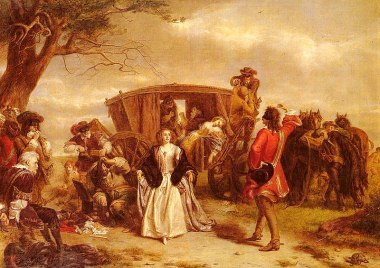
The famous incident in which Claude Duval the notorious highwayman tells a lady  whose coach that he has just held up that in exchange for a dance he will refrain from robbing her.

Our current government claims to be one that is tough on crime, yet in practice it seems to being doing the opposite. What I am going to suggest that the government through its policies is reverting back towards an earlier model of society, one similar to that of the 18th century. In that century policing was massively under resourced. Crime prevention and detection was in the hands of the Parish Constable. A man who had to rely on the support of his parishioners to arrest criminals. Policing was so ineffective that the government had to resort to the extreme measure of making most offences capital offences as a means of deterring crime. The Black Act of 1723 tried to compensate for the lack of an effective police force by making some 50 offences punishable by hanging, for example the punishment for breaking a farmer’s gate was hanging.The only way the to keep one’s household safe was to ensure that all the doors where secured by good locks and a variety of loaded guns where at hand to fend off any intruders. Ominously I was told by a member of the police force that his recommendation was to secure one’s house with good locks and stay in at night, he thought the policing levels were inadequate to guarantee the public’s safety. One senior police office ventured the opinion that he would not go into the centre of Manchester at night because it was not safe.

The combination of weak governments and under resourced policing is all to evident in Eire. Even before the financial crash and the austerity programme that forced large cuts on the Garda (Eire’s police force), this force was struggling to cope with the criminal activities of both terrorist groups and criminal gangs. These gangs were then so powerful that they could shoot a campaigning journalist at a busy cross roads and get away unhindered. Now an even more depleted police force is unable to prevent tit for tat killings that are occurring between these criminal gangs. Yet in spite of the evidence of the evident dangers of relying on an under resourced and undermanned police force to contain these dangerous criminal gangs the government is insistent on following the unwise path already trodden by Eire.

There is ominous evidence from my home city that this is already happening. Cuts to the number of the police have meant the ending of an effective pro active drugs strategy. The teams that were used to break up and disrupt the drug dealing gangs have been disbanded and the remaining police officers used to street patrols. The police will now only react to evidence of drug crime and only if it is thought that the individual in question has drugs in excess of a street value of £10,000. This means that the street dealers which are the bread and butter of the organised drugs trade are given a relatively free hand.

Why despite all the evidence of the dangers of allowing the drugs gangs to flourish has the government adopted policies that will encourage these gangs to flourish.

Why?

There are several possible answers but the most likely is the change in the philosophy of the government. The adoption of the brutalist philosophy of Neo-Liberalism, which emphasised the supremacy of free market, competition and the end of regulation. Regulation it was argued did not prevent wrong doing so much as impose additional and unnecessary burdens on business. However Hayek (The Road to Serfdom) who was the founding father of Neo-Liberalism did not argue for the extreme Neo-Liberal system of today. He believed in the good society, a society in which all paid tax for finance those items that made up the common good. He never once in his writings claimed that the ideal state is one in which the tax authorities collaborated with the rich in a programme of tax avoidance. He would have been horrified at the programme of tax cuts that reduced the effectiveness of the police and other public services.

Rather than looking to Hayek it is the writings of a novelist and minor philosopher called Ayn Rand that are the inspiration for the new Neo-Liberal State. In her influential novel “Atlas Shrugged” she wrote that the billionaires are the saviours of society. It is their energy and drive that moves society forward. Any restrictions on the activities of these people negatively impact on society as it prevents them fulfilling their primary purpose which is wealth creation. Therefore in her good society there are to be few regulations imposed on the billionaires or the businesses they run. Regulations that protect workers at their place of work are no more an unnecessary increase in costs as they disproportionately increase the costs of labour far beyond the contribution labour makes to wealth creation. All these high labour costs do is reduce the number of goods and service produced as what might have been produced if labour was fairly priced is now uneconomic. Similarly high rates of taxation on the rich do little more than reduce the amount of money that they have available for investing in the economy. In contrast the poor and the great majority contribute little to the economy, they are merely the simple tools that the billionaire uses to create wealth. Only if the billionaire class is freed from all restriction will they be able to use their energies creatively to add to the wealth of society. It is this author who is the inspiration behind the new Neo-Liberal State, that is the Britain of 2016.

Although her books are widely read amongst students at our elite universities, there has to be another reason as to why she has been adopted as the political philosopher of choice by our political classes. I think part of the answer is that they identify with her billionaire class. They see themselves as much victims of society as the billionaires of Ayn Rand. These leaders are continually frustrated in their great schemes for change and reform by the opposition of the little people. People of little worth, who lacking the skills or even intelligence for government think they have to right to a say in how policy is made. This contempt for the little people is demonstrated in the distain our leaders show for them. One former leader spoke of constantly being stabbed in back by public sector workers who failed to understand that the policies he was introducing were for their benefit and the good of society. Another continually referred to his opponents as the ‘blob’, abusive terms are the common currency of politicians who want to minimise the role of the people in a democracy.

It must also be mentioned that the political classes believed that the political and economic reforms espoused by Ayn Rand would if adopted would lead to a new political and economic dynamism in what they saw as a moribund society and economy , too rooted in the practices of the past.

Rather than continue with a psychological analysis of the political classes, what I want to demonstrate is the impact of what I shall call ‘Randism’ has on society and crime in particular. If the billionaires and their proxies the great business corporations are to be freed from almost controls and regulations, there are other greater predators the will benefit, which are the organised crime networks.

Changes in the legal system, in that is company law and tax law have created a situation in which the big corporations are largely outside the law (at least in the UK). What has been created is an opaque system of company organisation the will frustrate any attempt at regulation or control. However such a system is open to abuse and it offers possibilities for criminal organisations that had not previously existed. Formerly in the UK criminal groups used small businesses as a front for their illegal activities, such as scrap metal dealing, now they have the opportunity given the opaque nature of company organisations to move into large scale legitimate business. What is to be feared that the change or weakening of company regulation could result in a similar situation to that in southern Italy where the criminal gangs have penetrated legitimate businesses.This has already happened in the meat processing trade, there was a recent scandal in Britain where it was discovered that criminal gangs had infiltrated the food processing industry and were able to pass off horse meat as beef. While a few minor wrong doers were arrested the members of major criminal gangs were never arrested. The abolition of most regulation relating to food production has not freed the large supermarkets from unnecessary regulation but opened up a new field of opportunity for organised crime.
Perhaps the fate of the National Crime Agency illustrates best the dangers of an opaque legal system. The National Crime Agency was set up to tackle organised crime or more particularly the large drug gangs. It was to be a British FBI, with some of the best detectives seconded to it. However it has been largely ineffective in its main purpose which is to seize the assets of the big criminal gangs as a means of rendering them ineffective. Its ineffectiveness is a consequence of legal changes designed to minimise the impact of regulation on the big corporations and it is this lack of legal powers to intercept the flows of cash within big business that means this agency is unable to disrupt the large organised crime enterprises. It is not only in Britain that the law enforcement agencies are unable to confiscate the income of these criminal empires but also in Eire where the crime lords can amass their ill gotten gains without any apparent interference from the legal authorities.

Governments know that the lack of effective financial regulation means that the large income flows that enable the criminal gangs to prosper. What prevents them taking effective action is the corporate interest which is opposed to any stricter regulation of international finance. They see any change as a threat to them, what they want least of all is to be liable for their fair share of taxation. They will continue to work against any effective control of financial transactions, even if it means tolerating the growth of large scale criminal empires.

The political classes in Britain with the belief in Ayn Rand’s Neo-Liberal dream would never countenance any change in law which might disadvantage the billionaires or their proxies the large business corporation. Their rigid adherence this extreme ideology or dogma means that effective action will never be taken against these criminal empires as the consequence of any such actions may have what the big corporations see as negative consequences for them.

This belief is all to clearly illustrated in the actions of the British Treasury who believe that any government spending reduces national income and so the minimum should be spent on public services such as policing. Newspaper columnists can continue to write horror stories about the iniquities of the trades trade but the Treasury would never countenance any increase in spending on the police as they believe it would negatively impact on the nations wealth. They believe that if the price of greater wealth is increased criminality, that is a price worth paying, as its better to live in a dynamic society that has high growth and crime than in one that is the reverse.

Criminality and Bad Economics

Our current government claims to be one that is tough on crime, yet in practice it seems to being doing the opposite. What I am going to suggest that the government through its policies is reverting back towards an earlier model of society, one similar to that of the 18th century. In that century policing was massively under resourced. Crime prevention and detection was in the hands of the Parish Constable. A man who had to rely on the support of his parishioners to arrest criminals. Policing was so ineffective that the government had to resort to the extreme measure of making most offences capital offences as a means of deterring crime. The Black Act of 1723 tried to compensate for the lack of an effective police force by making some 50 offences punishable by hanging, for example the punishment for breaking a farmer’s gate was hanging.The only way the to keep one’s household safe was to ensure that all the doors where secured by good locks and a variety of loaded guns where at hand to fend off any intruders. Ominously I was told by a member of the police force that his recommendation was to secure one’s house with good locks and stay in at night, he thought the policing levels were inadequate to guarantee the public’s safety. One senior police office ventured the opinion that he would not go into the centre of Manchester at night because it was not safe.

The combination of weak governments and under resourced policing is all to evident in Eire. Even before the financial crash and the austerity programme that forced large cuts on the Garda (Eire’s police force), this force was struggling to cope with the criminal activities of both terrorist groups and criminal gangs. These gangs were then so powerful that they could shoot a campaigning journalist at a busy cross roads and get away unhindered. Now an even more depleted police force is unable to prevent tit for tat killings that are occurring between these criminal gangs. Yet in spite of the evidence of the evident dangers of relying on an under resourced and undermanned police force to contain these dangerous criminal gangs the government is insistent on following the unwise path already trodden by Eire.

There is ominous evidence from my home city that this is already happening. Cuts to the number of the police have meant the ending of an effective pro active drugs strategy. The teams that were used to break up and disrupt the drug dealing gangs have been disbanded and the remaining police officers used to street patrols. The police will now only react to evidence of drug crime and only if it is thought that the individual in question has drugs in excess of a street value of £10,000. This means that the street dealers which are the bread and butter of the organised drugs trade are given a relatively free hand.

Why despite all the evidence of the dangers of allowing the drugs gangs to flourish has the government adopted policies that will encourage these gangs to flourish.

Why?

There are several possible answers but the most likely is the change in the philosophy of the government. The adoption of the brutalist philosophy of Neo-Liberalism, which emphasised the supremacy of free market, competition and the end of regulation. Regulation it was argued did not prevent wrong doing so much as impose additional and unnecessary burdens on business. However Hayek (The Road to Serfdom) who was the founding father of Neo-Liberalism did not argue for the extreme Neo-Liberal system of today. He believed in the good society, a society in which all paid tax for finance those items that made up the common good. He never once in his writings claimed that the ideal state is one in which the tax authorities collaborated with the rich in a programme of tax avoidance. He would have been horrified at the programme of tax cuts that reduced the effectiveness of the police and other public services.

Rather than looking to Hayek it is the writings of a novelist and minor philosopher called Ayn Rand that are the inspiration for the new Neo-Liberal State. In her influential novel “Atlas Shrugged” she wrote that the billionaires are the saviours of society. It is their energy and drive that moves society forward. Any restrictions on the activities of these people negatively impact on society as it prevents them fulfilling their primary purpose which is wealth creation. Therefore in her good society there are to be few regulations imposed on the billionaires or the businesses they run. Regulations that protect workers at their place of work are no more an unnecessary increase in costs as they disproportionately increase the costs of labour far beyond the contribution labour makes to wealth creation. All these high labour costs do is reduce the number of goods and service produced as what might have been produced if labour was fairly priced is now uneconomic. Similarly high rates of taxation on the rich do little more than reduce the amount of money that they have available for investing in the economy. In contrast the poor and the great majority contribute little to the economy, they are merely the simple tools that the billionaire uses to create wealth. Only if the billionaire class is freed from all restriction will they be able to use their energies creatively to add to the wealth of society. It is this author who is the inspiration behind the new Neo-Liberal State, that is the Britain of 2016.

Although her books are widely read amongst students at our elite universities, there has to be another reason as to why she has been adopted as the political philosopher of choice by our political classes. I think part of the answer is that they identify with her billionaire class. They see themselves as much victims of society as the billionaires of Ayn Rand. These leaders are continually frustrated in their great schemes for change and reform by the opposition of the little people. People of little worth, who lacking the skills or even intelligence for government think they have to right to a say in how policy is made. This contempt for the little people is demonstrated in the distain our leaders show for them. One former leader spoke of constantly being stabbed in back by public sector workers who failed to understand that the policies he was introducing were for their benefit and the good of society. Another continually referred to his opponents as the ‘blob’, abusive terms are the common currency of politicians who want to minimise the role of the people in a democracy.

It must also be mentioned that the political classes believed that the political and economic reforms espoused by Ayn Rand would if adopted would lead to a new political and economic dynamism in what they saw as a moribund society and economy , too rooted in the practices of the past.

Rather than continue with a psychological analysis of the political classes, what I want to demonstrate is the impact of what I shall call ‘Randism’ has on society and crime in particular. If the billionaires and their proxies the great business corporations are to be freed from almost controls and regulations, there are other greater predators that will benefit, which are the organised crime networks.

Changes in the legal system, in that is company law and tax law have created a situation in which the big corporations are largely outside the law (at least in the UK). What has been created is an opaque system of company organisation the will frustrate any attempt at regulation or control. However such a system is open to abuse and it offers possibilities for criminal organisations that had not previously existed. Formerly in the UK criminal groups used small businesses as a front for their illegal activities, such as scrap metal dealing, now they have the opportunity given the opaque nature of company organisations to move into large scale legitimate business. What is to be feared that the change or weakening of company regulation could result in a similar situation to that in southern Italy where the criminal gangs have penetrated legitimate businesses.This has already happened in the meat processing trade, there was a recent scandal in Britain where it was discovered that criminal gangs had infiltrated the food processing industry and were able to pass off horse meat as beef. While a few minor wrong doers were arrested the members of major criminal gangs were never arrested. The abolition of most regulation relating to food production has not freed the large supermarkets from unnecessary regulation but opened up a new field of opportunity for organised crime.
Perhaps the fate of the National Crime Agency illustrates best the dangers of an opaque legal system. The National Crime Agency was set up to tackle organised crime or more particularly the large drug gangs. It was to be a British FBI, with some of the best detectives seconded to it. However it has been largely ineffective in its main purpose which is to seize the assets of the big criminal gangs as a means of rendering them ineffective. Its ineffectiveness is a consequence of legal changes designed to minimise the impact of regulation on the big corporations and it is this lack of legal powers to intercept the flows of cash within big business that means this agency is unable to disrupt the large organised crime enterprises. It is not only in Britain that the law enforcement agencies are unable to confiscate the income of these criminal empires but also in Eire where the crime lords can amass their ill gotten gains without any apparent interference from the legal authorities.

Governments know that the lack of effective financial regulation means that the large income flows that enable the criminal gangs to prosper. What prevents them taking effective action is the corporate interest which is opposed to any stricter regulation of international finance. They see any change as a threat to them, what they want least of all is to be liable for their fair share of taxation. They will continue to work against any effective control of financial transactions, even if it means tolerating the growth of large scale criminal empires.

The political classes in Britain with the belief in Ayn Rand’s Neo-Liberal dream would never countenance any change in law which might disadvantage the billionaires or their proxies the large business corporation. Their rigid adherence this extreme ideology or dogma means that effective action will never be taken against these criminal empires as the consequence of any such actions may have what the big corporations see as negative consequences for them.

This belief is all to clearly illustrated in the actions of the British Treasury who believe that any government spending reduces national income and so the minimum should be spent on public services such as policing. Newspaper columnists can continue to write horror stories about the iniquities of the trades trade but the Treasury would never countenance any increase in spending on the police as they believe it would negatively impact on the nations wealth. They believe that if the price of greater wealth is increased criminality, that is a price worth paying as its better to live in a dynamic high crime society than in a moribund low crime society.

In Memoriam – a tribute to a feminist sister

Awesome-Yellow-Rose
The Yellow Rose a symbol of joy and gladness
A recent personal tragedy made aware that philosophies of kindness are regarded more highly than is widely assumed, many remain impervious to the worse excesses of our materialistic culture. The values associated with a more traditional culture still exist within contemporary culture, values such as friendship, compassion and caring. The respect shown towards my sister by her many friends demonstrated how these highly these values are still regarded. The turnout at her funeral and the grief expressed showed how much people value this individuals whose life demonstrated these principles in practice. She was a woman who worked in the caring services, most recently teaching children that had been excluded from school because of behavioural problems. Even accepting back into her class a violent teenager who had made an attack on her. She was a central figure in many friendship groups and social activities such as the book club. These friends all supported each other through the problems that life throws up, illness and death for example. Men seem to lack these support groups as we seem much more one dimensional in our relationships.When I started my last job I made friends with Keith, yet it was a number of years before I knew he had two children in their teens. We just talked about work, philosophy and politics, never our families. One sociologist made a study of language use and she came to the conclusion that women make much more use of relational language. Going back to my example if we had been women, we would asked each other about family and known almost immediately how many children each had. I think one writer wrote that it is woman kind that civilises mankind. Perhaps illustrated by a remark made by my wife. When hearing that the British army was to allow women to engage in combat on the frontline, who said that, ‘I thought we were capable of better than that’. What the life of my sister reminded was that there is a different culture within our society of which I as man was unfamiliar.

Feminist philosophers and theologians believe that their gender gives them a very distinct life, which makes the dominant male oriented philosophies and theologies of our society irrelevant to those who don’t have the male experience of life. Grace Jantzen is one of these writers. She in her book ‘Becoming Divine”,redrafts Hannah Arendt’s philosophy of natality to give it a distinctly feminist context. For Arendt natality is a philosophy of rebirth, a philosophy of revolution and change. There are times when the power exercised by the dominant group in society weakens and falters.This is becomes a time of opportunity, a time when a public space opens up which allows all those feelings and ideas that had been repressed to be expressed. It is a brief moment of time in which change in the social order can occur as new ideas are given the time and space to take root. The Arab spring briefly appeared to be one such moment of natality, it seemed as if Arab societies could be reborn on more egalitarian lines, when fairness established as one of the founding principles of a new society. Unfortunately, in all but Tunisia the old repressive forces reasserted themselves with renewed vigour.

People of mine and my sister’s generation thought the 1960s was such a time of rebirth and the remaking of society. A time of the ‘the Age of Aquarius’, certainly it was for many individuals, who in response to the times entered into the caring professions or adopted an alternative lifestyle. Unfortunately this brief spring time of liberation was crushed by the forces of reaction. Not the cruel reaction of a repressive police state, but the overwhelmingly seductive power of the consumer society. Potential revolutionaries were bought off by the promise of wealth. I can remember conversations between avowed Marxists in which the main topic of conversation was house prices and how they would benefit from the rise in these prices. The wealth on offer was so much greater than any of our parents knew so young people it easily seduced into becoming willing participant in the consumer society. What remained of the revolution of ideas and behaviours, quickly metamorphosed into a revolution of style and appearance. Revolution was to be expressed in liking a particular type of music or through dress, revolution segued into glam rock, it was a revolution of style. This revolution left intact the very fundamentals of the old unequal society, the power of the old order was never really challenged. When the opportunity came in the mid 1970s this group savagely reasserted its claim to wealth and privilege. The welfare state was slowly dismantled, poverty appeared again on our streets in the person of the beggar.
One interview I saw on television encapsulated this change. A representative of a country landowners association said how the fashion for large country houses had changed. In the 1960s these great houses were being knocked down, whereas in the ‘noughties’ there was a renewed interest in building great country houses. He failed to mention that this was a consequence of increasing inequality of wealth and income in the country.

Grace Janzten was part of new rising group of feminist thinkers who reacted against the philosophy of the times, that of Neo-Liberalism in its many forms. These new patriarchal philosophies were as the old male religions the philosophies of anti-life given new guises. These old new philosophies for her sprung from the inability of men to directly experience the act of creation, that is giving birth. It was the experience of or the potential experience of this that gave women a different understanding of life. Central to women’s lives are the acts of creation and nurture, as without nurturing that created thing, life would not thrive. Masculinist philosophies such as Neo-Liberalism make the nurturing society impossible. Its very Darwinism emphasis on winners and losers is anti-nurture, as in such a society only the winners thrive. Rather than thrive the great majority of society, that is the losers languish and flounder. The number of children in poverty is rising and those malnourished children lose out in the academic race that is now schooling. They cannot compete with their better fed and resourced rivals. Neo-Liberal Britain is the society of the precariat and the underclass, where only the possession of wealth is celebrated. A Jantzenist society would be very different, in that all its children would be nurtured and all have an opportunity to succeed. This would mean the removing of those barriers to aspiration, that is the many barriers placed in the way of the children of the poor by low income and poverty. Motherhood would be the basic principle around which society would be structured, rather than the very masculinist one of power.

Jantzen never really develops how her philosophy/theology in the context of remaking society, her interest is in power. How to grab back power from the patriarchy. Her solution is the development of a feminist philosophy of natality and life as a counterweight to dominant masculinist philosophies of power and violence. She wants equal recognition in society for the very different life experience of women. This in turn brings me back to my sister and I, as our childhood experiences demonstrate the two very distinct philosophies of life. She would work as a volunteer for the St.Johns Ambulance Brigade, which meant giving up her spare time to work in the wards of the local hospital. While I went out with my friends fishing or shooting, more usually the former, inflicting pain and suffering on the local wildlife. Although Grace Jantzen can justifiably be accused of presenting a very idealised view of women’s life experience, it does not diminish her claim for the need for a powerful feminist philosophy of natality to oppose and limit the predatory masculinist Social Darwinist philosophies of today. It is the latter that have wreaked havoc on society reintroducing to it, poverty, insecurity and ill health all the evils of the societies of the past.

Is Apple responsible for its own woes – a sceptical economist’s observation on falling IPhone sales

As an enthusiastic purchaser of all Apple products, my attention was caught by an article in my paper, in which it was stated that Apple was having problems selling it latest Iphone. It’s stores are apparently stockpiling unsold IPhones. Today as if in confirmation of this I received an email from Apple offering me generous terms for upgrading my IPhone 5s to the latest model. What I am going to suggest is that Apple itself is in part responsible for its own woes.
Reading this article reminded me of a story about Henry Ford. It might be apocryphal but Henry Ford was considering automating the production line at his Detroit car assembly plant. He spoke to one of his most trusted advisers, who said it is claimed, ‘that if you lay all these men off, who will buy your cars’. Henry Ford considered his friends advice and continued with his labour intensive methods of production and so the story goes sales of his cars remained high. 
Apple and all the major manufacturing companies in the US and Western Europe have done the opposite of Henry Ford. They have by outsourcing production to foreign countries where labour is cheap, impoverished many of their potential customers. When the Rover car plant was being closed in Oxford, a study was produced that showed the replacement jobs for those car workers would be in the service sector, where wages were 30% lower than in manufacturing. Similarly in those former mining areas in England, high income mining jobs have been replaced by low income jobs in call centres or warehouses. The same trend is evident in the USA where increasingly the new jobs that there are created are relatively low income jobs in the service sector. If they are in manufacturing they are again likely to be relatively low income low skill jobs. A recent study showed that incomes for men in the USA with no more than a high school diploma showed a decline in incomes since 2007. 
Checking with Amazon I note that the price of the most basic IPhone 6s is £524 in UK and the similar model in the US is over $800. In the new age of capitalism when increasing numbers of workers are in low wage economy, they are effectively priced out of the market for expensive smart phones. The wisdom of Henry Ford seemed to have been forgotten by the current generation of business leaders.
What is common to all large corporations is the tax strike, as these businesses use a variety of tax avoidance schemes to avoid to paying their taxes. Usually this involves locating the head office in a low tax location, so corporation tax due on profits on the profits earned from sales in high countries . Ireland is the low tax headquarters for Apple in Europe and Luxembourg is that for Amazon. The scale of corporate tax avoidance is subject to varying calculations, in Britain even the conservative tax authorities estimate the scale of tax avoidance at being a sum in excess of £30 billion, other sources such the sum is much higher. The consequence is that the government’s of Western Europe and have less cash than is normal for the government of a developed country. The consequence is that government’s lack tax revenues to fund those activities undertaken by government and are over dependent on borrowing to finance their activities. This has had a knock effect in that in times of financial stress governments are forced to cut their borrowings and spending, resulting in an age of austerity. This austerity further reduces the incomes of the low paid through benefit cuts and job losses. These newly poor Europeans are unlikely to be customers for new expensive IPhones. 
I believe businesses such as Apple face a problem in that by minimising their costs of production in by outsourcing production and by minimising their tax payments they maximise short term profits, at the expense of long term sales revenue. It is the latter which generates real profits for the company and actions which damage revenue streams threaten the long term viability of the business. Car manufacturers have long faced this problem and have overcome that by boosting the income of potential buyers by offering low cost loans for car purchase. Perhaps Apple to maintain sales will have to look to alternate ways of boosting their potential customers income. 
This particular economist doubts the wisdom of replacing earned income with cheap loans as an the main means of increasing household incomes. Already consumer debt in the UK is reaching 180% of GDP, a sum which becomes unviable if there is a collapse of the banks, as happened in 2008/9. Borrowed income is more volatile and less reliable than earned income and is a source of financial instability and economic meltdown.

The Philosopher and the Economist

Over the last twenty plus years their have been a series of financial crisis each inflicting damage worse than the previous on the world economy. Yet economists see no need to change there understanding of economics as they believe that in the years before 2008/9 they had discovered the ‘holy grail’ of economics, that is the free market economy. The two schools of British economics Neo-Liberalism and its free market cousin, New Keynesian have an enthusiasm for the largely unregulated market system, seeing it as the best possible of all possible economic models. Yet evidence suggests otherwise and as an avid student of philosophy I would say that all understandings of human behaviour and society are imperfect and that no one understanding of the nature of the economy is without significant flaws. 

 
Image taken from drury.edu

John Locke in his discussion of the nature of philosophy (Essay on Human Understanding) makes what I believe the most compelling case for the inclusion of philosophy in the economists tool box. He compares the role of the philosopher to that of the under labourer. The under labourer on the 17th century building site cleared the ground in preparation for the building work to come. Similarly the philosopher clears and tidies up the area of study for others, they clear the intellectual clutter from the site making clear to other, making clear the areas of study and highlighting the key questions to be answered. Their role is to dismiss all those questions that prompt research that hinders or obstructs the progress of research. In the science of the 17th century this would mean excluding astrology from the in study of astronomy, as the study of this distracted from the real science of the universe. While it might be argued by economists there is no equivalence of astrology studies in economics today, their still practise their subject in a way that prevents real solutions being found to the current economic malaise.

As a Lockean philosopher I would ask why do economists not recognise that the economy is an integral part of the wider social organisation that is society. What they should be asking is how does the wider society impact on the economy? What are the consequences for the economy in changes of human behaviours and attitudes, do these changes contribute to the current economic malaise? Why leave the builders out of the study, after all the economy is but a human construct?
Just as with the fashion in clothes it is at affected by changes in people’s tastes and attitudes.

Perhaps the most significant change in people’s attitudes and behaviour is the shared undertandin of the purpose of the legal system. Initially lawsand the legal system were seen as indispensable to the working of society, as they prevented those disruptive behaviours that would prevent a settled society from existing. These crimes when committed could attract severe sanctions, in the most extreme cases a life sentence. However there has developed in recent years a new understanding of the role of law. Law is now seen as a means of facilitating certain approved behaviours which are known by the generic term entrepreneurship. Laws aimed at eliminating bad behaviours by this group have been removed or emasculated, as it is believed that the free market is the best means of regulating such behaviours. The assumption is that competition in the market will drive out bad entrepreneurs and the law that by intervening in this Darwinian market will result in interventions that damage the economy. Consequently laws on employment protection and the governance of companies are either abolished or have their impact minimised. Now the legal profession is tending towards the belief that the free market and not law is the best guarantor of good behaviour in business and that their role is to stop groups such as environmental activists interfering in the market. In Britain there any many legal restrictions that can be imposed on such awkward groups.

One such consequence is that company law has been rendered largely ineffective. Originally the public company was developed as a means of enabling businesses to raise large sums of money from the public to finance large scale business investment. This organisation has now evolved primarily into a means of tax avoidance or for the owners a means of avoiding legal responsibilities and liabilities. When companies go bankrupt through mismanagement ,the directors are free to walk away from the company free from any legal sanction. No blame attaches to them. It is the legal entity the public company that has gone bankrupt, not the directors. The structure of the public company encourages irresponsible and reckless behaviour by company directors, as was demonstrated during the crash of 2008/9 when no senior banker was held to accountable for reckless or irresponsible behaviour.

This widespread practice of wrong doing throughout the corporate sector has had very negative consequences for the economy. Increasingly people come to distrust the large business corporations all they see is a group of greedy individuals exploiting their customers for their own benefit. Such people have achieved the impossible in making people yearn for a return of the once much derided nationalised industries. The directors of the privatised rail industry have been responsible for massive increases in rail fares making British railways the most expensive in Europe. Fares on British trains can be six times the price of their equivalent in Italy. This behaviour is producing a reaction in the community at large, in Western Europe groups such as Momentum in Britain or Podemos in Spain are campaigning to end this abuse of the system.

However my intention is to demonstrate how the tolerance of widespread mismanagement, corporate greed and wrong doing impacts on the economy as a whole.This is most clearly demonstrated in the finance industries. In the days of my childhood one of the most trusted figures was the ‘man from the Pru’. He called every month to collect a small payment from my parents for life insurance, savings and house insurance. My parents knew that a reputable firm such as the Prudential would always pay out whatever the circumstance, they had faith in the company. The first sign that all was not well in the finance industry was when England’s oldest insurance company ‘The Equitable Life’ went effectively bankrupt, as it lacked the funds to pay the pensions it had promised. There then followed a long series of scandals in this industry due largely to a combination of mismanagement, individual greed and irresponsible behaviour. The consequence was the development of a widespread distrust of the financial services industry.

This justified widespread distrust of the financial services sector has led to some unfortunate consequences. People began to look for alternatives to saving their money with these institutions; they looked for investments that would offer far better and safer returns than those promised by the financial institutions. The one alternative for most people was property, asset prices rose more rapidly in the housing market than in any other alternative market, so any investment in property appeared to be a win, win situation. There is no other market in which the value of the initial investment would increase so quickly. Many entered the rental market as the returns on rental properties were astronomic, it was a market in which it seemed nobody could lose, except they did. There is the now forgotten property crash of 1990 and the more recent one of 2008/9. The problem was that the increase in house prices was due to a speculative boom, caused by more and more money chasing an ever more slowly increasing supply of homes for sale. A market based on speculation will always be subject to booms and busts. The supply of money for this speculative investment will always slow at some stage, usually due to some downturn in the economy or the realisation that much of the property in which the money is invested is not worth the money paid for it, as in the sub prime market in the USA. Such as downturn is occurring now and there will be a crash in the property markets in either 2016 or 2017. What cannot be predicted is the scale of the crash.

Unfortunately this rise of the property market has coincided with the decline of the manufacturing sector. Manufacturing now only generates 10% of UK’s national income. In the housing market much of the investment is recycled money as the same properties are sold over and over again at ever increasing prices; whereas the manufacturing industry creates new products for sale, which generates ‘real’ extra’ income. With the decline of manufacturing people could look less and less to an increase in income, as most new jobs created were in the less productive service sector. As people could no longer rely on ever increasing incomes that looked to speculative returns to boost there spending. The market that offered huge speculative returns was the housing market.

There are two negative impacts on the economy from the growth of the housing market. Funds are attracted to the higher speculative returns in that market, rather than the lower returns from investment in manufacturing industry. At the time of the crash in 2008 over 80% of bank loans where made to the property market. A manufacturing industry starved of investment funding can only decline. The consequence is that Britain has become increasingly dependent on foreign manufacturers to supply the goods it needs. Britain now has the largest trade deficit as a percentage of national income for any developed industrial country.

This has resulted in a disastrous change in government economic policy. Now as so many people are dependent on speculative booms in the housing market for extra income (loans secured against the increase in property values), the main role of government economic policy is to support the speculative boom by adopting a series of policies that constantly increase house prices. What never occurs to the government is that this is a foolish policy that can only end in tears,as happens when the market crashes. No government minister or Treasury official seems to have noticed that each successive crash requires greater and greater sums of government money to bail out the losers in the crash. Figures for the money used to bail out the bank’s etc in 2009 are notoriously opaque. One figure I came across was that in 2009 the government pledged £1.2 billion to support the bank. This figure was about a 100% of national income, fortunately it was no called on, it remained just a pledge. If the bank creditors had demanded that the money be paid into the banks coffers, Britain would be in a far worst situation than is Greece.

What I am trying to say is that as a philosopher I look beyond the current economic toolkit to try to understand the nature of our current economic malaise. It is by asking different questions that I arrive at different conclusions to those proffered by orthodox economists. The main solution to our problem is to stop the speculative frenzy that is the property or more accurately the housing market. If the banks and other lends could not increase by astronomic sums the amount they lend to the property market, there would be no money to fuel this frenzy. This could be done quite simply by increasing the reserves the banks hold, one economist has suggested that the bank’s reserves should be increased to 10% of total assets (or loans). If this happened banks would have to go to the market to raise huge sums of money to increase their share capital. It would not happen and banks would be forced to withdraw funds from the housing market. There would be a painful crash in that market, but once that the effects of that crash had receded the economy could be rebalanced towards manufacturing. An increase in manufacturing activity would have many beneficial effects, one of which would be the reduction of our horrendous trade deficit, as people rather than buying imported goods bought domestically produced ones.

There would be a price for making this change, there would be a fall in the incomes of many people, as they could no longer rely on loans to boost they’re spending. It is quite likely that there are a number of senior politicians that are aware of this and for that reason they are afraid to end the speculative housing boom. Conventional knowledge states that any government that presides over falling house prices is committing electoral suicide. Instead they hope the great crash will happen on somebody else’s watch. To put it another way fear of electoral suicide makes cowards of all politicians.

What I am saying is that while economists fail to consider factors such as a change in the attitudes and behaviours in the population at large and in particular that of the political and cultural elites, they will never come up with solutions to the current economic malaise. This type of thinking that does take into account these cultural changes was known as political economy, yet this school of economics has long been abandoned by practising economists.

Returning to my initial thoughts on Locke and the under labourer, perhaps what really needs to be cleared away is the current economic orthodoxy, which acts as an intellectual road block to prevent the development of any new approaches to solving the current economic malaise.