Category Archives: United Kingdom

History has it wrong the Soviet Union won the cold war (at least in Britain)

One of the commonplaces of history is that the communists and in particular the Soviet Union lost the Cold War. This victory was exemplified in the pulling down of the Berlin Wall in 1990. However this is a misreading of history. There are two ways of winning a war, one the most obvious is the conquest of the enemies territory, the other less obvious is when the loser takes on the ideas and practices of the winner. A more subtle form of conquest but just as real. Recent history demonstrates in Britain at least there is an enthusiasm for the ideas and practices of the former Soviet Union.  As a teacher I always spent at least one lesson teaching communist economic practice, as I found it fascinating and I thought that the students would benefit from the knowledge of an alternative economic system. Imagine my fascination when recent events recorded in the media demonstrated that he practices of the Soviet Union had been adopted wholeheartedly by the department of education.

The leaders of the communist state realised that they had taken over a country steeped in capitalist values and their major task would be to re-educate the people in the values of communism. In the early years of the Soviet regime trains carried artists and other propagandists from town to town to teach the people communist values and practice. Without this programme of re-education the communist state would fail as the capitalist enemy from within would undermine all the efforts of the communist state at reform.  There had to be  in tandem with this programme of re-education active policing to root and destroy those enemies of communism. Just last week the latest schools minister just like any good communist politician he was claiming that saboteurs were seeking to wreck his programme of educational reforms. In this case it was a small group of rogue examiners and teachers, all of whom he was determined to root out of education system.

The Soviet State believed that schools would play a key role in re-educating the population into the correct mores of the communist state. Not only school students but those at university were expected to study the thoughts of the communist leaders. In addition they to follow courses of the approved and correct ideological content. Marxist studies were a key element of both the school and university curriculum. There was a certain paranoia in the thinking of the Soviet leaders as they saw themselves as the enlightened minority constantly threatened by the actions of the mass of unbelievers; it was the same attitude that prevailed in the Conservative government elected in the 1980s. They saw a failing nation corrupted by the anti capitalist values of social democracy and socialism. Just as their communist predecessors had, they employed the law and aggressive policing to destroy the power of the enemy within, that is the trade union movement. They also realised that the success of their conservative counter revolution depended on the re-education of the populace into the right ways of thinking. Obviously the start was be made with the easiest to re-educate the young that is those at school. This would be achieved by changing the curriculum and by re-educating the teachers.

I was one of the first teachers to be put on the programme of re-education. It was obvious to the government that we were imbued with the wrong thinking and one of the best ways of eradicating this was to introduce teachers to the right way of thinking. When a communist state wanted to re-educate the population they were sent to the camps in their thousands for re-education. When the South Vietnamese State fell to the communists all the army officers and government functionaries were sent to the camps for re-education in the values and ways of communism. In Britain the government made a half hearted attempt at re-eduction, was rendered ineffective hampered by their commitment to spending to cutting government spending so their was only a minimal amount of money to be spent on re-education. I as one of the selected few for re-education attended on training session given by a manager from the private sector in the values of business and free enterprise. Then I had to follow in my own time a modular course of re-education and produce a portfolio to demonstrate my commitment and willingness to teach the new ideas. I guess like many in the old Soviet system I was very sceptical about its value of this programme but I completed the it because it was the only way of saving my job. This made me less than an ideal ideologue for the cause.

Rather than continue with this programme of ineffective  re-education the government resorted the negative tactic of weeding out unsuitable teachers. They created a new inspectorate who role was to ensure that school worked in conformity with the new rules and values. This body weeded out many staff who were resistant to the new ideas. Many creative and talented teachers left the profession, rather than be forced to teach the new orthodoxy with it series of box ticking exercises. A flight similar too but much smaller in numbers than the flight of intellectuals from Russia in 1920s. Now as in much of the old Soviet State promotion is gained by adherence to the values and practices espoused by a series of government ministers. Promotion now is largely dependent on a display of the toadying factor.

Teachers are still regarded as potentially the enemy within and are subject to a series of punishing controls, usually in the form of inordinate amounts of paper work. Just as a worker under the Soviet system was expected to attend regular party meetings to demonstrate their commitment to the system, so a teacher is expected to produce mountains of paper work to demonstrate their commitment to best new system.

What as an economist struck me was the similarity of the economic models they employed. In the old Soviet Union Gosplan Moscow decided on the targets for all Soviet Enterprises and there were a series of Gosplans at different levels of government that added more and more detail to the plan to ensure that the central directives were met. Not only that but there were Gosfinance and Gosresources, that decided the money and resources to be allocated to the education sector. Since there were at least three separate bodies in Moscow deciding upon targets, finance and resources it was inevitably that these directives issued by these three bodies were often in conflict. Also it must be added that these detailed central plans always specified quantitive targets to be met to demonstrate that the planned targets were being met. Managers of local public enterprises struggled to meet these targets set by these different bodies so they often resorted to all kinds of practices in an effort to appear to be meeting these targets. Since it was easier for a shoe factory to meet the target to make by making only shoes of one type, a factory would often turn out only right or left handed shoes.

The similarities with the education system in Britain today are striking. The department of education set targets for schools to achieve. These targets are always expressed in quantitive terms, as they are easier to measure and check. Quantitive targets such as a setting numbers to pass tests in English and Maths. However the Education Minister and his planner set the targets  independent of the Treasury which controls funding and resource allocation. The consequence is targets being set that are impossible to achieve with the funding and resources available. This has led to the development of a new profession the private consultants who teach how to achieve the impossible targets.

Just as in the old Soviet Union the performance of individual schools is measured against a set of targets set by the central government. This means the emphasis in schools must now be on achieving government targets and so teaching practice is changed to enable the school to score as high as possible in tests, as high scores earn score additional scarce funding and resources.  In the Soviet Union factories made only left handed shoes, so schools similarly  turn out students with only the left handed education. Right handed education that is creative thinking cannot be measured so it is increasingly left out of the curriculum. Creative subjects such as art and music are downgraded within the system so the most able are encouraged to do the book ticking knowledge based subjects. In the Soviet Union what mattered was the quantity not the quality, the same is true of British education. What matters is the attainment of government targets not the quality of the educational students receive. Many of the targets are of have little real educational value but what matters is appearance, these statistics that can produced to show how successful is the minister of education and his latest reform programme.

What demonstrates most clearly the success of the Communist model is that Britain is eager to emulate the methods of teaching used in the schools of Communist China. Britain invariably lags behind China in the PISA tests. These are supposed to be impartial means of assessment by which the performance of a nation’s school students are  judged. Everybody outside the Government and the Department of Education knows that Chinese score highly in such tests because only students at the best selective schools in Shanghai are entered for the Pisa them. What matters to the Chinese is prestige and they would never think of entering students from those schools whose relatively poor performance  who would drag down the nations scores. Given that in a Soviet type education system all that matters is the appearance of doing well, rather than the more difficult task of actually doing well, in Britain the government is now importing Chinese teachers to help remodel our schools to be more like those of the Chinese.

Note. Despite their claimed difference between the Communism of the former Soviet Union and the Neo-Liberalism of the West are vastly overstated. They both claim to be ideologies of freedom but are in fact authoritarian ideologies that intend impose their limited understanding of freedom on their host societies. Under Neo-Liberalism we should all have the freedom to buy and sell without hinderance. One hinderance is what are regarded as the bedrock of democratic society, the freedom of association.  Political movements that intend to enact a reform of society, will according to the Neo-Liberals hinder the workings of the free market. They wish to impose restrictions and costs on business that will increase costs and reduce the supply of goods available to consumers. Therefore such movements should be discouraged or prohibited as they interfere with the workings of the free market to the detriment of all. It is the increasingly authoritarian nature of the British Neo-Liberal model of society that means that British society increasingly resembles that of the Soviet Union.
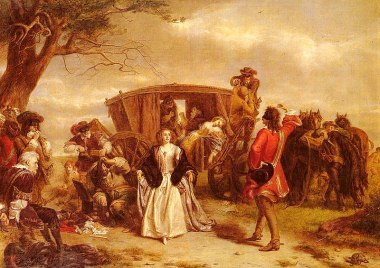
Why does our government seem to be determined to increase the levels of criminality in our society

claudeduval

The famous incident in which Claude Duval the notorious highwayman tells a lady  whose coach that he has just held up that in exchange for a dance he will refrain from robbing her.

Our current government claims to be one that is tough on crime, yet in practice it seems to being doing the opposite. What I am going to suggest that the government through its policies is reverting back towards an earlier model of society, one similar to that of the 18th century. In that century policing was massively under resourced. Crime prevention and detection was in the hands of the Parish Constable. A man who had to rely on the support of his parishioners to arrest criminals. Policing was so ineffective that the government had to resort to the extreme measure of making most offences capital offences as a means of deterring crime. The Black Act of 1723 tried to compensate for the lack of an effective police force by making some 50 offences punishable by hanging, for example the punishment for breaking a farmer’s gate was hanging.The only way the to keep one’s household safe was to ensure that all the doors where secured by good locks and a variety of loaded guns where at hand to fend off any intruders. Ominously I was told by a member of the police force that his recommendation was to secure one’s house with good locks and stay in at night, he thought the policing levels were inadequate to guarantee the public’s safety. One senior police office ventured the opinion that he would not go into the centre of Manchester at night because it was not safe.

The combination of weak governments and under resourced policing is all to evident in Eire. Even before the financial crash and the austerity programme that forced large cuts on the Garda (Eire’s police force), this force was struggling to cope with the criminal activities of both terrorist groups and criminal gangs. These gangs were then so powerful that they could shoot a campaigning journalist at a busy cross roads and get away unhindered. Now an even more depleted police force is unable to prevent tit for tat killings that are occurring between these criminal gangs. Yet in spite of the evidence of the evident dangers of relying on an under resourced and undermanned police force to contain these dangerous criminal gangs the government is insistent on following the unwise path already trodden by Eire.

There is ominous evidence from my home city that this is already happening. Cuts to the number of the police have meant the ending of an effective pro active drugs strategy. The teams that were used to break up and disrupt the drug dealing gangs have been disbanded and the remaining police officers used to street patrols. The police will now only react to evidence of drug crime and only if it is thought that the individual in question has drugs in excess of a street value of £10,000. This means that the street dealers which are the bread and butter of the organised drugs trade are given a relatively free hand.

Why despite all the evidence of the dangers of allowing the drugs gangs to flourish has the government adopted policies that will encourage these gangs to flourish.

Why?

There are several possible answers but the most likely is the change in the philosophy of the government. The adoption of the brutalist philosophy of Neo-Liberalism, which emphasised the supremacy of free market, competition and the end of regulation. Regulation it was argued did not prevent wrong doing so much as impose additional and unnecessary burdens on business. However Hayek (The Road to Serfdom) who was the founding father of Neo-Liberalism did not argue for the extreme Neo-Liberal system of today. He believed in the good society, a society in which all paid tax for finance those items that made up the common good. He never once in his writings claimed that the ideal state is one in which the tax authorities collaborated with the rich in a programme of tax avoidance. He would have been horrified at the programme of tax cuts that reduced the effectiveness of the police and other public services.

Rather than looking to Hayek it is the writings of a novelist and minor philosopher called Ayn Rand that are the inspiration for the new Neo-Liberal State. In her influential novel “Atlas Shrugged” she wrote that the billionaires are the saviours of society. It is their energy and drive that moves society forward. Any restrictions on the activities of these people negatively impact on society as it prevents them fulfilling their primary purpose which is wealth creation. Therefore in her good society there are to be few regulations imposed on the billionaires or the businesses they run. Regulations that protect workers at their place of work are no more an unnecessary increase in costs as they disproportionately increase the costs of labour far beyond the contribution labour makes to wealth creation. All these high labour costs do is reduce the number of goods and service produced as what might have been produced if labour was fairly priced is now uneconomic. Similarly high rates of taxation on the rich do little more than reduce the amount of money that they have available for investing in the economy. In contrast the poor and the great majority contribute little to the economy, they are merely the simple tools that the billionaire uses to create wealth. Only if the billionaire class is freed from all restriction will they be able to use their energies creatively to add to the wealth of society. It is this author who is the inspiration behind the new Neo-Liberal State, that is the Britain of 2016.

Although her books are widely read amongst students at our elite universities, there has to be another reason as to why she has been adopted as the political philosopher of choice by our political classes. I think part of the answer is that they identify with her billionaire class. They see themselves as much victims of society as the billionaires of Ayn Rand. These leaders are continually frustrated in their great schemes for change and reform by the opposition of the little people. People of little worth, who lacking the skills or even intelligence for government think they have to right to a say in how policy is made. This contempt for the little people is demonstrated in the distain our leaders show for them. One former leader spoke of constantly being stabbed in back by public sector workers who failed to understand that the policies he was introducing were for their benefit and the good of society. Another continually referred to his opponents as the ‘blob’, abusive terms are the common currency of politicians who want to minimise the role of the people in a democracy.

It must also be mentioned that the political classes believed that the political and economic reforms espoused by Ayn Rand would if adopted would lead to a new political and economic dynamism in what they saw as a moribund society and economy , too rooted in the practices of the past.

Rather than continue with a psychological analysis of the political classes, what I want to demonstrate is the impact of what I shall call ‘Randism’ has on society and crime in particular. If the billionaires and their proxies the great business corporations are to be freed from almost controls and regulations, there are other greater predators the will benefit, which are the organised crime networks.

Changes in the legal system, in that is company law and tax law have created a situation in which the big corporations are largely outside the law (at least in the UK). What has been created is an opaque system of company organisation the will frustrate any attempt at regulation or control. However such a system is open to abuse and it offers possibilities for criminal organisations that had not previously existed. Formerly in the UK criminal groups used small businesses as a front for their illegal activities, such as scrap metal dealing, now they have the opportunity given the opaque nature of company organisations to move into large scale legitimate business. What is to be feared that the change or weakening of company regulation could result in a similar situation to that in southern Italy where the criminal gangs have penetrated legitimate businesses.This has already happened in the meat processing trade, there was a recent scandal in Britain where it was discovered that criminal gangs had infiltrated the food processing industry and were able to pass off horse meat as beef. While a few minor wrong doers were arrested the members of major criminal gangs were never arrested. The abolition of most regulation relating to food production has not freed the large supermarkets from unnecessary regulation but opened up a new field of opportunity for organised crime.
Perhaps the fate of the National Crime Agency illustrates best the dangers of an opaque legal system. The National Crime Agency was set up to tackle organised crime or more particularly the large drug gangs. It was to be a British FBI, with some of the best detectives seconded to it. However it has been largely ineffective in its main purpose which is to seize the assets of the big criminal gangs as a means of rendering them ineffective. Its ineffectiveness is a consequence of legal changes designed to minimise the impact of regulation on the big corporations and it is this lack of legal powers to intercept the flows of cash within big business that means this agency is unable to disrupt the large organised crime enterprises. It is not only in Britain that the law enforcement agencies are unable to confiscate the income of these criminal empires but also in Eire where the crime lords can amass their ill gotten gains without any apparent interference from the legal authorities.

Governments know that the lack of effective financial regulation means that the large income flows that enable the criminal gangs to prosper. What prevents them taking effective action is the corporate interest which is opposed to any stricter regulation of international finance. They see any change as a threat to them, what they want least of all is to be liable for their fair share of taxation. They will continue to work against any effective control of financial transactions, even if it means tolerating the growth of large scale criminal empires.

The political classes in Britain with the belief in Ayn Rand’s Neo-Liberal dream would never countenance any change in law which might disadvantage the billionaires or their proxies the large business corporation. Their rigid adherence this extreme ideology or dogma means that effective action will never be taken against these criminal empires as the consequence of any such actions may have what the big corporations see as negative consequences for them.

This belief is all to clearly illustrated in the actions of the British Treasury who believe that any government spending reduces national income and so the minimum should be spent on public services such as policing. Newspaper columnists can continue to write horror stories about the iniquities of the trades trade but the Treasury would never countenance any increase in spending on the police as they believe it would negatively impact on the nations wealth. They believe that if the price of greater wealth is increased criminality, that is a price worth paying, as its better to live in a dynamic society that has high growth and crime than in one that is the reverse.

Is Apple responsible for its own woes – a sceptical economist’s observation on falling IPhone sales

As an enthusiastic purchaser of all Apple products, my attention was caught by an article in my paper, in which it was stated that Apple was having problems selling it latest Iphone. It’s stores are apparently stockpiling unsold IPhones. Today as if in confirmation of this I received an email from Apple offering me generous terms for upgrading my IPhone 5s to the latest model. What I am going to suggest is that Apple itself is in part responsible for its own woes.
Reading this article reminded me of a story about Henry Ford. It might be apocryphal but Henry Ford was considering automating the production line at his Detroit car assembly plant. He spoke to one of his most trusted advisers, who said it is claimed, ‘that if you lay all these men off, who will buy your cars’. Henry Ford considered his friends advice and continued with his labour intensive methods of production and so the story goes sales of his cars remained high. 
Apple and all the major manufacturing companies in the US and Western Europe have done the opposite of Henry Ford. They have by outsourcing production to foreign countries where labour is cheap, impoverished many of their potential customers. When the Rover car plant was being closed in Oxford, a study was produced that showed the replacement jobs for those car workers would be in the service sector, where wages were 30% lower than in manufacturing. Similarly in those former mining areas in England, high income mining jobs have been replaced by low income jobs in call centres or warehouses. The same trend is evident in the USA where increasingly the new jobs that there are created are relatively low income jobs in the service sector. If they are in manufacturing they are again likely to be relatively low income low skill jobs. A recent study showed that incomes for men in the USA with no more than a high school diploma showed a decline in incomes since 2007. 
Checking with Amazon I note that the price of the most basic IPhone 6s is £524 in UK and the similar model in the US is over $800. In the new age of capitalism when increasing numbers of workers are in low wage economy, they are effectively priced out of the market for expensive smart phones. The wisdom of Henry Ford seemed to have been forgotten by the current generation of business leaders.
What is common to all large corporations is the tax strike, as these businesses use a variety of tax avoidance schemes to avoid to paying their taxes. Usually this involves locating the head office in a low tax location, so corporation tax due on profits on the profits earned from sales in high countries . Ireland is the low tax headquarters for Apple in Europe and Luxembourg is that for Amazon. The scale of corporate tax avoidance is subject to varying calculations, in Britain even the conservative tax authorities estimate the scale of tax avoidance at being a sum in excess of £30 billion, other sources such the sum is much higher. The consequence is that the government’s of Western Europe and have less cash than is normal for the government of a developed country. The consequence is that government’s lack tax revenues to fund those activities undertaken by government and are over dependent on borrowing to finance their activities. This has had a knock effect in that in times of financial stress governments are forced to cut their borrowings and spending, resulting in an age of austerity. This austerity further reduces the incomes of the low paid through benefit cuts and job losses. These newly poor Europeans are unlikely to be customers for new expensive IPhones. 
I believe businesses such as Apple face a problem in that by minimising their costs of production in by outsourcing production and by minimising their tax payments they maximise short term profits, at the expense of long term sales revenue. It is the latter which generates real profits for the company and actions which damage revenue streams threaten the long term viability of the business. Car manufacturers have long faced this problem and have overcome that by boosting the income of potential buyers by offering low cost loans for car purchase. Perhaps Apple to maintain sales will have to look to alternate ways of boosting their potential customers income. 
This particular economist doubts the wisdom of replacing earned income with cheap loans as an the main means of increasing household incomes. Already consumer debt in the UK is reaching 180% of GDP, a sum which becomes unviable if there is a collapse of the banks, as happened in 2008/9. Borrowed income is more volatile and less reliable than earned income and is a source of financial instability and economic meltdown.

A Sceptical Economist’s understanding of War and War Making

The sudden rush of enthusiasm for war in Syria made me realise that there is no commentary on the economics of war and war making. What I don’t intend to do is repeat the moral and political arguments on the subject of war making, which others are better qualified to make. The question that I want to answer can economics justify war, is there an economic equivalent of the churches ‘just war’? (As defined by St.’s Augustine and Thomas Aquinas)

  
Image of  Syrian  War taken from  Geopoliticsmadesuper.com
The first thing to note is that there is a peculiarity embedded in the economics of war making. All war materials be they planes or tanks are built to be destroyed. Each item will be used repeatedly until it is either no longer fit for purpose or destroyed by enemy action. War weapons are a very poor investment one that adds little to the wealth of the community. This represents a problem for accountants and economists, how do you value an asset whose only purpose is to be destroyed? The simple answer is that these war weapons are valued according to their cost of production, they can add nothing to the future wealth of society.

There is another strange feature of war weapons that represent their paradoxical nature. They are designed not to be used, the best weapons are those which are an effective deterrent to war. One such weapon is the Trident nuclear weapons system, it works if it’s never used. The government’s of the sixty years have invested vast amounts of money into a product that has never been used. It cannot be stated often enough that the best weapons are those that are never used. This was a policy practised by the British Empire in the 19th century, it always had a fleet of warships that was at least twice the size of twice the size of its rivals. No rival power ever threatened the Empire, because it risked the annihilation of their navy. Trident as a weapon of mass destruction is unparalleled as a weapon of deterrence. Perhaps this is the only occasion in which vast amounts of resources and time is spent on a product that is intended never to be used.
Although military men might object, this is where marketing proves invaluable. It is very rare for these weapons to work as described. One version of the Trident missile was rumoured to be equipped with war heads that could malfunction when in action. There was the Lockheed Starfighter nicknamed the flying coffin because of the regularity with which it fell out of the sky. There are numerous other examples of under performing expensive weapons of war, but the military of both sides keep to the pretence that their weapon systems their super weapons work perfectly well. Given the success of the intelligence services of both sides in discovering the military secrets of their rivals, they must know about the underperformance of their rivals weapons systems but prefer to keep quiet. There is an omertà in the world’s military one that prevents them ever being honest about the poor performance of their weapons systems because that would undermine their credibility as masters of war.There are no marketing men in existence as effective as the generals when it comes to marketing a dud product. 
This is another strangeness of the war market, while military men claim to be men of action, they are more accurately termed men of inaction. The most successful ones never have to do the task for which they are paid. What the good general most wants to do is avoid action and the destruction of much of his military assets. A philosophy best demonstrated in medieval warfare. Then a battle would involve such huge loss of life, that each army would usually lose a third of their manpower in battle, more in the losing army. Therefore medieval monarchs tried to avoid open battle as it would leave their army so depleted that it would be unable to fight another war. When Henry V left France in 1405, the army that remained was so depleted that it was unfit for any further battle. Only the weakness of the French acing lost the Battle of Agincourt, kept this weakened army safe from attack and destruction.
On occasions military men forget the first rule of war, that is not making war. The most recent example was the war on Iraq. There were a number of senior officials and generals in the Pentagon who were eager to test their new weapons of war in combat. War technology was so far advanced in America that these men were eager to test their weapons in combat. While there were other reasons for the Iraq war, the American military and Pentagon officials were desperate for an opportunity to play with their new weapons. When it came to war, American technology was so superior that the war was over in a matter of weeks. However it later turned out that victory was due less to superior weapons technology and more to old fashioned bribery. The Americans had paid the generals of the elite Republican Guard not to fight. The chaos that has been Iraq since 2003 demonstrates why it is foolish to regard the military option as the first and best option. When leaving the Oval Office in 1961 President Eisenhower warned of the danger posed by the ‘military industrial complex’ a danger shown by the Iraq war when the arms salesman were able to push America into a costly and pointless war.
This leads to the first rule of the economics of war, never engage in a war unless the enemy poses an existential threat as the destruction of resources and human life is so that war can never be justified for any other reason. As a British citizen the war against Hitler can be justified as it presented an existential threat to the UK, the wars in the Falklands, Afghanistan and Iraq cannot be justified.
History provides examples of why war is such a bad investment, it is their huge cost. Recently I read a history of Edward I. He was a successful war leader constantly beating his Welsh and Scottish adversaries, yet time and time again his campaigns ground to a halt when he ran out of money. What usually happened was the foot soldiers who made up the majority of the army would desert when the campaign was well under way and approaching a successful conclusion, because they had not been paid. All medieval monarchs were in debt to their bankers, because of the huge sums they had borrowed to fight wars. Today it’s little different money borrowed to finance the campaigns in Iraq, Afghanistan and Syria will be paid by our grandchildren. When I was a student in the 1960s, I was told that the country was still paying for the Crimean War, a war that was fought in the 1850s. War is a fantastically expensive enterprise for which their is little return. 
As a sceptical economist I doubt the value of making huge investments in products that either will never be used or if used destroyed in combat. If I heard the new correctly our government is preparing to invest in a fleet of new fighter planes the F35 at a cost of £100 million a plane. I cannot as an economist see the utility or purpose of investing £10 billion in a product that only has one purpose which is to be destroyed. The cost of the new Trident missile system is estimated at £100 billion or just less than 10% of our annual national income. Why I don’t dispute the value of deterrence in an irrational world I do wonder if it needs to cost so much. Is their an inverse logic that applies to military thinking, which simply stated means the more that is paid for war weapons the more utility and value they possess regardless of their effectiveness? It is often said of the British military that they want gold plated weapons systems. The British and European government’s spent billions developing a warplane that had such poor flying characteristics that it was nicknamed the ‘flying sow’.
There can only be one somewhat nonsensical conclusion, the government has to invest in a product they never intend to use or hope never to use. The investment in military hardware must be sufficient to deter possible aggressors yet never be such as to bankrupt the economy. Perhaps the ideal situation occurred during the Cold War when both the USA and the Soviet Union invested billions in a weapon they never wanted to use, that is the nuclear deterrent. However peace was maintained only at the price of mutually assured destruction (MAD). This however was far from ideal as in the case of the Iraq war warriors, if one group of leaders thought they possessed an advantage over the others, they could be tempted to use their weapons of mass destruction. Perhaps the only solution is for the leaders of the most technologically advanced nation to limit their military superiority over others so no future leaders are tempted to use those weapons in a pre-emotive strike. 

The first thing to note is that there is a peculiarity embedded in the economics of war making. All war materials be they planes or tanks are built to be destroyed. Each item will be used repeatedly until it is either no longer fit for purpose or destroyed by enemy action. War weapons are a very poor investment one that adds little to the wealth of the community. This represents a problem for accountants and economists, how do you value an asset whose only purpose is to be destroyed? The simple answer is that these war weapons are valued according to their cost of production, they can add nothing to the future wealth of society.

There is another strange feature of war weapons that represent their paradoxical nature. They are designed not to be used, the best weapons are those which are an effective deterrent to war. One such weapon is the Trident nuclear weapons system, it works if it’s never used. The government’s of the sixty years have invested vast amounts of money into a product that has never been used. It cannot be stated often enough that the best weapons are those that are never used. This was a policy practised by the British Empire in the 19th century, it always had a fleet of warships that was at least twice the size of twice the size of its rivals. No rival power ever threatened the Empire, because it risked the annihilation of their navy. Trident as a weapon of mass destruction is unparalleled as a weapon of deterrence. Perhaps this is the only occasion in which vast amounts of resources and time is spent on a product that is intended never to be used.
Although military men might object, this is where marketing proves invaluable. It is very rare for these weapons to work as described. One version of the Trident missile was rumoured to be equipped with war heads that could malfunction when in action. There was the Lockheed Starfighter nicknamed the flying coffin because of the regularity with which it fell out of the sky. There are numerous other examples of under performing expensive weapons of war, but the military of both sides keep to the pretence that their weapon systems their super weapons work perfectly well. Given the success of the intelligence services of both sides in discovering the military secrets of their rivals, they must know about the underperformance of their rivals weapons systems but prefer to keep quiet. There is an omertà in the world’s military one that prevents them ever being honest about the poor performance of their weapons systems because that would undermine their credibility as masters of war.There are no marketing men in existence as effective as the generals when it comes to marketing a dud product. 
This is another strangeness of the war market, while military men claim to be men of action, they are more accurately termed men of inaction. The most successful ones never have to do the task for which they are paid. What the good general most wants to do is avoid action and the destruction of much of his military assets. A philosophy best demonstrated in medieval warfare. Then a battle would involve such huge loss of life, that each army would usually lose a third of their manpower in battle, more in the losing army. Therefore medieval monarchs tried to avoid open battle as it would leave their army so depleted that it would be unable to fight another war. When Henry V left France in 1405, the army that remained was so depleted that it was unfit for any further battle. Only the weakness of the French acing lost the Battle of Agincourt, kept this weakened army safe from attack and destruction.
On occasions military men forget the first rule of war, that is not making war. The most recent example was the war on Iraq. There were a number of senior officials and generals in the Pentagon who were eager to test their new weapons of war in combat. War technology was so far advanced in America that these men were eager to test their weapons in combat. While there were other reasons for the Iraq war, the American military and Pentagon officials were desperate for an opportunity to play with their new weapons. When it came to war, American technology was so superior that the war was over in a matter of weeks. However it later turned out that victory was due less to superior weapons technology and more to old fashioned bribery. The Americans had paid the generals of the elite Republican Guard not to fight. The chaos that has been Iraq since 2003 demonstrates why it is foolish to regard the military option as the first and best option. When leaving the Oval Office in 1961 President Eisenhower warned of the danger posed by the ‘military industrial complex’ a danger shown by the Iraq war when the arms salesman were able to push America into a costly and pointless war.
This leads to the first rule of the economics of war, never engage in a war unless the enemy poses an existential threat as the destruction of resources and human life is so that war can never be justified for any other reason. As a British citizen the war against Hitler can be justified as it presented an existential threat to the UK, the wars in the Falklands, Afghanistan and Iraq cannot be justified.
History provides examples of why war is such a bad investment, it is their huge cost. Recently I read a history of Edward I. He was a successful war leader constantly beating his Welsh and Scottish adversaries, yet time and time again his campaigns ground to a halt when he ran out of money. What usually happened was the foot soldiers who made up the majority of the army would desert when the campaign was well under way and approaching a successful conclusion, because they had not been paid. All medieval monarchs were in debt to their bankers, because of the huge sums they had borrowed to fight wars. Today it’s little different money borrowed to finance the campaigns in Iraq, Afghanistan and Syria will be paid by our grandchildren. When I was a student in the 1960s, I was told that the country was still paying for the Crimean War, a war that was fought in the 1850s. War is a fantastically expensive enterprise for which their is little return. 
As a sceptical economist I doubt the value of making huge investments in products that either will never be used or if used destroyed in combat. If I heard the new correctly our government is preparing to invest in a fleet of new fighter planes the F35 at a cost of £100 million a plane. I cannot as an economist see the utility or purpose of investing £10 billion in a product that only has one purpose which is to be destroyed. The cost of the new Trident missile system is estimated at £100 billion or just less than 10% of our annual national income. Why I don’t dispute the value of deterrence in an irrational world I do wonder if it needs to cost so much. Is their an inverse logic that applies to military thinking, which simply stated means the more that is paid for war weapons the more utility and value they possess regardless of their effectiveness? Is price becoming the new deterrent? It is often said of the British military that they want gold plated weapons systems. The British and European government’s spent billions developing a warplane that had such poor flying characteristics that it was nicknamed the ‘flying sow’.
There can only be one somewhat nonsensical conclusion, the government has to invest in a product they never intend to use or hope never to use. The investment in military hardware must be sufficient to deter possible aggressors yet never be such as to bankrupt the country.Perhaps the ideal situation occurred during the Cold War when both the USA and the Soviet Union invested billions in a weapon they never wanted to use, that is the nuclear deterrent. However peace was maintained only at the price of mutually assured destruction (MAD). This however was far from ideal as in the case of the Iraq war warriors, if one group of leaders thought they possessed an advantage over the others, they could be tempted to use their weapons of mass destruction. Perhaps the only solution is for the leaders of the most technologically advanced nation to limit their military superiority over others so no future leaders are tempted to use those weapons in a pre-emotive strike. 

Can a sense of collective depression account for the decline of Britain and the West

depression_by_ajgiel-d7l4ewu

Image taken from socialworktutor.com

Periodically I suffer from depression and with depression comes a self loathing. The depressed individual sees themselves only in terms of their failings, it is a worse picture scenario. When going through a bad patch I would compare myself unfavourably with others, in my mind I over exaggerated their strengths and virtues and under estimated my own. Something similar has happened to Western democracies, they seem to be under going a collective depression. This collective lack of self confidence negatively impinges on our choice of leaders. We just them by their failings not their strengths, we have lost the ability to pick leaders on the basis of their strengths.

Womanising politicians such as John Kennedy, Franklin Roosevelt, Lloyd George would have never made it near the top in our contemporary world. A rival would have revealed their many liaisons to the press so as to destroy their career. Yet these three men were visionaries who could envisage a better world and could motivate others to share their visions. David Lloyd George had a vision of a society in which the ills of the industrial revolution were ameliorated through the provision of unemployment benefit. Franklin Roosevelt bought into effect the New Deal which ended the mass unemployment and poverty of the Great Depression. John F. Kennedy initiated the Great Society and under the aegis of this umbrella term many reforms such as Medicare where introduced to improve the lot of the less well off in American society and he started the process that ended worst forms of racial discrimination in the USA. Black Americans now had the protection of the law and killing of ‘uppity Negroes’ had became a crime. This is not to deny that politicians with exemplary family lives don’t make great leaders, but as leaders are chosen on the basis of whether or not they behave well towards family, excludes the great leaders who have had a less than moral personal life.

Britain in particular cannot conceive of leaders except in terms of their vices or relative lack of vices. Not being a self confident society, it like the depressive only sees the world around them in the worst possible terms. Great ideas and the associated visionary politics have disappeared from British society. Now great ideas are seen to be a propaganda cover for a particular interest. Words are bandied about by politicians but those words have no real meaning. Rather than explain a policy vision a politician’s speeches contain a number of key phrases designed to evoke the right feeling and response from voters. In the words of a former Prime Minister, that ‘vision thing’ is lacking from politics. Our depressive society cannot believe that there can be any great ideas or leaders.

There is one example that I can call to mind, which illustrates perfectly the current low level of personality based politics. During a wartime debate in Parliament Winston Churchill was accused by an opposition MP Bessie Braddock of being drunk. He replied that ‘I may be drunk now, but I shall be sober in the morning, you are ugly now and shall still be ugly in the morning’. The sexist language is no longer acceptable but the important fact is many people in Westminster and the press where aware that he had a serious drink habit, yet it was considered of no significance. What mattered were the outstanding qualities he embodied as national leader. Churchill was also subject to intense periods of depression, periods he referred to as the black dog’. Today a rival would have leaked stories to the press about his drinking and depression ensuring that he would never get anywhere near the leadership of the country.

A more current example illustrates how a political career can be destroyed through gossip. Charles Kennedy as leader of the Liberal Democrats took the party from being an insignificant fringe party to the centre of British politics. He increased the number of the parties MPs from less than twenty to over sixty. Unfortunately he as with Winston Churchill had a serious drink problem. A problem which destroyed his career in these timid times. His rivals leaked stories about his drink related problems and he was forced to resign the leadership. After rejecting the next leader for being old, they selected a leader fit for the times. He was a very presentable young man who was a devoted father and good husband. This leader displayed such a lack of political acumen that he led the party to disaster at the polls. Now the total number of Liberal MPs could be comfortably be seated in a small family car. The party rivals by focusing on Charles Kennedy’s weakness, were able to obscure the fact that he was an inspiring and effective leader, who in spite of his drinking towered above his rivals. Charles Kennedy’s rivals were able to leak stories about his drinking problems to a press that saw an MPs vices as the story, not his politics. It is true as had been said that the British press rarely ventures out of the gutter in which it habitually wallows. Only a society with no confidence in itself would think that politicians foibles rather than policies are the main story.

There is an interesting historical comparison. In the dog days of Athenian democracy, when it was in decline, politicians stopped attacking each other’s policies and instead attacked their rivals by claiming their bad behaviour in their personal life made them unfit for high office. These politicians planted informers within the entourage of their political rivals. These informers would report salacious stories about these men to their employers. Political careers were destroyed on the basis of what can only be called malicious gossip. A situation not unlike today’s Britain were the informers are political rivals in the same party ever eager to leak damaging stories to the press. These stories are then published in the news media and a run of bad stories can ruin a politicians career. Today’s politicians have delegated the role of destroying political rivals through the publishing of malicious stories to the press. It is the press not politicians than determine the success or otherwise of a politicians career. These stories can be quite trivial in nature but the cumulative effect is the destruction of a career. One such example this trivia is the leaking to press of stories that a particular senior politician had a quick temper and threw staplers at his staff. A story that was totally irrelevant to his leadership capabilities. Unfortunately in today’s Britain politicians prefer to destroy their rivals anonymously through the leaking of malicious stories than through open debate.

Suggesting British society is going through a period of collective depression is unusual, but I can think of no other equally valid metaphor that can be used to describe Britain today. Only a society in this strange mood which can see nothing good in their politicians, a country in which the least bad are chosen as our leaders. One characteristic of all our leading politicians is their emphasis on their normality. They never aspire to greatness, oratory has vanished from our politics speeches put the emphasis on their ordinariness they always agree with the generally accepted opinions. The leader of the opposition party is subject to vilification for not going along with the majority view in parliament. When one reads about the actions of the members of his parliamentary party one gets the impression that there is a desire to abandon these challenging policies and retreat the safety of the parliamentary consensus. These MPs have been baying for military intervention in Syria in unison with the members of the governing party, they are afraid of seeming to be different. This fearfulness and the seeking of a security blanket is also typical of depression. The depressed individual seeks to hide from the world, normal social intercourse becomes difficult. There is also a desire for the peace of anonymity, a desire not to stand out. All characteristics of the current political classes.

All to often commentators speak of the loss of hope among the young, as they face a world which is increasing hostile to their aspirations. Yet this loss of hope is common to all levels of society, but particularly among the political classes. They also lack in the future, they lack the confidence to introduce for example radical policies on climate change. A selection of policy proposals from the last election demonstrate this timidity, rather than offering private rental tenants security of tenure, they were to be given the right to ask for it from their landlord after a certain period of time. Rather than ban zero hour contracts the employer would be given the right after twelve weeks to ask to be given permanent contract. Taking the last one it is obvious that employers would dismiss staff after eleven weeks to avoid having to offer that a permanent position in the workforce. Probably the same employer would after having given an enforced break to their employees, would rehire them on a new eleven week contract. A good example of promising to alleviate a major social ill, while in fact doing nothing to change the situation. What could be a better example of the mood of hopelessness that infects the mood of politicians.

Often it is the young who are cited as having no hope, which may be true but its more true of our political classes. They as with the depressed individual have lost hope and believe it hopelessly misguided to think they can do anything to improve the situation. They as with the depressive see themselves as helpless pawns who are the playthings of greater forces, such leaders lack the self belief to implement changes necessary to arrest the slow decline of this country economy a decline that will see the living standards of the majority fall towards those prevalent in the less developed economies. Already this country’s fall from major power status is obvious, as it can only provide six ageing fighter bombers for the campaign against Isis.