Category Archives: religion

Scapegoating the dominant economic policy of our times

images

There is a difference between the economics practised by politicians and the economics taught in the universities. One commentator has called the former macromedia (Professor Wren-Lewis) meaning that politicians have developed their own unique understanding of economics. The politician’s economics is a mish mash of economics, common sense and prejudice. While the economy is doing well this misunderstanding of economics matters little, however the problems occur when this misguided economics is the basis of policy making in the time of crisis. This is seen in the various crisis that have afflicted Europe since the crash of 2008/9. Greece is perhaps the most notable policy failure, although even the one self proclaimed success story the UK, if far less successful than claimed by its leaders. The Central Bank interest rate remains at crisis level of 0.5% as even a modest increase will derail the recovery.

The consequence of this misguided economic practice is that all governments can now do is hope that the next crisis will not occur on their watch, as they have little clue as to how to tackle it. Political economics is informed by prejudice as with many a primitive religion and always looks for scape goats to blame for provoking the anger of the Gods. If they can identify those who have angered the Gods, they can deflect blame from themselves. This policy means the government won’t have to undertake of those difficult policy measures that would mean taking on those powerful interests that would oppose change. In Europe a convenient scape goat has been found in the people, much as in many a fundamentalist religion it is the misdeeds of the people that has brought suffering on them. God punished the people of Sodom and Gomorrah by turning their cities into salt, while the God of the market punishes the people by making them poor. In the case of Sodom and Gomorrah it was the sexual licence that brought down on them the punishment by God. In Europe it was the greed of the people. They were not content with the modest income the market allocated them, they wanted more. More generous wages, sick pay, benefits of all kinds, the greed of the people know no bounds and forced the governments into borrowing more and more and forcing the government into greater and greater debt. The God of the market punished the people with the great crash of 2008/9 and his angr could only be appeased through an act of penance. This penance was to intended to get the people to reject their greedy lifestyle by embracing austerity. Since the people would not willing do this themselves government would have to act to compel them to do  penance. Penance was enforced through cutting people’s incomes, such as by welfare cuts, wage cuts or wage freezes Once people had learnt the error of their ways after a period of suffering, prosperity would return.

(Using ‘The Old Testament’ to explain the practices of contemporary politicians might seem strange. However once it is realised that the sophistication of policy making by the political leaders has advanced little since the time of ‘The Old Testament’; this use of ‘The Old Testament’ stories as a metaphor to explain contemporary political behaviour is  valid.)
One consequence of this is that it is hard to make a reasoned defence what is an irrational policy so the opponents of the austerity programme must be labelled as deviants, to prevent their policies being given a hearing. Politics can be divided into the sensibles and the foolish. The upholders of the agreed of consensus of policies are the sensibles and their opponents are as but foolish children, who know no better. One notable sensible is Christine Lagarde of the IMF who described the Greek politicians who opposed austerity as children. In Britain since the Labour party members elected a leader opposed to austerity he has been subject to a constant stream of abuse by the media and the austerians of his own party. This last group have pledged that they will do all in their power to prevent a move away from the agreed policy consensus. In terms of ‘The Old Testament” metaphor the guilty people are asking to practice again those bad habits that got them into trouble in the first place. Only the superior people that is the austerians in parliament understand what is best for the people.

When the next crash occurs the austerians will tell the people it is because they did not willingly embrace poverty. They again are at fault and the only solution is to subject more of the people to increasing poverty so they learn the error of their ways. Only in that way can the God of the market be persuaded to relent and ease the suffering of the people. How long this policy approach will work is unknown. It will at some stage be challenged by an equally irrational ideology or belief system that cannot be discredited by upholders of the dominant austerian ideology. Perhaps the ideology of the Neo Fascist Golden Dawn in Greece will be that of the group that successfully challenges the dominant irrational belief system with that of a more compelling narrative, but one that is equally irrational.

Superstition not reason is the basis for much government economic decision making

The English have any good luck mannerisms which are intended to ward off bad luck. One which I particularly do is crossing my fingers when I mention something dreadful, to prevent it occurring to me. Another is touch wood, as in I have not caught flu this year touch wood. Surprising this superstition is the basis of much economics practised by this government and to be fair many others.

Economists claim scientific status for their subject on the grounds that it based on quantitative analysis, analysis from which predictions can be made about future events. They will admit that in their predictions they cannot match the accuracy of those of a physicist, but the difference they claim is one of degree not nature. Governments invest billions in IT programmes that use the tools of economic analysis try to predict future events in the economy. It is telling that the most accurate predictions about the economy are made after the event, when there is more reliable information about the event that has taken place. Unfortunately the errors in these programmes have caused real problems in the past, as in 1976 when government statisticians calculated that the country was experiencing a horrendous balance of payments crisis; yet when later revisions of the figures showed that the initial calculations were inaccurate the damage had been done. The  revisions came to late to avert a financial crisis which included a large outflow of currency and forcing the government into borrowing from the IMF and the introduction of an austerity programme which effectively ended social democracy in the UK.

However past history demonstrates that this attachment to facts and figures is more apparent than real. One of the theories underlying the initial Neo-Liberal  free market economics, (practised by all British governments since 1979) was the quantity theory of money. This theory states that if money supply increases faster than productivity, inflation will result as their will be more money chasing the same number of goods. The control of inflation that as now was one of the chief concerns of government policy. In the 1980’s when this theory took hold one of the first policies that the government’s introduced was a policy to reduce the money supply to cut inflation. This in Britain caused the recession of 1980 and the loss of 20% of it’s manufacturing base, and this was decreed a good result, as in the new low inflation economy, growth would soon compensate for the losses of 1981/82. However after several years in power politicians of the Neo-Liberal persuasion seemed to forget about the quantity theory of money, despite it being the guiding principle of their policy decisions in the early 1980’s.

If Neo-Liberal economists wanted a demonstration of the truth of this theory, it is in their actions over the past thirty years. Politicians in Britain and Europe have overseen a huge rise in bank credit with a consequential inflation in asset prices, particularly in housing. According to the latest figures the debts of the UK banks total 340% and 324% respectively of the nation’s GDP in Britain and Germany respectively. Instead of the politicians reacting negatively to this huge rise in bank credit and the inflation that it induces, they have done all they can to keep that inflationary spiral going ever upwards. When in the crash of 2008/9 these over indebted banks should have experienced a painful devaluation of their assets, as many of their debtors defaulted on loans. Instead the governments of Europe  pumped money into these banks to prevent any real deterioration in their loan books. Consequently the banks have continued with their irresponsible behaviour and their loans spiral ever upwards, pushing up house prices. The politicians believe that the inflation in house prices contributes to the ‘feel good’ factor and that any downward movement in house prices would mean instant unpopularity and losing office, which would result if they reduced money supply through a reduction bank credit. Foolishly the Neo-Liberal politicians and economists put electoral popularity above a painful restructuring of the economy, which would mean no longer using inflation as a driver of growth.

Recently the governor of the Bank of England announced that he was happy to see bank deposits (largely loans) to increase to 900% of GDP. Sometime in the future there will be a painful awakening for the over indebted Western European economies. All this is detailed in painful detail by the economist Anne Pettifor in her book “The First World Debt Crisis’.

There is a blindness in economists and politicians to real nature of the problems of debt. Never in any debates in parliament will the huge private sector debt be mentioned. Policy is based on the hope that the problems that this huge debt will cause will never happen. It seems to be if you ignore the problem and hope for the best the debt problem can be wished away. Whether I call it crossed fingers or touch wood policy, it is a very naive belief by economists and politicians that all will be well in the future. It is economics as superstition in that if the real crisis is never mentioned it will never happen.

Going even further I can suggest that there is an element of voodoo about government and inter government policy making. They seem to think if they sacrifice one element of debt it will appease the Gods of economics and prevent them from causing the house to fall down. Rather than sacrifice a chicken they sacrifice public spending. They seem to hope that the misery inflicted on those dependent on welfare will appease the Gods of the economy. If the bankers are the Gods of the economy it has worked, as there have been no adverse movements in the financial markets against the pound sterling. They certainly are satisfied with the sacrifices made by the poor. However they are not the Gods, as is demonstrated by their failures in 2008/9, the Gods (if they exist) are much more abstract figures not to be appeased by minor sacrifices, inevitably they will visit punishment on the foolish and naive governments of the West.

Evil always comes with a smile on its face

When you write it is because there are certain ideas and thoughts that obsess you and you find that all to often you are reworking familiar themes, no matter what the subject matter of the essay. In my case it is the learning of the past, I cannot dismiss the writings of the Christian fathers or the medieval Islamic philosophers as being rooted in the past and as having no relevance to today. What could be more relevant in the age of Isis, than St. Augustine’s thoughts on the nature of evil. He offers a far better explanation of the actions of Abu Bakr Al-Baghdadi and his followers than any contemporary analyst. Not only that but the hateful ideology of Isis and the Salafist strand of Islam which it encapsulates, obscures the wisdom and learning of the medieval Islamic scholars. What has been forgotten is the debt that medieval Christianity owes to the great Sufi scholars of Spain, who had preserved the teachings of the classical and Hellenistic philosophers in their writings. Without their knowledge medieval Christianity would have been much the intellectually poorer. Yet Islam is now seen as a religion of cruelty and barbarism, a religion of the stoning of adulterers. What has been lost is the compassionate and sophisticated religion of the Sufi’s of Islam. Could anybody today know that the great Sufi thinkers saw Christianity and Islam as two different approaches to one the true religion, religious brothers in arms not enemies?

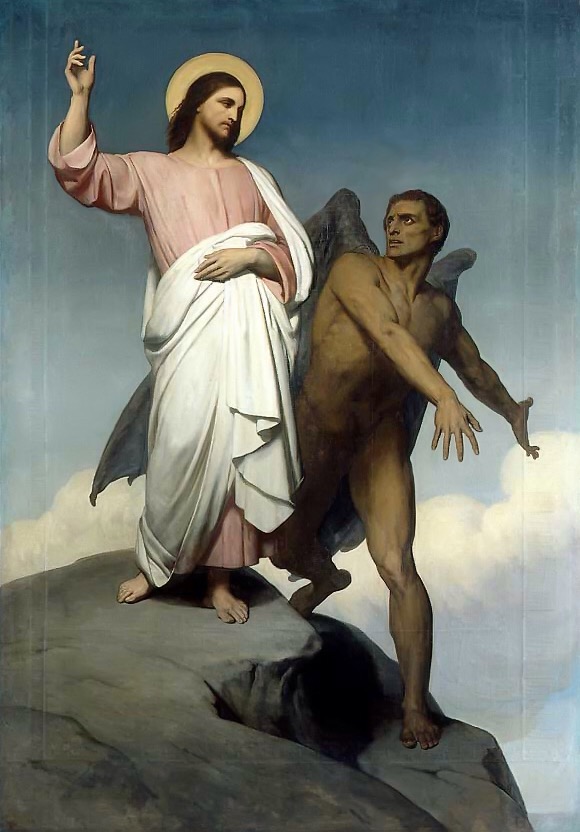
The Temptation of Christ
Ary Scheffer, 1854
The Devil depicted in the Temptation of Christ, by Ary Scheffer, 1854.

One such lost wisdom is the understanding of evil, an understanding that evil all pervasive and constantly needed to be countered. St. Augustine’s conception of evil as ignorance or not knowing God is easily misunderstood today. Obviously the members of Isis know God but still commit horrible atrocities. What they claim is that they are the true followers of God, who are opposed to kafirs or those individuals who do not know God and are therefore not worthy of humane treatment. However knowing God is not knowing as its usually understood, it’s far more than a knowledge of the correct religious tracts. It’s a knowing that is beyond words and cannot be explained in the words of the everyday language of the world of human experience. A knowledge and understanding the religious texts is just the first stage towards knowing God. Knowing God is a transforming life experience, knowing God means accepting a life changing experience through religious enlightenment. Perhaps it can be described as an engagement with God, an emotional commitment or living a life informed by God. However one tries, words remain inadequate for explaining the experience of knowing God. As Plato writes once a person knows good (God) they never want to know anything else, it is a sufficient principle for life. The sufi’s explain knowing God as moving beyond religious ritual and practice to a higher level of understanding, an understanding that can only be achieved with the guidance of a teacher. One Christian text that explains this level of knowing, is medieval Christian classic ‘The Cloud of Unknowing’, in which the author describes the various clouds of misunderstanding and misapprehension that obscure a knowledge of God.

What I am arguing for is a Christian sensibility to be part of the mainstream of human thinking. A perception of the world that is infused with the language of morality, but the sophisticated moral practice of the past. The Christian Fathers such as St.Anthony, Athanasius and Augustine spent a life time trying to understand what it meant to lead a good life. Unfortunately the language in which they write makes them seem alien to today’s readers. The sin about which they write should be understood as human fallibility or weaknesses, a weakness which makes a person liable to commit act badly. It takes a determined act of the will to act well. Christian belief and practice gave them the strength to overcome their very human fallibilities and act well. This lifetime of study and prayer gave them an intuitive knowledge of the good, but they were never so naive that they did not realise that they had to constantly revise their thinking in terms of what they understood to be the good, as they were constantly beset by human weakness that plague us all. Augustine while being a caring father to the people of Carthage who looked after their welfare, could also,support the cruel persecution of heretics. However they had a better grasp of human psychology then today’s generation of leaders and how to better overcome its flaws.

The Christian sensibility of Augustine is founded on a very different psychology to that of today. He sees the human personality divided between two opposing drives. There is the sensory or appetitive drive that tends to the indulgence of selfish interests. Then the soul which is the self reflective drive that directs the individual towards a higher level of behaviour be it spiritual or philosophic. These two parts of the personality are tendencies within the human personality and not a literal description of that personality. Accepting Augustine’s theory of human personality does not mean rejecting later theories of personality, it’s just a different perspective on human behaviour.

Walter Benjamin offers a different approach to the past. He writes that the past is that part of the past that lives within contemporary culture. Europe for centuries embodied this past in the form of Christian culture living within the mainstream of society. Christianity and with it the learning of the past has been now been expelled from the main stream of contemporary culture. The fundamentalist Christianity of the American mainstream or the Wahhabism Islam is a contemporary creation. It is the crude reimagining of a golden religious past, it is religion in monotone, it excludes the kaleidoscope of understanding that is real religion. Whether a state is secular as with contemporary Britain or religious in practice as with the USA or Saudi Arabia, all are bereft of the learning of the past.

In Saudi Arabia and Western Europe and the USA, what is happening iis the removal of all traces of the past learning from contemporary culture. In Saudi Arabia it takes the form of the physical destruction of the buildings of the old Islam. Their presence is regarded as a temptation to heresy, Muslims who identify Islam with particular holy sites, are behaving like the pagans who identified their temples as the dwelling place of God, confusing idols and icons with God. In Western capitalist countries the destruction of the thinking of the past, is through the teaching of post modernism which teaches that a philosophy or belief system are only valid for a particular time and place. There can be no universally valid belief systems, and those of the past should have no claim to validity in contemporary Britain. Britain is a post ideological society, a society that believes in nothing or perhaps whatever is considered right at a particular moment. There is no great inclusive vision such as the Christian belief system of previous generations, a belief that gave politicians an vision of what makes a good society.

IMG_0427

Philip Jacques de Loutherbourg:Battle Between Richard I Lionheart 1157-99 and Saladin 1137

This is not to deny that in the Christian past there were not leaders who committed horrendous atrocities in the name of God. Richard the Lionheart slaughtering thousands of Arabs when he captured the Acre. There was the lesser known Arnaud Amaury, Abbot of Cîteaux the leader of the Albigensian crusade who went his forces captured the city of Béziers ordered the killing of all the inhabitant with the immortal phrase “Kill them all. God will know his own”. About 20,000 were slaughtered in this brutal massacre. Yet throughout this period there was a moral counterweight opposed to the brutality of the medieval knight. Churchmen tried to civilise the barbaric knighthood by trying to persuade them to accept the code of chivalry, which insisted that the victorious Knights treated the defeated with compassion. One of the great stories of the Middle Ages, that of the Holy Grail, was an attack on brutal ways of the medieval knight. The greatest knight of Christendom (Lancelot) is denied any vision of the Holy Grail because of his sins, which included adultery. Only three Knights who are pure in spirit get to see the Holy Grail and unlike the Knights of the Round Table they accept martyrdom at the hands of a Saracen king. Any other of the knightly heroes would have fought there way out of such situations with the slaughter of hundreds or thousands of their enemies. There were always great churchmen and women such as Saint Francis or Hildegard of Bingen who lived lives that were a constant criticism of the knightly ideal.

With the relegation of Christianity and ideologies such as socialism to the history books, there is no longer this moral counter weight to the self seeking actions of the political and financial elites. Some of the most brutal of the medieval leaders accepted the Christian critique of their actions and endowed the churches with money to build great cathedrals, or money to relive the suffering of the poor. Unlike today when only monuments the great and good will leave behind are shopping malls and offices blocks. The super rich of today no longer have to contend with the criticisms of a thriving moral counterweight in the community. Instead contemporary culture lauds them as the heroes of the age, they are the ‘movers and shakers of society’. A view expressed at its most extreme by Ayn Rand (Atlas Unchained) a book in which the heroes of our age are the billionaires and the poor are nothing but the dregs of humanity, worthless beings who must die their thousands to relive society of the burden of providing for such worthless beings. This book despite its inhumanity is a book popular with with people of this new uncaring world.

Perhaps this problem is best expressed in the words of Hannah Arendt in her book on the trial of Adolf Eichmann, when she writes of the ‘banality of evil’. What astounded her was the very ordinariness of this monster who had been responsible for the gassing of millions of Jews during the holocaust. Evil did not give him any distinguishing features, there was no hint of evil in this appearance of this very ordinary looking man. Even his speech was undistinguished,he was unable to give more than a matter of fact account of his activities. If this was the Nazi superman, he was indistinguishable from the ordinary clerk, the myth of the superman was merely that, a propaganda exercise. Judging by Eichmann evil is extraordinarily average, evil comes with a smile on its face and with a modest demeanour. Eichmann could easily be a member of the British Parliament, he is indistinguishable in appearance and demeanour from the average British MP. He has no understanding of morality that went beyond being kind to his family and friends, which is also characteristic of the majority of our politicians. Having no concept of evil politicians are extremely poor judges of what is wrong. They are products of the Neo-Liberal society of the 1980’s that declared that there is no such thing as society. In a society of individuals there can be no public morality, there can only be the morality of friends. It’s a society in which tax avoidance and evasion becomes elevated to a moral good. Through avoiding tax, the family income and assets are maximised for the benefit of its members and its contributions to that meaningless abstract, society are minimised. What is lacking from the public and political debate is common moral belief against which the actions of the great and good can be measured. Perhaps which could be best achieved by reintroducing the sophisticated Christianity of Augustine into the mainstream belief system.

The Pleasures of Old Age

IMG_0422
Nicholas Lancret :The Four Ages of Man: Old Age: The National Gallery

Although I’m not sure when old age starts, I’m sure being 68 enables me to speak authoritatively on this subject. Cicero was probably the first to write on this subject. What strikes me is his words on no longer being distracted by the thoughts of young women, which when young had prevented him from focusing on the more serious business of life. Although I think he was perhaps overstating the case, as older men do still notice pretty young women. Cicero was correct in that in old age the removal of the distractions of youth meant he had the time to do those things that really mattered. For Cicero this was mastering his Greek philosophy texts and rendering them into a form suitable for his Roman readers.

Cicero carefully omits to any of the downsides of ageing, the chief of which is the physically disabling illness that come with age. Perhaps as old age occurred at early age in classical Rome, he was spared these illnesses or perhaps he realised all of his readers were so aware of them that they did not need repetition. However I do feel there is a certain dishonesty to an account of ageing which leaves this out. Ageing for me means an intermittently crippling neurological condition that prevents me indulging in one of my favourite activities, that is walking in the Yorkshire countryside. However such problems are more than offset by the pleasures of ageing. Slowing down because of physical infirmities forces on a you a different kind of sensory pleasure, one that which is associated with doing things slowly. In my case spending time savouring coffee in my favourite coffee shop, a pleasure when young which was spoilt by the constant need to be somewhere else.

Freedom means being freed from the constraints of having to conform to the rules and conventions that govern working and social life. To be a success in a chosen career or at social gatherings one has to conform to these rules. Now being freed from the need to impress my superiors and peers I have the freedom to do as I please. What I hated about my younger self was the need to conform to the conventions in clothing. I wore jeans long past my youth trying to retain the pretence of a former youthful appearance. What I tried but soon gave up on was the baseball cap. Fashionable it might be but I’m not an American high school student or rapper. Now I wear in preference the impracticable British flat cap. An item of headwear that blows away at the first gust of wind, but it’s establishes my British identity. If I was to describe my appearance, it would be that of a slightly down at heel ‘Edwardian gent’. Sensible but stylist jackets in the winter and blazers in the summer are my choice for coats. Never the summer T-Shirt of youth. When in Italy I am paid the supreme compliment of being mistaken for an Italian, although to be honest I’m not as stylish as the average Italian man. What I do try to do is conform to a certain concept of ‘smartness’ that is alien to today’s culture. Is not the Englishman at home distinguished by his ‘dress down’ appearance? This dressings down is not so much a sign of indifference to appearance, but fear of looking different from one’s friends. Respect is earned by dressing down and drinking too much, both of which I can now disregard through not caring.

However the real gain from ageing is the retirement and the freedom it confers. A freedom to do nothing, although that pleasure soon dissipates after the first few days of retirement. It’s the freedom to indulge in those pleasures that the time constraints of working life denied you. Aristotle is right when he says the greatest good of all human activities is contemplation. It’s the freedom to think, a right increasingly denied in my former profession of teaching. Now head teachers, education managers and politicians are terrified of independent thinking, as it might expose the fallacious nature of many of their actions. J.S.Mill defined freedom as the freedom to think as you please without constraint. Now in so much of public service, that pleasure is denied as the individual that thinks independent thoughts might inadvertently express them much to the discomfort of big brother and their career. As a retired teacher I am free from this restrictive self policing. Only when you are old can you really appreciate the pleasure of allowing you thoughts to meander in any direction, as you no longer have to think to someone else’s order.

This freedom from self policing is not what Cicero was writing about in his discourse on old age, but the freedom to have the time to re-evaluate one’s life. To consider what is important and discard those activities that are unimportant. The trivia that clutters up life when working, which detracts from the pleasure if living can be discarded. One such trivia was unnecessary travel, I spent many hours stuck on the motorway going to or from work. Now I only travel for pleasure and usually that only involves a short walk to my favourite coffee shop, where I spent my time in active contemplation over numerous cups of coffee. It’s not true that you need quiet for contemplation, people such as myself require noise, as my whole working life was spent in the noise and bustle of the classroom. Much of my time is spent on meditating on the writings of such past philosophers and religious thinkers such as Ficino and Farid Ud-Din Attar, that I read for pleasure not work. Cicero is right in this respect when you are distracted by the pleasures of youth you lack the time and inclination for the pleasures of study. The classical Greeks valued their time off for contemplation, the Greek citizen deferred work to others. They could spend the day arguing and discussing matters of concern in the agora (the market place). One hallmark of the Athenian citizen was to attend the assembly of the citizens and actively partake in decision making. Work was for slaves, not citizens. Thinking or contemplation now has become thoroughly professionalised and only professional philosophers have the right to think. Only a paid for activity is considered valuable in our society; yet it is retirement that makes you realise it is the unpaid for activities that are really valuable. In a society that values work and despise time off as being for wimps, only the aged are allowed the privilege of time off.

Montaigne in one if his essays writes of the pleasure of engaging in thinking with his old friends. Except in his case these old friends are the philosophers whose books he keeps in his library. In this I concur, there is no greater pleasure than in dipping into a book that you have read and becoming reacquainted with an old friend. Revisiting a text such as ‘The Protagoras’, where Socrates goes to meet his philosophically minded friends who are staying at a friends house and meets them when they are rising from their beds and from then on the discussion ensues on the nature of man and the Gods, gives me constant pleasure. As with Montaigne I feel that I am a privileged but invisible observer at this discussion.

Briefly the pleasure of ageing is time, time to think and stand back observe the doing of others. Not to feel the necessity to participate in the frenzied activity that is contemporary society, ageing allows to you be yourself.

Notes
Socrates Classical Greek philosopher died 399 BCE
Aristotle Classical Greek Philosopher 384 – 322 BCE
Cicero Classical Roman Statesman and Philosopher Assassinated 44 BCE
Ficino Italian Philosopher 1433 – 1499 CE
Farid Ud-Din Attar Persian Muslim poet, theoretician of Sufism. 1145 -1220 CE
Montaigne French Essayist and Philosopher 1553 – 1592 CE
J.S.Mill British Philosopher 1806 – 1873 CE

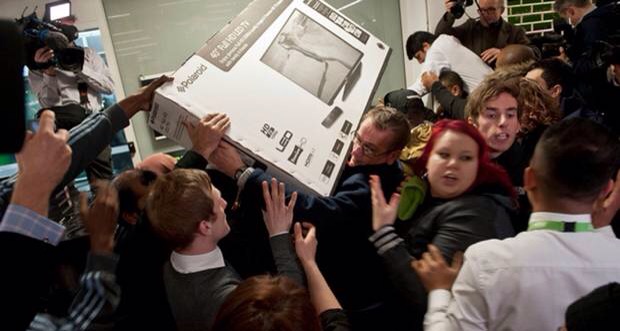
Is not ‘Black Friday’ but a symptom of a sickness that infects British society?

/home/wpcom/public_html/wp-content/blogs.dir/c1e/54687079/files/2015/01/img_0417.jpg

Shoppers competing to get discounted televisions on Black Friday. (London Evening Standard)

Seeing the gardarene swine like behaviour of the Black Friday shoppers, with customers fighting each other to get bargains, reminded me so much of the emptiness of contemporary Life. Thus behaviour longer attracts much criticism of these it is more likely the competitive zeal of these shoppers will earn them admiration. If this frenzied hyperactivity was restricted to shopping, it would be a problem but one with limits. However this frenzied hyperactivity is not limited to bargain hunters but is a behavioural practice characteristic of contemporary Britain. This practice is at is most dangerous when practised by our politicians who rush out a frenzy ill considered legislation to meet whatever crisis or problem occurs. Criminal law reform is one such example it seems that each successive government has to make major changes to criminal law to satisfy the apparent public demand for new laws to protect them from dangerous criminals. Reflection not something practised by contemporary politicians, no contemporary politician would copy would as did Prime Minister, Harold MacMillan read Trollope’s novels while in office, reading would either be some serious economic or political tome for fear of not being seen to be ‘on the job’ or a collection of DVD’s, acceptable frivolity. They are truly the ‘One Dimensional Men’ as described by Marcuse. Men with no depth or breadth of vision. One unfair but a comment with some truth in it is that legislation is rushed out to meet tomorrow’s media deadlines.

Politicians have a philosophy to justify their behaviour, it’s the market led theory of politics. They are as with businesses just there to respond to the demands of their customers. If their consumers suffer from a fear of crime, what is needed is more laws to reassure the voting political customer that their concerns are being met. Whether this crowd pleasing legislation has any impact on actual crime is debatable. What matters is reassuring the customer. Draconian anti drug legislation has had little impact on actual drug taking, but it’s there to reassure the public that the government takes drug abuse seriously. The unintended consequence of this legislation is to eliminate the small time (easily caught) drug dealer from the market, leaving the trade in the hands of major criminal cartels who are able to evade detection through either corrupting the law enforcement agencies or through using expensive sophisticated methods to avoid detection. The fact that current drug laws have inadvertently led to the creation of rich powerful criminal gangs is of no relevance to the government of the day. The fact that there are better alternatives is irrelevant as they lack the crowd pleasing factor.

One thought that occurs to me is that any drug baron would want the current laws to continue in operation as by eliminating many smaller rivals it enables them to remain a monopoly supplier.

A possible explanation

What I want is an explanation of why so many in society indulge in this frenzied purposeless activity. Kierkegaard (The Concept of Anxiety) does offer for me an explanation of this behaviour. His explanation was in part based on self analysis and in part in from observation of his contemporaries in 19th century Copenhagen. In his youth he could be described as a ‘party animal’ a person who was a popular guest at parties, because of his ready wit. However he was aware of an inner emptiness which frenzied social activities could not remove, a behaviour he observed in his friends. However he realised that this emptiness was not apparent to his friends and contemporaries who were content to live life on the ‘outside’. Yet even these apparently happy people would experience an anxiety of something missing, but suffer from not knowing the cause of their anxiety. The solution for them was to engage in more social activities to offset this feeling of anxiety.

This anxiety was consequent people’s failure to understand their true nature. *There is within the human psyche a longing for a different life, an aspiration for a more satisfying spiritual life. He identifies two forms of better life, the first a life lived in conformity to the norms of religion and the second superior a life lived in knowing God. This life may be achieved, through the individual opening themselves to God. They become as a mirror reflecting God in their lives. It is only this final group who are truly free from anxiety, they know happiness, all others know an inferior or counterfeit happiness.

It is not necessary to accept Kierkegaard’s Christianity to see the value of his analysis. Contemporary culture whether it be political or that of wider society fails to recognise the need for spirituality or any form of life that is not based on the consumption of goods or services. It is a barren and empty culture. A market society in which everything is up for exchange lacks any sense of higher value. There can be no universal value system such as Christianity which values compassion, agape (love of mankind) as they have no place in a society of aggressive self seeking traders. There is no market in agape, fairness or compassion, instead they are seen a barrier to wealth making as they demand restrictions be imposed on the businessman. Only recently the Chairman of the Confederation of British Industries spoke out against fairness and compassion. Imposing the living wage on employers or ending the cruel zero hours contracts he said would make the British economy uncompetitive in world markets. The economy demands the immiseration of the majority, if it is to prosper. It is the worship of a strange inhuman God, that is not too different in nature from the Aztec Gods that demanded human sacrifice.

A possible solution

While it is tempting to say that a happiness is dependent on a redistribution of material wealth; this fails to recognise why one of the richest world economies has descended to a level where an increasing number live impoverished lives. Why does the miserablist philosophy of Neo-Liberal dominant the political discourse? Quite simply because the majority of politicians exist at the lowest level of life as identified by Kierkegaard. Their realist philosophies have taught them that there can be no higher values as all that matters are the practical and graspable truths, so we have an opposition campaigning to reduce energy prices and ignoring the problems of a dysfunctional economy that created the misery associated with low incomes. Focus groups are set up to find what are the simple wants of the the electorate. The questions are designed to elicit simple responses that can be transferred into easily marketable policies. Never do politicians offer more than a few simple and banal phrases in place of a political philosophy, a something that is easily sellable.

Kierkegaard for me offers an answer to this malaise, that is how do you stop politicians behaving like moths flitting from one policy light to another. He writes of two religious types, religious A and B. The first practise religion without real understanding they know that they must conform to certain religious practices otherwise they will suffer the wrath of God. If fear of God made politicians believe that they should conform with the rules of Christian practice then the mindless inhumanity of Neo-Liberalism will be dropped. A minority would achieve the understanding necessary achieve to become religious B. They have the understanding necessary to develop policy in conformity with the highest moral and spiritual standards. They would be the leaders or natural aristocrats who would lead society in towards a change that would benefit all.

However Kierkegaard admits that his truly spiritual man would be more likely to be an outsider. His criticisms of society would make him an uncomfortable companion to the rich and powerful. Thus man would have to be prepared to suffer in return for a life lived in imitation of Christ. Father Gleb Yakunin a Russian orthodox priest was one such man. He was a fierce critic of the old soviet regime for its persecution of christians, for which he suffered imprisonment and exile. Yet his actions led to a change in government policy, first the destruction of churches ceased and a policy of toleration adopted towards the Orthodox Church. The role of such critics in society needs to be tolerated, beneficial change only follows from listening to them. In Old Testament Israel these men were the prophets. The Jewish people had a schizophrenic attitude towards their prophets they both accepted and rejected them. They recognised the need for such men as only they kept them true to their faith, yet they also hated them for their criticisms. One of the Isaiah’s was sawn in half by angry Israelites and another John the Baptist was beheaded.

In Britain there is a need for such critics, yet their their voice is silenced. The judiciary is going through one of its most repressive phrases, critics of powerful businesses can be silenced by super injunctions or through expensive libel actions. Police spies are used to infiltrate and disrupt opposition groups. The same police through the misuse of bail conditions can effectively silence activists through making avoidance of political protest a condition of bail. Any organised opposition is emasculated and marginalised through repressive laws. Recently legislation makes it impossible for charities and other groups to campaign on policy issues during an election campaign. While the voice of opposition is so effectively silenced there will be no change in society.

It is too easy to criticise Kierkegaard by claiming that he had an unrealistic view of mankind’s potential. Even when he was alive it was said of Kierkegaard that his definition of a Christian as a life lived in imitation of Christ was practically impossible to achieve. Rather than hoping for an unrealistic change, there is an alternative. I want a return to the age of ideology, an ideology such as socialism that celebrates the potential of man, one that should replace the inhumane Neo-liberal ideology that celebrates the brutal nature of man. There can be no more depressing philosophy than that of Neo-Liberalism that sees man as a grasping egotistic animal seeking only to advance their own interests. An ideology that encompassed hope, compassion would constrain the behaviour of politicians. They could no no longer claim indifference to to what can only be described as the evils in British society. They could no longer ignore the plight of the low paid, the least cost philosophy would be replaced by the criteria of fairness. It could easily be achieved by insisting that all businesses that are in receipt of government contracts or funding pay the living wage to their staff.

The emptiness at the centre in to the political debate would be replaced by an ideology that celebrated humanity. There have been plenty such ideologies in the past such as evangelical Christianity, socialism, the ‘One Nation Toryism’ of Benjamin Disraeli and the compassionate social liberalism of Herbert Asquith and Lloyd George. Such ideologies would constrain the behaviour of politicians, their behaviours and policies would be judged against a set of higher standards. Who would not judge the parliaments of the reforming 19th century and early 20th century superior to those of today. Contemporary parliaments are where self interest in the guise of Neo-Liberalism is the only moral standard. These are the no hope parliaments of today, inhabited by politicians whose attitude is ‘that I would like to help but …’ the but being the cruel moral imperative of Neo-Liberalism.

*i have edited and simplified Kierkegaard’s psychological analysis of human spirituality

Why economists would benefit from a little Christian sensitivity

Why do economists need a Christian sensitivity? The obvious answer would be to instil in them a sense of compassion, while the suffering caused by economics does not compare to that caused by the most brutal of political ideologies it is on the same suffering causing spectrum. The spirit of the Reverend Malthus has always inspired economists and never more so than today. Population growth he believed would always tend to outstrip the resources needed to food, clothe etc. the ever growing population. Therefore his first conclusion was that there must always be the poor, as there was never sufficient wealth in any economy to enable all to have an adequate standard of living. He also saw disease, famine and war as the saviours of mankind as they kept the population within bounds. While economists particularly those in the British Treasury have persuaded politicians of the need for the first, they have not yet tried to persuade of the need for the second. There is another answer and that is economics is one of the best examples of arrested thinking, so common in contemporary Britain. What concerns me is the immaturity of thinking of contemporary economists, their overly simplistic reasoning.

/home/wpcom/public_html/wp-content/blogs.dir/c1e/54687079/files/2014/12/img_0410.jpg

The inspiration for my reasoning is Kierkegaard (Fear and Trembling), in that book he bemoans the practice of Christianity in 19th century Denmark. He writes that the Christian intelligentsia regarded an afternoons reading as sufficient to acquaint them with the essentials of Christianity. This he compares unfavourably with the Christian Fathers who spent a lifetime trying to understand Christianity and who even at the end of there life said their understanding was limited and flawed. Just like Kierkegaard’s Christian intelligentsia economists suffer from the same intellectual arrogance. They just know, they have at hand the answer to all society’s problems. The comment that the answer was worked out on the back of an envelope is intended as an insult but with economists as a statement, the truth of economics can be distilled down to a few sentences that could be written on the back of an envelope. The best metaphor that describes contemporary economics is that it arrested thinking that has never really progressed beyond that if the schoolboy. This school thinking is demonstrated in the words of the Shadow Chancellor, who spoke with glee when he said his cuts to public spending would leave the public sector reduced to its bleeding stumps. As with a schoolboy no thought of the consequences of his actions for the people of an austerity hit economy. Military terminology can be applied as for the modern economist the people are unfortunate collateral damage, who suffer for some greater good.

Economics unlike contemporary theology is a closed subject, the truths are already known and its the work of the economist to apply those known truths correctly in their analysis of any given problem. In a closed subject such as economics, no new thinking is needed because all the fundamental truths have been discovered, all that is required is some tinkering to achieve perfection. Theology by contrast is an open subject, all the truths are not known and those that are are but imperfectly known. It would be ridiculous for any theologian to claim to know the mind of God, yet Christianity has been a closed subject many times in the past, when it claimed this knowledge. It has an unfortunate past record of persecuting and killing those who did not accept the acknowledged truth. Galileo Galilee was silenced by the church for challenging the prevailing orthodoxy, that the earth was the centre of the earth, by the simple expedient of showing him the instruments of torture. Unlike my predecessors as a theologian I claim to know little about God, I am a negative theologian a theologian who admits that God is unknowable. However this does not mean negative theologians have no knowledge of God. They have knowledge of the presence of God in human society, the means by which the unknown makes themselves known. They can glimpse aspects of God’s nature and explain it to others. The aspect of God that I know is the good, the good that characterises all good actions. Good can never be explained except through good actions and as a Neo-Platonist I believe that within all these good actions, there runs an indefinable good. It is a good I know but whose essence I can never adequately explain. All I would claim is that I know something of God’s nature as in is known through the medium of human existence. I am looking through a very dark glass which obscures most of the truth, what a much better theologian than myself called the ‘cloud of unknowing’. What I do know is the limits of my knowledge. I only know a little of one aspect of God’s nature and I shall spent a lifetime trying to develop that understanding.This is unlike an economist who does know and they even know what forms of economics are in error, something I would never claim about other religions. To paraphrase Uriah Heep, I am ever so humble, whereas the good economist possesses the arrogance of truth.

A negative theologian such as myself is keenly aware of the limitations of their knowledge, whereas all economists are positive theologians, who are aware that they know everything and have little if anything to learn about the world. Whereas the truth is the opposite the theologians have spent centuries studying the nature of God and the few truths they know are greater than the imagined truth of economics. Economists have discovered one economic truth, the market and having achieved that they think they know all economics. What they need instead is the perspective of the negative theologian, which one of ignorance. The truths of theology are but a small part of the truths of Christianity, and therefore they are open to any approach that might shed new light on the ultimate truths. Economics needs similar enlightenment it needs to seek new ways to go beyond the few truths it has discovered. When doing a thousand piece jigsaw I always try to fit together first the pieces that make up the edge of the jigsaw and give it its shape. Having put together the outline it is tempting to think that the main task has been done, yet the jigsaw remains a hollow square, with most of the content missing. Economists are in the same position they have some awareness of the outline of the economy, but they are largely ignorant of its content. The pieces that make up the content are missing from the jigsaw economy. Only arrogance prevents them from seeing the truth. What economists lack is humility, if they acquired this very Christian virtue the practice of economics would improve immeasurably.

The New Generation of ‘Wreckers’ (at Westminster)

IMG_0398.JPG

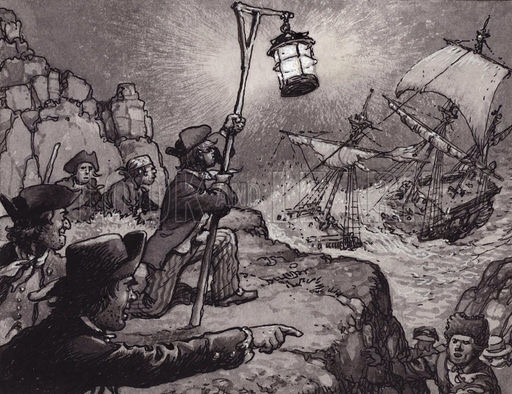
Originally the wreckers were inhabitants of the costal regions of Cornwall, who during stormy weather would lure ships on to rocks, where they would kill the surviving crew members and loot the wreck of its cargo. While today’s wreckers are very different, in that they are politicians that inhabit Westminster, their motives are very similar to those of the Cornish wreckers. They want to break up the public service organisations and sell off the most profitable parts to favoured buyers. Parts of the NHS are sold to Virgin Care, prison and probation services to Care4, the list is almost endless. These politicians would never view themselves as wreckers, they instead are the new Neo-Liberal thrusters, breaking up the old complacent society to remake it as a dynamic free market society.

IMG_0399.JPG

The recent privatisation of the Royal Mail provides a good example of this wrecking process. The Royal Mail was established in 1840 to provide a universal mail service at a fixed price to all customers. In Neo-Liberal Britain this in the words of one expert is an anachronism. The service could be broken up into its various parts and sold to for profit providers, who motivated by the need to make profits would provide a better service. What this means in real terms is that the customers of the most profitable parts of the mail delivery service would get a better service and the least profitable customers a worse one. Consequently the government first disposed on the profitable corporate mail shot business to private contractors, then permitted these same companies to cherry pick the profitable London mail delivery service, leaving the high cost universal mail delivery service to The Royal Mail. Now the now privatised Royal,Mail is requesting that it be relieved of the burden of providing a six day a week universal service. Inevitably its request will be granted as the universal service obligation is contrary to profit making. Soon Britain will,have an expensive fragmented mail delivery service similar to that in the Netherlands, where profit making rather than service delivery is the priority.

While a dysfunctional postal service may cause some problems it does not pose a major problem for British society. We can all learn how to manage with delays in post, however the wreckers in politics seem unaware of the damage that they are inflicting on the social fabric damage in their effort to create the perfect Neo-Liberal society. It is as if they have taken a ‘wrecking ball’ to the fabric of that society, they are on the same spectrum of political leadership as Chairman Mao. He was responsible for the death of millions, when he tried to impose a communist agenda on China with the ‘Great Leap Forward’. I guess we should be content that our current leaders are content with the remaking of society only involves the immiseration of the majority, and not their death in service the higher cause. Food banks, zero hour contracts, low wages, insecurity of tenure and homelessness are the price to be paid for the ‘Great British Leap Forward’. Our leaders as with Chairman Mao hope to recreate a new society out of the ruins of the old state. Any price paid is regarded as one well paid for the creation of the day new society.

The Real Price paid for the ‘Wrecking Ball’ of Westminster politics.

As with Chairman Mao’s ‘Great Leap Forward’ the real price paid by the people for this misguided reform is largely hidden from view. The losers are the poor, the underclass largely hidden from the view of the media, unless they are needed for examples for the purpose of scapegoating the feckless poor. Strangely enough for a political class that lauds the family as the cornerstone of society, it shows little concern about the destructive impact of its policies have on the family unit. It is recognised that financial stress in one of the main factors in family breakdown, yet successive governments have imposed more and more financial stress on the family unit.

Their Neo-Liberal or supply side side reforms require a labour force that is infinitely flexible, one that can and will move from one job to another, at a moment’s notice and one also that is so cheap to employ that high wages are no bar to employers wishing to take on extra staff. By removing employment protection laws, wage councils and emasculating the trade unions the government’s of the UK have achieved this flexible labour force so desired by businessmen and economists. Recently a think tank of Swiss millionaires lauded the UK for having the most flexible of labour markets.

The price paid for this free market in labour is high in terms of human suffering. A comparison is the family structure within the Victorian army, offers a useful parallel to today’s family. Then because of the high mortality rate amongst the soldiers a fluid family pattern developed. The loss of a male partner meant poverty for the family, so frequently the woman in the relationship had more than one partner so as to avoid the poverty that would be attendant on the death of the breadwinner. For the same reason serial monogamy was a necessity as women would need a succession of male partners, if the woman based family unit was to survive. Many middle class commentators saw army wives as little better than prostitutes, as they failed to recognise the financial stresses that made this a necessary way of life. Any reader of today’s papers will recognise this description of family life as that ascribed to the underclass. Stories abound in the tabloid press of the amoral underclass, not recognising that it’s the way the poor have of coping with the stresses of everyday life. Only a fluid weak family structure can survive in a situation of extreme financial stress.

IMG_0401.GIF

There is the impact on the men in low wage insecure occupations, which impacts negatively on family life. As demonstrated in Wilfred Foote Whyte’s book ‘Street Corner Society’, there the men he interviewed had numerous liaisons and partners. What is he discovered was that it was not so much amoral behaviour, but shame that drove these men into having numerous sexual relations. What forced them to move on from one relationship to another was the shame of being unable to support a family properly because of their low income. Running out on the relationship was the only way to avoid the humiliation of not being able to buy one’s children clothes. This explains the prevalence of so many one parent families in the UK.

Family breakdown is not unique to the underclass, it is spread throughout society. A society that regards people as resources of labour to be used when and as the employer pleases is bound to be destructive of social relationships. Social change has made once secure jobs, such as the professions insecure. One comment strikes me as typifying today’s destructive society, a neighbour said that if she became pregnant she would have to have an abortion, as her partner’s salary would be inadequate to pay the mortgage and support a stay-at-home wife. A society such as Britain which has bought wholeheartedly into the Neo-Liberal agenda is uncaring of damage inflicted on its members if it boosts the bottom line.

What prompted this essay was the evident damage shown in our society from just a few years of the Neo-Liberal experiment. In primary schools there are an increasing number of children starting who lack social skills or in some cases language skills. (There are children of five who can only only communicate, with sounds lacking any language skills.) There are even children attending school who have rickets, the illness of poverty, once thought to have been eradicated. Blame for this is put on inadequate parents, but with the destruction inflicted on the family, it can be no surprise that damaged families produce dysfunctional, inadequate adults. Are these the people that made up the mob so feared by Victorian society?

There has been another warning sign, it has been estimated that societies where average income is less than $7,500 social discontent is endemic. Just recently recently our major cities were subject to a spate of rioting in which the police temporarily lost control of the streets. It goes almost without comment that the riots were the young on disproportionately low wages. If current trends continue with average wages continuing to fall, inner city violence may become endemic.

The Return of the Old Fear of Revolution

Strangely the best educated generation of British politicians has an appalling ignorance of the past. When at university in the 1960’s it was an age of optimism. My teachers in common with the rest of society thought that the evils of the Victorian cities were a thing of the past. Society had been remade along social democratic lines, so as to eliminate the evils of that time. Too many politicians could remember the horrors of the ‘Great Depression’ and wanted to ensure that they would never return. Yet our current generation of politicians seem to want consciously or unconsciously to return to the divided society of Victorian times. The Victorian middle classes had a constant fear of revolution and the masses. When the Chartists marched through London in 1848 to demand universal suffrage, the fearful middle classes turned out in force as special constables to police the marchers, such was their fear of revolution. Such was their fear of the masses that a series of murders in the East End of London, became magnified into the ‘Jack the Ripper’ scare. For a fearful middle class it was all to easy for to imagine that the poor areas of the East End, were the breeding ground for monsters such as Jack the Ripper. This fearful middle class fled the city and the mobs for the green suburbs. I now live in one such suburb created by the mill owners of Leeds who wanted to distance themselves from the city poor.

Now having started to create an divided and unfair society, politicians and the middle class have rediscovered their fear of the poor. Such is the fear that the rioters of 2011 that judiciary under pressure from frightened politicians handed out draconian sentences to deter future rioters. A practice common in the 19th century when hard labour and hanging were the punishments for rioting and offences against social order; however in such a divided society such punishments had little impact on reducing violence.

Today the East End of London is an area of new city blocks and affluence, yet in the recent past it was a place in which the well off feared to venture. I remember a professor telling me that when he ventured there in the 1930’s he was driven out for being posh. He was subject to stone throwing from the local youths.

Although it might be disputed by some but the fear of revolution has returned in the guise of Muslim extremists. Only today the Home Secretary warned that the likelihood of a terrorist attack was at the greatest since 9/11. It is from those areas of the ‘Other’ in which the fearful rich and well to do never venture, that they fear attack. They have declared a war on terror, they fear Muslim minority, regardless of the fact this minority has integrated well into society. While there is a justified fear of Muslim extremism, extremists are a minority and it was largely complacent policing that allowed them to thrive.

There is however a disaffection amongst the young, they see a society that is indifferent to them. It is a society that cares little for its young people, denying them good wages and housing, it is a society in which disaffection will grow. At least in the majority it’s protests that are legal, but in minority groups that are feeling oppressed a small number while turn to more violent means. Even history teaches us that this minority can be contained through good policing. The Fenians in the late nineteenth century were as dangerous as any modern Islamic terrorist and yet the police successfully contained them. Unfortunately the return of the ‘great fear’ of the dispossessed ‘other’ means that our political leaders will inevitably overact to a small disaffected group. The best advocates for the extremist cause are the politicians who constantly over estimate the power and success of them. They cannot see that Islamic extremists are as much a creation of their making, as of their religion. If a people are impoverished and brutalised through political and social change, social order and peace will be undermined, but our current complacent political class never realise that. They will instead resort to more and more repressive measures to control the simmering discontent. The 1950’s and 1960’s were an unusual period in British history, one of social peace, achieved because the vast majority felt they had a stake in maintaining the well being of society.

Fundamentalist Religion and the Economics of Fear

IMG_0393.JPG

A Rural Christian Childhood

When I remember when I was young and staying at an aunt’s house I picked up a copy of John Bunyan’s ‘Pilgrim’s Progress’ to read before going to bed. It was a old edition illustrated with what I imagine were wood cuts, which terrified me. Having tried scan the text for parts with interesting stories I gave up. What I read about Doubting Castle and Giant Despair and the numerous beatings that Christian and his companions suffered filled me with despair. I resolved that evening to live a virtuous life and not suffer the fates inflicted on Christian. However the fear that motivated me to adopt the strict lifestyle of my aunt disappeared on my return home. There days spent playing out in the sunlight summer countryside of Kent restored my childish optimism. Even when attending services at the village church, there was little to remind me of the horrors that that abounded in ‘The Pilgrim’s Progress’. Church services were happy affairs reaffirming the good life lived by the inhabitants of our rural community.

IMG_0390.JPG

What I learnt unconsciously as a child was that any religion or morality of fear was only effective as long as that fear was constantly reinforced by repetition. Sunlight and the beauty of the countryside removed the shadow of fear that clouded my mind. Once those influences that made fear so oppressive, that is the strangeness of the dark oppressive city bedroom, the terrible words and depressing images were removed my fears vanished. Instead there was my love of the Christianity of the countryside. Even through my periods of atheism at the big city university, my affection for the Anglican Church never diminished. Unknowingly I took with me to the city my love of the life affirming Christianity of my childhood.

This simple unreflecting religion of the countryside has remained with me. It was not a religion that was unaware of the unpleasantness of life, many from the village were all too familiar with such, having experienced the horrors of World War II. They did not want a religion that told them that they lived within the confines the ‘Vale of Tears’ and the ‘Slough of Despond’. The beauty of the surrounding countryside gave the lie to such perceptions. What they wanted was a religion that celebrated life they knew and experienced. The religion that enabled them to celebrate the seasonal rites of passage that gave meaning to their lives.

There were two vicars in my time in this village. Neither over intellectualised life and were very representative of that strain of bucolic Anglicanism that once characterised the English church. The one vicar I knew well had been a Cambridge Rowing Blue, a man who epitomised the muscular Anglican Christianity of Charles Kingsley, I suspect that as with Charles Kingsley he always slept in a bedroom with an open window, exposed to even the winter cold. Kingsley believed healthy living was an essential part of the Christian life a healthiness engendered by physical exercise and through a rejection of the soft effeminate lifestyle that avoided exposure to the elements. (It should be mentioned that his insistence on always having an open window led to him catching a chill which caused his death.) Our athletic vicar’s sermons were couched in a language that the unsophisticated country dweller could comprehend. There were no difficult intellectual frills, about the nature if the triune God for example. This God only mentioned The Lord’s Prayer a God whose existence was accepted and whose existence was never questioned or explained. Even this twelve year old choirboy as I was then could understand his sermons.

His predecessor commanded great respect in the village, even although I as a child found his manner gruff and intimidating. During the war he had been a padre and when his unit had been captured by the Germans, he refused repatriation which was his right as a non combatant and instead went into captivity with the rest of his unit. This man my father really liked as he would visit him when working in the fields and talk about their shared wartime experiences. I don’t think he once mentioned religion in his conversations with my father. On reflection I think what I mistook as gruffness was in reality the blunt manner of a countryman. A man with a simplicity of manner and directness of speech, who felt no need to add in the unnecessary courtesies of ‘townified’ speech making.

The Economics of Fear

Between the world of my Kentish childhood and that of England today, there is a yawning chasm, it as if the first never existed. All the certainties of my childhood, fair wages (sufficient income to support a family), good housing, security of tenure and employment have disappeared. One story illustrates this, there was on the estate a worker who was notoriously lazy. One day when he heard the church clock strike twelve for lunch, he stopped his hedge cutting mid stroke and left the half open shears on the hedge in the cutting position. Today such action would merit instant dismissal, then the estate management knew that he had a large family to support and they would be the losers if he lost his job. Now the manual work undertaken by my father and his friends is subject to low wages and insecurity of employment. Within the manual trades workers are either self employed or have zero hours contracts, both of which enable the employer to manage by fear, as the hours of work he gives his workers depends upon their good behaviour. Insecurity and the anxiety it brings are now seen as the best means of managing the workers.

Fear is even the most used management practice in the middle class professions. As a former public service professional I witnessed the introduction of the target based culture and the accompanying culture of institutionalised bullying. Neo-Liberalism the dominant political philosophy of our times is a belief system that states that any service or product can best be judged by the quantitative or monetary value it is given by its purchasers. Other than taxes no price is paid for public services such as policing, health care care and education, this meant that politicians had no means of judging the productivity of the public service sector. It did not matter that the service provided was qualitative and had no direct monetary measure. How could a life saved be valued or in my case how could the treatment that cured my infant daughter of meningitis be valued? Ignoring the impossibility of turning quality into quantity, the government decided that they would introduce quantitive measures of output into these services. This was the target culture, there would be a time limit for how long a patient should wait in the accident and emergency department before being treated. There are very valid reasons for reducing waiting times, but the problem is that this directive outweighs the qualitative judgement of doctors. One consequence was those with minor illnesses nearing the four hour deadline for treatment would get priority over those with more serious illnesses.

Global target setting has one major failing, it is a very crude measure of service and can give misleading results. Very soon the politicians realised that these initial global targets were too broad to measure the output of public service workers. If the state was paying a large salary to a doctor, teacher or policeman, how could they be sure that the service provided by that individual was equivalent in value to say, £30,000? To ensure that the state was getting value for money it had to introduce more and more directives to direct the working practices of the public service workers to achieve the desired ends. The consequence is that the activities of all public service workers are now micro managed from Whitehall by bureaucrats at the behest of their political masters, who have little knowledge of the service they manage. Given the mismatch between the civil servants knowledge of working practices and actual working practice, there had to be found a way to ensure a reluctant workforce complied with these centrally imposed directives. Particularly where the workers thought they contradicted good working practice. Coercion or management through fear is the only possible way of making these directives effective.

Managers in the public sector fear now losing those jobs if their targets are not met and they transmit their fears through the workplace. Managers desperate for their jobs will adopt bullying measures to ensure these targets are met, not caring whether such targets improve the effectiveness of the service they are providing, all that matters is that these targets are met. To strengthen their arm the government has introduced job insecurity into the public service sector to improve efficiency. Workers deemed ineffective can be summarily dismissed and quickly replaced with new more effective staff. Such managers are unaware of the evidence from business that high staff turnover reduces the overall effectiveness of the business rather than increasing it.

The system in the public services now resembles the management practices in the old Soviet Union. There the KGB was the inspectorate that ensured compliance with approved management practices and that targets were met. Targets were met but often by producing poor quality goods or services. The same naivety permeates the English public sector, where London rather than Moscow bureaucrats write the service manual by which the inspectorate judges public sector workers. Their belief is that is they draft a sufficiently detailed manual of what the good teacher, doctor or policeman should do, the government inspectorate will ensure compliance with that manual so taking service provision to a higher level. The fact that top civil servants have little knowledge of the practices in the classroom or hospital does not matter, as constant revision of work practices to eliminate error will result in the perfect instruction manual for public service workers which will deliver the highest level of service provision. What they fail to realise is that this practise engenders uncertainty in the workplace and often confusion as this year’s directives may contradict last year’s. Politicians, civil servants, economists and political servants never understand that one model does fit all. The practice of teaching and medicine is as much an art as a science, individual practice cannot be reduced to a pre agreed script. The agreed script cannot produce the great teacher or doctor, but they can both thrive in a very different culture that values individual creativity. Again the Soviet Union provides an insight into the fallibilities of this system. Centrally given directives drafted in ignorance of working practices are frequently unworkable and can work to frustrate their intended purpose. To persuade workers to adopt these practices it was necessary to use extreme measures, failure to comply meant exile to a labour camp and possibly death. The point I am trying to make is that the more and more directive working practices become, the more and more extreme measures have to be adopted to ensure compliance. Is it not possible when the threat of dismissal proves to be ineffective in ensuring the public sector workers achieve their targets, more extreme measures will be considered such as imprisonment?

Religious fundamentalism and the economics of fear

This essay is intended to demonstrate the similarities between religious fundamentalism and the new economics of fear. Fear is one of the main drivers in Baptist religious practice. One of the last services I attended was in small corrugated iron chapel in a remote country field. There the preacher spotting a large audience of young people on the threshold of adult life, resorted to a sermon on the dangers of hellfire, intending to set them on the right path for adulthood by warning them of the dangers of failing to do so. Similarly When I attended a service given by a well known American preacher he also tried to frighten his audience into becoming Christian by talking about the imminence of death and the likelihood of eternal torment for sinners. Hundreds went up to the front in a sign that they had received the message. One of these was my atheist friend, but by the next day he had recovered his composure and gave up the Christian religion, when the fear of hellfire had been lost. I don’t think he has been to a religious service since. Only by being repeatedly reminded of the perils of hellfire would he have continued in his newly discovered Christian practice and belief.

Management in the public sector is similarly premised on fear, the fear of dismissal rather than hellfire. Both the Baptist preacher and public sector manager lack faith in their congregation and workforce, and believe that only fear can deliver the right behaviours. While I disapprove of the use of fear as a means of controlling human behaviour, I do have some sympathy with the Baptist preacher who is using fear to for a good end, even if I don’t agree with the means used. I have none with the public sector manager who uses fear as a means of improving productivity, the ends don’t justify the means.

If I can compare myself with my atheist friend he was Christian for one night when the terrors of hellfire where present in his mind, while I have remained a Christian (with a few lapses) as a consequence of having been introduced to Christianity which was a celebration of life. Fear is only effective for the moment it is introduced and will only remain an effective motivator of human behaviour if it is constantly reinforced. The consequence for the public sector in Britain is that an ever growing workforce of managers and inspectors is required to ensure that the workforce complies with the ever growing list of centrally issued directives. However productivity is measured this ever growing non productive workforce can only diminish individual productivity, or to put it more simply a decline in the quality of service.

Neo-Liberalism the latest of a long line of pseudo philosophies that plague mankind

Isaiah Berlin once remarked that there could be no such thing as a right wing philosophy. This at first puzzled me as the philosophers I studied were generally to the politically right of centre. What I then realised was that although these philosophers were of the political right their philosophies were not. Their philosophies were too enlightened to be confined within the bounds of conventional right wing thinking. A truly right wing philosophy would be founded on the principles of personal aggrandisement, the abuse and exploitation of fellow men (a contempt for the majority of mankind), the extolling of social inequality and social privilege. To express it more simply there cannot be a philosophy of nastiness; it is contrary to the understanding of the that the Greeks gave to this word, which that it is the love of wisdom. Praising greed or inequality cannot be the basis of any philosophy as it is a paean to unpleasant form of self interest.

IMG_0360.JPG

Having introduced the term pseudo philosophy I need to explain what I mean by the term. A pseudo philosophy is a one that serves to justify the self interest of a particular group. This self interest is always described in terms of a higher idealism, always a theft of universally admired ideals, but ideals that were redrafted to serve a particular narrow self interest. The medieval knight was at his worst was a killer, a rapacious looter and rapist yet this brutality could be justified by chivalry. This knight was a Christian knight, who spent the night before knighthood in prayer at a chapel. A knight who promised to use his strength to protect the poor and weak, treat women with courtesy etc. Somehow those killed by the knights did not fit into any of the protected categories, they were non people excluded by the code for a variety of reasons, for example when the Christian knights stormed Constantinople, the killing of Christian priests and monks was justified as they were heretics.

Pseudo philosophies unlike philosophy have the intention of stopping the advance of human knowledge, they want to stop the clock on change. They want to preserve the contemporary society in aspic or in the most extreme cases regress to a less enlightened age. The militants of Isis in Iraq practise the pseudo philosophy of violence, their rise to power is justified by the need to purge society of non Islamic elements. The barbarity of their regime can only be justified if they remove and destroy the enlightened elements of modern Islam society, as their existence is a constant and compelling criticism of their regime and a reminder that there is an alternative. Barbarity and the lust for power cannot tolerate learning whether it be culture or education as it is in opposition to their barbaric ethos. An ethos best expressed in the words mistakenly attributed to Goebbels, ‘when I hear the word culture, I reach for my revolver’.

IMG_0361.JPG

What these pseudo philosophies have in common is a disregard for majority of humanity, who they class as inferior beings, full membership of humanity is limited to elite groups, the medieval knight or the contemporary billionaire. Possibly the cruelest of pseudo philosophies is National Socialism which classified whole groups of people as sub human, such as the Jews, the Roma, homosexuals, the disabled and proceeded to exterminate them. Contemporary pseudo philosophies such as Neo-Liberalism embody this same inhumanity. Ayn Rand a leading prophet of this philosophy also demonstrates a contempt for the masses of humanity. In her novels mankind is divided into two groups the ‘producers’ and ‘looters’, with corresponding physical characteristics. Her producers are square jawed of an angular physique, her looters are weak chinned and have flabby physiques. A caricature of humankind that could almost have been borrowed from the Nazis, with their comparisons of the magnificent physique of the Aryans with the grotesque bodies of the Jews. One critic said that there was the whiff of the gas chambers in her novels

Rand as with all pseudo philosophers is able to dress up her ideas with a moral grandeur suggestive of utilitarian philosophers Jeremy Bentham and J.S.Mill.

My philosophy, in essence, is the concept of man as a heroic being, with his own happiness as the moral purpose of his life, with productive achievement as his noblest activity, and reason as his only absolute.

—Ayn Rand, Atlas Shrugged[11]

Unfortunately such grandeur can be deconstructed into the belief that greed is the motor that drives the world. Evil gets redefined as the attempt by the ‘looters’ to deny the ‘producers’ through legislation and its evil begetter over mighty government to rein in and control the wealth producers and creators. Billionaires are her heroes the poor are ‘lice’ and ‘maggots’. Unsurprisingly Ayn Rand is popular with the right, particularly the Republican Right in America. She seems to have been almost as influential as Friedrich Hayek and Milton Friedman in recasting the USA and the UK in the Neo-Liberal mould.

Since the philosophy of Rand, the economics of Hayek and Friedman gives a moral camouflage to the activities of the predatory financier class, it is not surprising that Neo-Liberalism has become the moral philosophy of this class. They by using their financial clout have manipulated the political classes into accepting Neo-Liberalism as the philosophy of the political class. In the UK politicians as in the USA have become totally subservient to the ‘producers’, government now is principally run to facilitate the interests of the producers. Public service (big government) has been diminished through the wholesale privatisation of public services. In their latest act of obeisance they are about the agree the Transatlantic Trade and Investment Programme (TTIP) which will enshrine in legislation the dominance of producers over the political class. If in the future any government has the temerity to force the big corporations to adopt environmental or labour protection policies which they claim could reduce their profitability, they can reclaim those lost profits from the government. Usually when a political class legislates itself into irrelevance it is under the threat of violence as in Nazi Germany, the signing of the TTIP treaty is unusual in that our legislators are wiling signing themselves into irrelevance.

IMG_0358.JPG

Practitioners of pseudo philosophies such as National Socialism and Neo-Liberals in their anxiety to give their philosophy a more secure cultural underpinning, drift into turning their philosophy into a religion. Towards the end of the Nazi regime the SS tried to reintroduce the old pagan Gods as a cultural reinforcement of Nazism. Neo-Liberals have already made that change. There is for them a superhuman entity that creates, controls and remakes life and that is the free market. All human societies should be modelled on the free market and Neo-Liberals believe that their role is to remake society into the perfect free market, a behaviour that can be compared to those followers of millennial religions. They thanks to Ayn Rand have a belief in a non-rational world view that is not subject to critical analysis, it is just true.

The purpose of my essay is to explain the nature of the enemy, that people such as myself oppose. If you understand your enemy you are better able to fight it. The philosophy that guides the Rand’s producers is a kind of disturbed masculinity and is a threat to the good society. All the sex in Rand’s novels display this disturbed masculinity, it always violent, suggestive of rape. Not a bad metaphor for the financiers who have raped society through their greed, living a damaged broken social world in their wake.

When being wrong is being right, the majority perspective on economics

IMG_0346.JPG

One of the greatest of follies is the excitement that is generated over the Bank of England’s announcement of interest rates. Once a month the monetary policy committee meets to decide the bank rate, that is the rate of interest the bank will charge on loans it might make. This committee of the great and good holds the nations future in their hands, holding rates steady as they have done yet again, brings great relief to the nation’s borrowers. In a nation that is as over indebted as the UK even small changes in the interest rate can be of great significance to borrowers, particularly those with large outstanding mortgages. Yet this is an illusion as so much economic policy making is a matter of smoke and mirrors. What matters is what people believe, if they think, as do the nation’s politicians and financiers, that such rate changes are of great importance, they are of great importance. However in moments of great crisis when events spiral out of control, they are almost useless. On Black Wednesday bank rate went up to 15%, 30 times today’s rate of 0.5%, yet it did little to halt speculation against the pound in the financial markets. The speculation was only ended when the pound was effectively devalued by Britain leaving the European Exchange Rate Mechanism and accepting a low market valuation for the pound. Raising interest rates did not stop financial speculators bringing the Bank of England to its knees.

While focusing on bank rate politicians and central bankers can pretend that they are in control of events. Stagnant incomes, over indebted banks (whose debts in 2013 were approximately 500% of GDP or £6.7 trillion), low productivity and spiralling trade deficit (now the highest in the developed world at 5% of GDP) are problems that can be ignored. At least until some future crisis reveals the fault lines in the UK economy. Incompetence in managing the economy despite popular misconceptions to the contrary never results in a lost election, unless it impinges on the popular imagination as in the form falling house prices.

IMG_0347.JPG

There is another misconception that a dysfunctional economy such as that of the UK is self correcting or pressures from within society will lead to a correction of the failures within the economic system. Nothing of the kind is true,dysfunctional economies such as the UK’s can function as they are for many years unless some internal or external shock forces traumatic change in society. If the political classes can somehow convey the impression that they are in control of the economy nothing will change. Nonsense if dressed up as sound economic policy will be accepted by the people as a whole in an economically illiterate society. Strangely enough for a subject whose practitioners claim to subject the economic to forensic analysis, artifice and appearance are often what matters.

I am not alone in my analysis as today one economics commentator described the policy of the central banks as applying cosmetics to the mummified economy.

Spoken or written truths are not welcome in such situations as this when the political,class and the supporting cast of economists are all desperately reassuring us that everything is well. The shrillness of the abuse with which they shout down proponents of alternative strategies is an indication of weakness of their grasp of the truth. They are aided in the suppression of the truth by their media allies who through controlling print and media outlets can prevent any alternative strategies being published or becoming known. What matters is that only the same story is told by politicians, economists, industrialists, the media etc.

What should not be underestimated is the staying power of the fictional story that by manipulating the bank rate the government is in control of the economy. Fortunately for all in the governing classes economics is going through the ‘dog days’, when all pretence of critical objective analysis of economic affairs has been abandoned, in favour of just telling the one story. If it is possible to describe one of the social sciences as a dead science, that description is true of economics. There will never be a university economist who will state that the emperor has no clothes.

Given my interest in theology, I can cite a similar example. Belief in the Gods of Olympus persisted for hundreds of years, even through the late days of the Roman Empire, when the educated classes had long since abandoned such a belief. Conservatism and the usefulness of such beliefs to the government, who could manipulate the fears of the population through supernatural portents gave belief in Jupiter and the other Olympian Gods an exceptionally long life. Belier in the efficacy of manipulating bank rate to control the economy started in the 19th century and despite a few short periods of disrepute it continuing to be the main measure of government economic policy.

There will be another financial crisis possibly worse than that of 2008/9 and again economists despite all the evidence too the contrary will again say that it was an event that nobody could have predicted. Policies that were adopted in 2008/9 despite their evident failure will be used again, as to do otherwise would be an admission of fallibility among the ruling class of politicians, bankers, industrialists, economists etc. What is needed is a new governing class with a new set of stories about the economy, hopefully stories that are grounded in reality. That will only result from a major trauma within society that destroys the myth of infallibility that cloaks the governing classes. The last time this happened was after World War 11 when a series of military disasters destroyed the credibility of the governing classes, when they were replaced with a middle class imbued with the ideals of social democracy.