Category Archives: Politics

The Big Lie 1 – an economists view of the general election

There is always one big lie in any election campaign and this year’s one is that the government’s election promises are practical because only they have realistically costed their programmes.   Natalie Bennett leader of theGreens was ‘monstered’  in the media for failing to explain how she would fund the house building programme that she promised. Instead of stumbling over the figures, she should have replied that all costings of public expenditure programmes are little more than  ‘guesstimates’ and some are more accurate than others. Given the access the government has to advanced computer technology, one would assume that it’s costing of programmes would be more accurate than that of others, although that is not always true. A glimpse at the history of government spending projects would demonstrate this; it is difficult to think of one government project that has come in on budget.  The costs and management of Britain’s two latest aircraft carriers demonstrate this all too clearly. Not only were the costs grossly underestimated, but so were  the ancillary costs were ignored, such as the need to construct supporting vessels. The consequence us that when completed only one aircraft carrier will be able to be put to sea and then only if our NATO allies can provide a projected shield of warships. There is even the suggestion the the costs were so grossly underestimated that their might only be enough money in the budget to provide enough aircraft for one carrier only. Yet this is the government that accuses the opposition of failing to fund its plans,


Canary Wharf http://www.rsh-p.com

Why cannot the government accurately cost its programmes? The first answer is that most programmes are intended to operate over a number of years and many unexpected factors can throw the best laid plans into chaos. Large construction projects very rarely come in on budget, unexpected geological problems might occur, or a spell of bad weather delay construction or conflict in a country providing essential materials all of which can lead to a spiralling of costs. Usually to avoid this most projected plans include an element of overspend. Even allowing for this large spending projects can bankrupt the business. Perhaps the best example is Canary Wharf, where the one company Olympia and York Canary Wharf Limited won the contract to build and develop a commercial centre on the  site of the old Canary Wharf Docks. Yet this well run business went bankrupt in 1992  having constructed most of the buildings. What bankrupted the company was the collapse of the property market in1992. If well run commercial enterprises can get costs and revenue so wrong, is it any surprise that government running much larger projects get their figures wrong? Uncertainty about the future is why so many cost estimates are wrong.

Government cost estimates for projects such as the High Speed 2 rail network and the Queen Elizabeth aircraft carriers are subject to an unusual budgeting practice, one based on the two principles over optimism and underestimation of the costs. Whereas in commercial practice an element of over spend is built into the costs, the government adopts the reverse practice, where the practice is to choose the most favourable cost projection (even if it’s an unrealistic option) in the belief that this is the best way to sell a project to the country. There are two infamous examples of this the cost estimates for the IT programmes in the Health Service and the now universal credits  programme for the Department of Work and Pensions. The first was abandoned because it proved unworkable and too costly, a fate that will be probably shared by the Universal Credit programme. Despite having proved so inept at costing their own programmes the government sneers at the other opposition parties for their so called ‘unfunded’ policy options.

Perhaps the best explanation lies with Disraeli who said there are ‘lies, dammed lies and statistics’. Statistics while if used correctly can be invaluable in the decision making process, all too often they are used to confuse. Part of what can be called a policy of disinformation. Confuse the opposition by getting them stuck in an unfathomable morass of misleading statistics.

Politicians also seem to believe that using statistics confers validity on their policies; I suspect because they believe that the arguments in support of their proposed policy option are not very strong. Using statistics no matter how flawed or selective is assumed to make their arguments more convincing to the electorate. What it signals is a lack of confidence in the politician who realises that they cannot win the debate by reasoned argument. Statistics are the screen behind which weak policies and politicians hide.  

Statistics when used properly are a useful guide to policy making, it is essential to have a reasoned estimate of the costs of a programme. Unfortunately politicians all to often make the most optimistic, rather than the most realistic cost estimates for their programme. When Ian Duncan Smith (Minister for Work and Pensions)  started the reform process to introduce universal credit, he claimed it would cost the tax payer £2.2 billion to introduce, yet three years later he acknowledged costs have risen to £12.8 billion. One estimate suggests that for every person placed on the scheme the cost was £225,000, an incredible figure for a programme that was intended to reduce the cost of administering welfare.  Perhaps the bible has the best explanation of Ministers who claim only they and not their opponents have properly costed their programme. Matthew 7:3 ‘And why beholdest thou the mote that is in thy brother’s eye, but considerest not the beam that is in thine own eye?’ (from the King James Bible). Whenever a government minister or senior opposition politician claims that only there policies are practical because they have been properly costed, the only answer can be an expletive. 


Nietzsche’s nightmare – the rise of the untermensch, a world ruled by mediocrity

History has been unkind to Nietzsche as his writings have been seen as one of the giving a philosophical underpinning to the emerging Nazi movement of the 1930’s. Principally because his sister pillaged his notes to produce ‘The Will to Power’, which appeared to endorse the ideology of National Socialism. Certainly Nietzsche appeared to give some credence to this reading of his work. In one of his last books he refers to the superiority of the ‘blond beast’ of Germany, however this was written at a time of his increasing mental breakdown and cannot be taken as characteristic of his thought.  Even then the phrase ‘blond beast’ cannot be taken as an implicit endorsement of German nationalism. Readers of Nietzsche have forgotten that he was primarily an aesthete and it is in that context that his writings should be understood.  

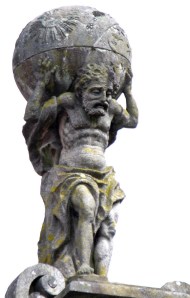
Throughout the twentieth century there have been constant reinterpretations of the Nietzsche’s philosophy. While his sister was the first there have been countless others. One writer that adopts the Nietzschean theme is Ayn Rand in her text ‘Atlas Shrugged’. A novel that through its endorsement of the now dominant philosophy of Neo-Liberal economics has become one of the books that all aspiring politicians claim to have read. This novel demonstrates a worship of the rich and powerful and  a contempt for the poor. However Ayn Rand’s failure as with all the others, was to misunderstand Nietzsche’s will to power, it was not about power. Nietzsche himself expressed doubts later about the naming of this concept. Personally I think it would have been better phrased as the will to aspire, that is the drive to fulfil human potential. 
  

When Nietzsche introduced the concept übermensch (super or over man) he was not so much thinking of übermensch as the superman as a man of extreme  physical strength but the man of superior intellect and sensitivity. His first three candidates for the role of übermensch were the artist, philosopher and Saint. Saint Francis would have been one of an übermensch as Nietzsche originally intended the term to be used. He had the vision to seen the failings of Italian society of the 13th century, he rejected the role of chivalrous knight, which was seen as the highest ideal that could be aspired amongst the rich merchant class of Assisi. He saw not knightly chivalrous’ warfare but murderous warfare between city states. St. Francis had the qualities to make him an übermensch; he had superiority and uniqueness of intellect allied and the courage to go against the norms and conventions of his age. The distancing of time negates the radicalism of St. Francis. His preaching was seen by later Pope’s as a threat to the social order. After his death the Pope had two Franciscan friars burnt, because they had condemned too forcibly the wrong doings of the rich and the powerful. 

Nietzsche later dropped the Saint from his typology  of supermen. 

Twentieth and twenty first century writers tend ignore the influence of the thinking of Classical Greek thinkers on Nietzsche. One such Greek was the philosopher Aristotle, who wondered how can you classify ever changing beings such as man. It was obviously wrong to identify man only through his physical characteristics, as these characteristics kept changing. What was it that identified the child and the man as being the same creature? Aristotle’s answer was that it was ‘Being’, that is what they had the potential to become. The child would evolve into the intelligent thinking being that was the mature man. Nietzsche’s insight was that the potential of each man or woman was different, not all,  in fact only a tiny minority were capable of achieving the full human  potential. He despised the common herd of humanity that lacked the potential to achieve this highest level of being. What he saw was a society in which the rules were written to benefit the average of humanity. The poor specimens that made up the mass of humanity needed rules and regulation, as their independent thinking tended on their towards barbarism and animal like behaviours. Behaviours that needed controlling for the social good. Unfortunately for the fate of humanity these rules and regulations constrained the übermensch to such an extent that they were denied the opportunity to fulfil their potential. It is impossible to calculate the loss of society of this unfulfilled potential. How many Michelangelo’s  had been confined to a life of mediocrity because of the oppressive nature of a society of mediocrities?

Nietzsche hated democracy because it enshrined the rule of the mediocre. Some of his fiercest criticisms were directed at the British, as he saw the triumph of the business orientated bourgeois as the triumph of mediocrity. He wanted a society in which the übermensch would thrive, as what could be a better society than one in which the best of humanity thrive, as opposed to one in which the worst prosper. It was his despair that caused him to make the more extreme statements that he made towards the end of his life, when he was nearing mental and emotional breakdown. He  despaired that the rise of industrial civilisation was embedding in society the rule of the mediocre, that is the industrial bourgeoise. 

German nationalism he despised as there could not be a superior people, only a society in which the superior were allowed to thrive. Übermensch could only be individuals not nations. 

Nietzsche’s left many notes, that is notes made for book written and for those yet to be written. It from these notes that Elizabeth Forster Nietzsche could draft a philosophy of German nationalism. A philosophy of power which misused Nietzsche’s concept the will to power. What she changed it into was something akin to Chamberlain’s social Darwinism, a philosophy of competing racial types. A competition in which the Germanic Aryan racial type was best fitted to win. Other philosophies of power  developed in that century, one of which was that of Ayn Rand. A philosophy of the power of wealth, a philosophy in which wealth became the criterion of human worth, or as she described it a philosophy of rational selfishness. This particular one has become extremely influential in the contemporary world. 

This philosophy is clearly explained in her novel ‘Atlas Shrugged’. This  novel starts in a dystopian society of the future, a society in which business enterprise is oppressed through a series of restrictions imposed on it by a dictatorial government. Restrictions that eventually provoked a businessman’s strike. The billionaire owners of business gradually disappear and without them at the helm of their businesses, these businesses begin to fail. The rich have disappeared, so as to avoid the depredations of the  ‘looters’, these looters are the government and labour unions which extort wealth from the non looters (the rich) through the threat of force. Wealth which is squandered on the undeserving poor. The productive entrepreneurs have had enough and can no longer tolerate the leeching of their wealth by the non productive looters and mooches.  Without the beneficent rich directing their companies chaos results and thousands of the poor die, because they lack the ability to provide for themselves. The death of thousands of these non productive leaches, she sees as a great benefit to human society, as they made no contribution to the well being of society. Eventually these self secluded billionaires return and restore prosperity and freedom to society. Freedom for Rand was the removal of restrictions on the rich powerful wealth creators, restrictions such as labour protection laws, that prevented them introducing the most cost efficient methods of production. A society that would cease its persecution of the rich wealth creators. In Rand’s utopia all are free to use their talents to maximise their individual wealth, nobody had the right to expect the society to support them. If there were poor hungry people it was their own fault, either through lack of effort or ability. There was no reason why the members of society should show any concern about the poor, as in this society all had an equal opportunity to become rich, if some ignored that opportunity it was their fault.

Rand did not create the callous Neo-Liberal society of today, but her philosophy of power is one of the more substantial foundations on which it stands. It would be difficult to argue that she was more influential that Friedrich Hayek and Milton Friedman, but her novels through simplifying the tenets of Neo-Liberalism contributed through popularising this philosophy. Her novels give the best explanation of the thinking behind Neo-Liberal thinking, in which people are valued for their worth as wealth creators. Those such as the poor who make meagre contributions to wealth creating are deserving of society’s contempt.

However the people who she elevates to the status of super men, the billionaires are the mediocre men who Nietzsche despises. They are to borrow Marcuse’s phrase the ultimate ‘one dimensional men’. A  simple historical comparison will demonstrate this. Cosimo de Medici, the man who dominated Florence in the late 14th century, was a wealthy banker which would have qualified him as one of  Ayn Rand’s financial supermen. Yet he was more than just that, he was a patron of the arts and artists he was responsible for funding the completion the dome of Santa Maria del Fiore (the “Duomo”, Florence’s cathedral). He had the foresight and wisdom to support the bankrupt architect Brunelleschi in completing this work. He was the patron of great artists such as Fra Angelico and Donatello and of perhaps patron of the greatest philosopher of his time, Ficino. Cosimo committed a great part of his wealth to public works, the magnificence of contemporary Florence is in part due to him. This contrasts with the selfish rationalists of Rand. These people avoid try to making any contribution to the society in which they live. Britain may be host to record numbers of the super rich, but the majority avoid paying tax. While their lack of tax payments show their unwillingness to contribute to the well being of society, they will also leave nothing behind in the form of public works. Any visitor can tour Florence today and marvel at its architectural splendours, whereas future visitors to London will see little to admire in in various shopping malls and office blocks of today.  If there was a negative  prize for the worse architecture in the world, London would regularly win the prize. The mediocrity of the new ruling class of politicians, financiers etc, is reflected in the mediocre buildings they erect. In biblical terms are a little more than the barbarous temples to mammon, in which worship and wonder are replaced by the act of buying and selling.
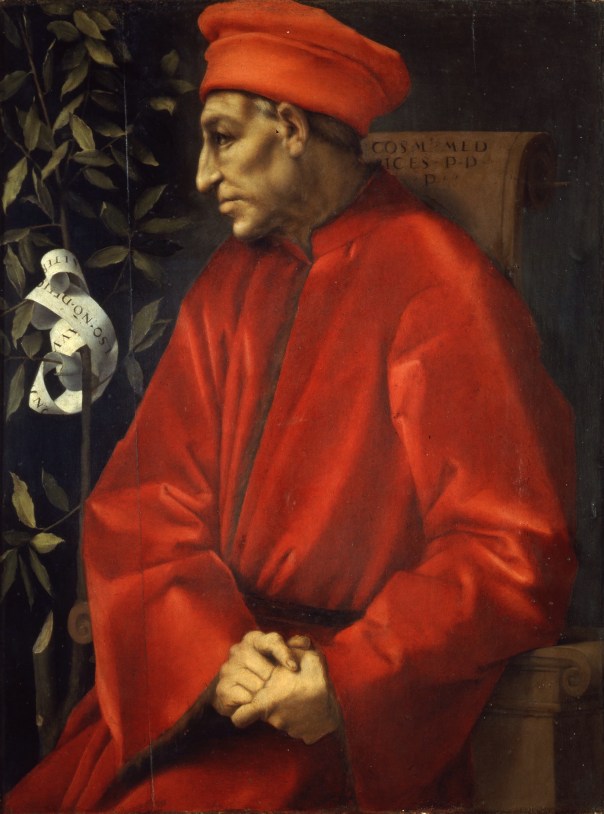
 

Cosimo de Medici, Portrait by Jacopo Pontormo; the laurel branch (il Broncone) was a symbol used also by his heirs [4]

The reason for my selecting Cosimo de Medici is that he is typical of the merchant princes of Renaissance Italy. These men used a large part of their wealth to sponsor public works on their cities, they vied with each other to get the best artists to create the greatest works of art of their cities. Cosimo de Medici is perhaps the type of capitalist that could be classed as one of the übermensch.  Today the super rich celebrate their philistinism. One suspects that Renaissance Italy was the one country that was most hospitable to the übermensch, while in contrast contemporary Britain is one of the least hospitable. 

This inhospitable climate can be demonstrated in the attack on the humanities in the universities. Mediocre men, be they politicians, university vice chancellors or businessmen can only see value in education if it  contributes directly to increasing the national income. When applying (unsuccessfully) to do a theology PhD, I was asked to write how my research would benefit society. Since I proposed to research the esoteric language that was used to speak of God, the I could not. The new type of university Vice Chancellors are all committed to make universities more productive in the business sense and of more direct benefit to the economy. These new university managers see no place for a liberal education as it does not translate in cost effective learning. Why study English literature, when the more cost beneficial course would be to study English as business communication?  Today those that want to study English or a modern language are favoured if it’s linked to business studies. Similarly the old tradition of disinterested research is being discarded in favour of that research that can best be demonstrated to show an economic benefit.  The cull of those cost ineffective departments has speeded up with the new coalition government of millionaires. A wrecking ball has been used on British universities in the expectation that from out of the rubble a profitable business enterprise is to be built. 

In the 1930’s great European philosophers came to teach in British universities, philosophers such as Isiah Berlin, Karl Popper, Ernst Gellner and Ludwig Wittgenstein. Either because they were freeing a regime that threatened their liberty and/or British universities with their tradition of disinterested research were congenial places to study.  Now such philosophers would merely use Britain as a transit point on their way to the more welcoming universities of the USA. 

Why I criticise Ayn Rand is not because she helped make Neo-Liberalism possible,  but because her doctrine of rational selfishness elevated selfishness into a virtue. The tax dodging businessman is no longer an immoral individual avoiding his social obligations, he is instead a moral non looter. They are acting morally in that they don’t want to see their hard earned income frittered away on poor ne’er do wells.  By elevating a particular kind of narrow mindedness (one that sees wealth accumulation as the only good), she has given sanction to the rule of mediocrity. A Cosimo de Medici would be regarded with horror by his billionaire contemporaries of today, all they would see is a billionaire frittering away a large part of his wealth on goods that produced no cash return. Perhaps it is in art that the clearest example is shown of the rule of mediocrity, Renaissance Florence produced  Michelangelo’s David, while contemporary Britain has produced Tracey Emin’s unmade bed.  

Rather  than initiating a new era of freedom as its proponents expected, the free market revolution has led to the rise of the new mediocrity, the rule of the untermensch (under man). Untermensch not as used by the Nazi’s to denote subhuman’s but men of dullness of mind, men self satisfied lacking any greater vision. Men and women with a preference for things as they were, wanting a return to an imaginary world of social peace, one unthreatened by change.  It is these men and women that dominate Britain, a Britain where thinking the same as the right people is the most admired trait. As demonstrated in Parliament where all the senior ‘responsible’ leaders all share the same view of Britain. They can see no alternative to austerity, anybody that suggests otherwise is subject to abuse, as witnessed by the demonising of Syriza. Syriza with its threats to end austerity in Greece is a threat to the agreed political consensus, where the fear is not the Syriza will fail, but that it will succeed. Therefore by continuing to insist on the inhumane policies that have impoverished Greece, they make it unlikely to happen. These scared people exclude from power the übermensch as they would threaten their position through change. Wherever you look in Britain the upper layer  of any institution, whether it be in parliament, finance or the universities, they are dominated by the untermensch. Mediocrities  of unbearable dullness who work collectively to ensure that the exciting, the new and the challenging ideas and people remain marginalised. Hayek thought that the social democracies of the 1950’s were drifting into a new serfdom, what he did not foresee was that his alternative society would be one by a ruled by a new class, the untermensch, the ultimate of one dimensional men. 

Notes 

Friedrich Hayek – the author of ‘The Road to Serfdom’ – one of the leasing advocates of what is termed Neo-Liberalism

Milton Friedman – the leading proponent of Chicago school  of Free Market Economics

Human Sacrifice the oldest of economic policies

Economists seem to have a historical blindness in that what happened in the past has no relevance today. Unlike contemporary economists I see a continuity in economic policy making that stretches back from now to the earliest civilisations. One such policy is the practice of human sacrifice,that is the practice of sacrificing certain individuals to appease the Gods. 


One early civilisation that practised human sacrifice was the Mayans. I mention the Mayans, because they practised a peculiar ball game in which the losing side where sacrificed to the Gods. They were in fear of the Gods that controlled nature, in particular the great God Itzamn. If these great Gods were satisfied with the sacrifice, the Mayan cities would be spared earthquake and other natural catastrophe’s that threatened these cities. In times of great peril the angry Gods would require even greater sacrifices. The remnants of Mayan cities are graveyards containing the remains of the hundreds of people sacrificed in the vain attempt to prevent impending catastrophe.

The nature of human sacrifice has changed in our more civilised society, it is not human life that is sacrificed but the hopes of the people, usually the young. While the Mayan invented cruel Gods to explain the threats that the Central American climate and geology posed to the people, economists and politicians have invented a God called the market to explain the seemingly random catastrophes that market failure inflicts on the people. Instead of killing their young people in barbarous rituals, they appease the market God by making a sacrifice of hopes the young have for the future. A sacrifice made through the ritual of austerity. In a Southern Europe young unemployment amongst the young has reached 40% in Greece and it’s even 20% in the UK, one of the so called success stories. Generation Y is expected to accept willingly a lifetime of poverty so as to pay for the follies of their betters and elders. 

One perceptive American IT zillionaire has warned his fellow American super rich that they risk the people coming after them with pitch forks. Probably the best phrase to describe the febrile situation in both the USA and Europe. 

There is one common theme that underlies the practice of human sacrifice. In both examples an elite group has invented a malign God to explain their failure to control the environment to the benefit of the people. The only policy that can offer is one of human sacrifice to appease the angry Gods. Both groups offer the same storyline to justify the policy of human sacrifice, that is the people have angered the Gods and must pay the ultimate price of human sacrifice. In contemporary Europe and the USA it is the feckless borrowing of the people that has angered the God of the market. Only by giving up part of their income and rendering themselves poor can the angry market God be appeased. If their sacrifice pleases the market God, prosperity will return to the people. Not really very different from the Mayan practice.

What the ruling caste of priests and the ruling caste of economists, financiers and politicians have in common, is an ignorance of the causes of the misfortune affecting their people. Priests and politicians both create seemingly plausible stories to explain the misfortune visited on the people, stories which conceal their ignorance. From the perspective of time it is easy to see the folly of the Mayan priesthood in ascribing natural events to the activities of supernatural beings. It is humbling to realise that the great combined caste of politicians, financiers and economists have little more understanding of the events of 2008/9 that caused and perpetuate the crisis of that date. Can anybody really believe that any of the current generation of policy makers have any idea of how to end the current crisis. The only criteria they have for judging the effectiveness of a policy is the scale of human suffering, the more pain caused the better the policy.

Scroogism the principle at the heart of the New Economics


Washington University Political Review

Scroogism is key principle at the heart of the new economics, that is economics as practised since the 1980’s. This can be explained by reference to the opening pages of Charles Dicken’s novel Scrooge. When he arrives home from the office, Scrooge gets an unwelcome visit from two of men collecting money for distribution to the poor at Christmas. His famous answer is, are there no longer any workhouse or prisons in which the poor  can be housed and fed. The assumption at the heart this tirade is that money should go to to those who deserve it most and who will make the best use of it. Men such as Scrooge a banker and trader who will invest it wisely to create more wealth. Any money going to the feckless poor is wasted, as in their folly they will only squander it. A philosophy best expounded by the politician who said installing bathrooms in the houses of the poor was the height of folly, as they would only use their baths to store coal. 

The belief that money is best kept in the hands of the deserving rich and out of the hands of the undeserving poor, is one of the core beliefs of the new Neo-Liberal economists. If money is in the hands of the entrepreneurs of society, ‘the great movers and shakers’ society will benefit from the activities of these people which creates more wealth for society to enjoy. Fairness is redefined, the majority of wealth created in society should goes to those that deserve it most, that is the wealth creators. The poor are poor because they create little in the form of wealth, their poverty level wages are fair recompense for their lack of effort and skill. The beggar who so inconveniences the theatre goer by asking for money at the entrance to the theatre is there because he deserves to be there, it’s his own fault.

Whenever their is any debate about welfare or the plight of the poor in Parliament Scroogism is seen at its most active. When parliament ever approves giving money to the less well off its only ever given on the most niggardly of terms, the unspoken assumption is that he poor are poor because of their own failings. Benefit caps are imposed or penalties are imposed on the most of undeserving of the poor. Parliamentarians are loath to throw good money after the bad, that is giving it to the poor, whereas they are over generous in giving tax breaks, subsidies and grants to the deserving  rich. Some of the richest landowners in the country receive hundreds of thousands of pounds from the tax payer in agricultural subsidies. 

Scroogism is the hypocrisy of the well-off, it’s provides a moral justification for ignoring the needs of the less well off.   This hypocrisy is best demonstrated in the debate on social mobility. Rather than give money to the poor, they will be given ever opportunity to better themselves, that is become one of the better off. In what can only be described as cover for the inherent meanness and nastiness of the prevailing philosophy of Neo-Liberalism, the poor are to be helped to become one of the well off. A good education is seen as the best means of achieving this, consequently there is in education a ‘constant revolution’ in teaching methods and practise. While  this ‘constant revolution’ has achieved little in practice, it gives politicians the sense of moral superiority in that they are doing their best to help their inferiors. If the recidivists among the lower orders reject there help its nobody’s fault but there own. 

There is one fact ignored by the politicians who preach the virtues of social mobility, if people are to move up the social scale this can only be made possible is some move down. Whether well off parliamentarians and the class of well to do, recognise this fact either unconsciously or consciously, they do their best to prevent anydownward movement as this would harm them and their families. In Britain the barriers of  social exclusiveness give it one of the lowest rates of social mobility in the developed world. Education provision is strictly rationed according to income. The quality of education varies according to the income of the pupils, an apartheid of wealth applies. In the wealthy suburbs pupils receive an education that is beyond the dreams of those living within the impoverished areas of our cities. Given that the children of politicians are educated in the wealthy suburbs, it is going against human nature to expect them to sacrifice the advantages that their children enjoy to benefit the poor. 

The only effective way of increasing social mobility for the poor is to increase their income. If a family has sufficient income they will keep their children in school to enable them to gain a higher education. Wealth is a qualification for citizenship, the individual on a low income, who perhaps has two jobs, who suffers from insecurity of employment and tenure, will lack the time and confidence to participate fully as a citizen. They know that their social situation excludes them from full citizenship.   A confident well resourced class of the less well off would exert pressure on the socially exclusive social system to provide ‘real’ opportunities for their children to join the social elite.  What is needed is a political and social revolution similar to that which developed forbtge organised working classes of the nineteenth century.

Knowing the Correct Nothing is the surest way of advancing in economics and politics

Probably it has been remarked elsewhere that ignorance is no barrier to advancement. This is certainly true of the economics. Despite the subject matter of economics being the stuff of existence, economists have little knowledge of the real economy. There are two explanations of this ignorance.

One is the age old bane of economics and that is economists of previous generations have already established all the fundamental truths of the subject and all the current generation of economists need to do is to refine the ideas and practices of the past. They are literally standing on the shoulders of the giants of the past, giants such as Ricardo and Marshall.  Economists established in the nineteenth century that the truth that the free market was the best possible economic system and their contemporaries today see their role as providing the necessary information and advice to enable policy makers to make the imperfect market nearer to the free market ideal. They do not see any need develop and advance the study of economics through a study of the real economy, as they already know all they need to know. The fallacy of this approach can be demonstrated by the famous question the Queen asked of economists after the crash of 2008/9, which was why did none of you know it was coming? The inward looking nature of the subject means they will always be caught by surprise by events in the real world.

The other explanation is that the practitioners of economics in the real world are politicians and all they want is winning slogans that will enable the to win elections. Slogans that mask the truth, that is the very vacuous nature of their economic policy making. Rather than truth what matters is appearance, what sounds right or appears right. These politicians have no interest in those few economists that talk about the complex nature of the economy and the difficulty of effective policy making. They prefer the economist that in Mrs Thatcher’s words ‘give answers’, and these economists tend to be the apostles of a simplistic Neo-Liberal economics. There are dozens of economic thinks tank that for the right money will come up with a simplistic solution, that can be sold as a winning economic policy.

One of such of these simple sellable solutions is the need to cut of government bureaucracy. In this vein both the Labour government of Gordon Brown and the coalition government of David Cameron have boasted about the number of civil servants they have cut from the payroll. It’s a simple solution that everybody knows is right, as if you employ less civil servants you reduce the cost of employing civil servants and you reduce taxation. In such a scenario everybody is a winner, except no politician have ever considered that some of these civil servants they dispense with may perform a service that is essential for the maintenance of the good society. 

Now with the Treasury and every other government department are lacking the core of experienced civil servants that in the past would have advised on policy making. Now they have to buy in the expertise that would formally been provided in house. The bill for consultation on the proposed High Speed Rail link has cost £1/4 billion pounds and is rising, much of this money has been spend on outside advisers from various think tanks and consultancies. One wonders how much less the bill would have been,  if much of this work had been provided in house. 

Perhaps the supreme example of this folly is the reducing the number civil servants is at the tax collecting body that is ‘Her Majesties Revenue and Customs’.  There are only 300 tax inspectors employed in the investigative body that collects taxes from the rich and powerful. Constantly these overworked and under resourced tax inspectors are out manoeuvred by the accountants of the rich and powerful so they frequently fail to collect the tax owed.  In consequence the IMF has laBelled Britain the world’s largest tax haven.

In practical economics that is politics what matters is not being right or having tge correct understanding economic reality, but a sharing the common fallacy and ignorance of the real economy that passes as the public debate. If one listens to the economic spokesman of either party they in the essentials relaying the same message. It never matters in politics if the economics spokesman is wrong, only that they share in the general consensus of wrongness.    

Why is the politics of our country so focused on headline grabbing? Is politics any longer an activity for grown ups?

Recently a prominent member of the opposition complained about the behaviour of the back bench MP’s of the governing party. She said that their behaviour was that of a group of three year olds. What she was referring to was the infantile sexual gestures made by these men whenever a woman spoke. This seems to be symptomatic of a change in the behaviour in the commons, the practice of politics does seem to have become more infantile. What makes this more surprising is that this change has occurred when we have the most educated parliament in our history. There are more graduates with good degrees from good universities in our parliament than ever before.  What I will argue is that politicians have since the 1980’s increasing  adopted a self denying ordinance which prohibits them from engaging in what most would consider politics. Instead too much political debate is devoted to trivia. Possibly the best example of the new politics comes from the USA, where Congress under pressure from the food industry decreed that the tomato topping on pizzas would count one of the five day fruits  or vegetables needed for a healthy diet. The fact that this decision was meaningless in terms of improving the health of nation mattered little to Congress.

This self denying ordinance which effectively prevents politicians from decision taking dates back to the 1980’s and the revolution in political thinking that was Neo-Liberalism. Prior to that time the management of the economy was considered part of the practice of government, now it was to be considered as something alien to the art of good government. As the former practices of economic management appeared to have brought the economy to its knees.  The economy was to best left unregulated, as government intervention no matter how well intentioned only had a negative impact on human welfare. This ‘avoidance of doing’ became so ingrained that the policy of doing nothing began to be applied to other parts of government. Politicians of both the right and left developed a phobia about the nanny state. 


http://www.mitchell the taxman

One of the best examples of the fallacious nature of the current political debate is that on alcohol consumption. In 1914 strict licensing laws were introduced to limit the hours in which licensed premise could sell alcohol as it was feared that the excessive consumption of alcohol was a threat to the war effort. These strict limits on the sale of alcohol were largely kept in place until 2003 when most restrictions of the sale of alcohol were removed. Now alcohol could be served 24/7 and it was argued that this would lead to the adoption of the ‘civilised drinking practices’ of the Europeans. It would lead to the introduction of the European cafe culture. Instead it led to introduction of the vertical drinking establishment in which the number of table and chairs were reduced , which enabled the pub/bar to cram in as many drinkers as possible. These pubs can be compared to the assembly line, the process of serving alcohol was simplified down to its minimal elements so as to speed up the sale of alcohol. The consequence was a massive increase in the consumption of alcohol with all its attendant social and health problems. 

There is one simple example that illustrates this change in social behaviours towards the more negative. In the 1950’s being drunk and disorderly was a criminal offence, now such disorderly behaviour has become normalised and being instanced by a as a senior officer in London’s police force said they no longer considered the stopping of such behaviour part of their role. Was this officer merely recognising the inevitable in that alcohol based disorder has become so common a behaviour that the the police can no longer control it? 

The reason I have highlighted the alcohol issue is because it’s a useful illustrative of the fallacious nature of so much political debate. I saw a late night TV programme in which politicians were debating the merits of raising the price of alcohol to reduce its consumption. All of the politicians on the panel agreed that it would be wrong, because it would penalise the less well-off sensible drinker. They argued vehemently that these sensible drinkers would be unable to afford their usual tipple. My reaction is the one my was wife has when interviewing parents about their misbehaving children hi say that they don’t want to upset their child by stopping them from doing what they want, event if it’s wrong bad and that is – who is the adult here? When the price of alcohol is increased,  it will mean that the less well off will be able to buy so much alcohol, but that is the purpose of the legislation. 

What characterises the political debate debate on this issue is the avoidance of any action to reduce alcohol abuse. Politicians debar themselves from any action that would limit alcohol consumption, such as increasing the price of alcohol by increasing taxes on it, reducing the number of places that are licensed to sell alcohol or limiting the hours for which those premises can sell alcohol. These politicians through believing any regulation of the free market is misguided have in effect prevented themselves from effectively intervening in the alcohol market. Their role is reduced to one in talking about alcohol they have no other role. 

The political dialogue about alcohol consumption demonstrates how out sourcing decision making to others removes any meaningful role the for politicians in so many areas of society.Their self denying ordinance not to interfere means they are reduced to talking  about the problems that affect society, while playing down the ineffectiveness of their role. This is why they command of the media is so vital to them, media noise will hide their ineffectiveness and insignificance.

Why have politicians given up on the exercise of power

Today’s politics cannot be explained without reference to the traumas of the 1970’s, when economic crisis threatened the stability of Western society.  It came to a head in Britain in 1976 when the government was forced to ask for a record loan of £2.3 billion from the International Monetary Fund (IMF) to avert national.bankruptcy. The IMF saw the problem Britain faced as a fundamental structural dysfunction. The political and economic institutions of Britain were not fit for purpose.  They insisted as a start of the necessary reforms that the government cut its spending programmes. Cuts in government spending would mean the transfer of investment from unproductive government programmes to productive private sector businesses. 

Neo-Liberals the over mighty state, caused the crisis as it had expanded far beyond its area of competence. Industry was shackled by regulation and suffered from too much political interference. What was required was what is now termed as supply side reforms. The labour and financial markets were to be freed of regulation which would create an economy flexible enough to respond to economic change. If for instance the government put money into a failing business such as British Leyland, it was investing in a business in which the returns were minimal and by keeping those workers on in a failing business it was preventing them from moving into a more productive business, so holding back economic growth. 

This new political philosophy not only demanded that government should get off the backs of business, but that it should get out of those parts of the economy and society, where it would be better managed by business. This meant  the wholesale privatisation of the nationalised industries and the outsourcing of many government services to the private sector. What was a crisis of political confidence meant that politicians were now willing to abdicate much of their powers of decision making to others. These others are referred to collectively as the free market. 

One consequence is that decisions that would have been taken in parliament are now taken by ministers in negotiation with outside contractors. Prisons and probation services are now the responsibility of various private contractors, not something that is considered to be within the remit of MP’s. Politicians have constantly acquiesced in the diminution of their authority. The Department of  Trade and Industry once one of the mightiest of departments is now a departmental backwater serving only to facilitate the requests of various business corporations. 

Given that parliament has diminished itself and become only a peripheral player in society, politicians will constantly over compensate for their insignificance by shouting as loudly as they can to draw attention to themselves. This means that they must constantly attract the media with new policy statements (of little real purpose) to demonstrate that, yes they still do matter. 

Coda 

There is an alternative reading of the history of the 1970’s which suggests that the problems of Western Democracies were not a product of structural dysfunction, but events unrelated to structural dysfunction.  One such event was the attitude of Jimmy Carter’s government in Washington towards the Labour government in London. They were concerned about there being a socialist government in London, which could act contrary to American interests. Great Britain with its command of the North Western European sea ways off Europe was a key strategic asset for the Americans. London was also home to the largest CIA station outside the USA. They wanted a friend in London, which could not be a socialist government.   When the financial crisis occurred in 1976 they saw it as an opportunity to destabilise this government. When the London government asked for American financial support they refused and discretely encouraged the financial speculation that threatened to undermine the British economy. This worsened the financial crisis forcing the London government to ask for an IMF loan, which came at a heavy price. The price was the acceptance of the free market ideology of the Neo-Liberals and an end to any possible policies of state socialism. 

There are other events, but to discuss them would needlessly lengthen the essay to no purpose and would not alter the conclusion of my essay, that the immaturity of the current political debate is in a large part due to the loss of confidence within the political classes. Politicians need to find a new sense of purpose, possibly hope can come from the margins, with parties such as the Greens with their plans for a renewal of British society. 

What economists will never tell you and what politicians prefer not to know

Gordon Brown when  Chancellor of the Exchequer was responsible for the infamous quote, ‘No return to boom and bust’ and then when the economy went bust in 2008 he had to retract his words. There was even the Stalinist rewriting of history when all references to this quote were removed from the Treasury website. Possibly Gordon Brown is amongst the cleverest of  the Chancellors of the Exchequer that we have had this century, yet he got it all so wrong. 

What his Treasury advisors should have told him was that the trade cycle is an unavoidable feature of capitalist economies and that all politicians can do is ameliorate its worst effects. There are invariably periods of boom followed by bust. A quick glance at history would have shown Gordon Brown the truth of this. In 1990 there was the collapse of the property boom, which bankrupted many property companies and in 1999 there was the collapse of the dot.com bubble. The latter bankrupted GEC which at the time was Britain’s largest electrical engineering company. A bankruptcy caused by paying too much to purchase a series of over valued software businesses. It does seem that with the bust of 2008, these financial crisis’s seem to occur every nine years. Unfortunately the current Chancellor of the Exchequer seems to be demonstrating a similar naivety to his predecssor about the economy. He claims to have put the economy on a sound footing and his preventative measures will prevent a repeat of the crisis of 2008/9. If history repeats itself there will be a financial crisis in 2017, something of which he appears oblivious. 

Why is there this constant misreading of history? One reason is the arrogance of both economists and politicians. Economists having discovered in the free market the equivalent of the economists  philosopher’s stone cannot believe that there are times when the market will fail. If the free market is the best possible of organising economic activity and can’t be bettered, it is foolish to look for non-existent flaws. Any economic crisis is not caused by any dysfunction in the market it is the politicians who fail to implement policy correctly, it’s human not market failure. There are  economists who claim that the financial crash of 2008/9 was not due their lack of regulation in the financial markets failing to rein in  the irresponsible banks but through there being too much regulation of the banking industry. Although economic reality intrudes all too often when the economy takes a down turn, economists prefer to ignore this inconvenient fact.


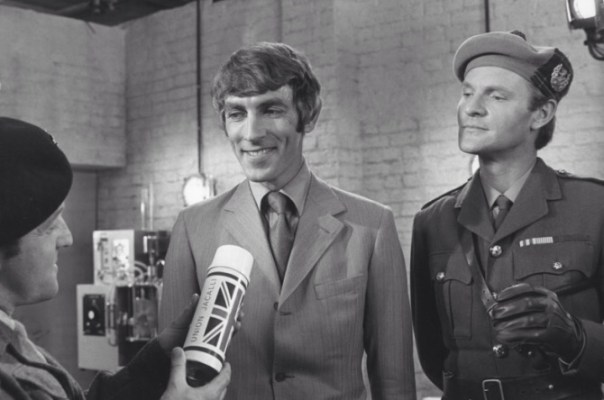
Peter Cook in a scene from the film ‘The Rise and Rise of Michael Rimmer’

Economics should not shoulder all the blame for the belief in what can only be best described as a preference for the economics of fairy land. The message has to be doctored to meet the demands of the economist’s political masters. Economists must be on the message politicians only want good news.

The new politics can be best explained by reference to a Peter Cook film, ‘The Rise and Rise of Michael Rimmer’. In this film Michael Rimmer on becoming PM cuts the defence budget to finance a tax give away. When faced with the disgruntled generals he shows them a film of the marvellous new weapons that he has purchased for the military. The generals immediately praise him for his policies, even when he tells them that the weapons they have seen featured on a film don’t really exist. What matters is what appears to be, given the guarantee of their jobs and incomes the generals are only to happy to acquiesce in the disarming of Britain. All party leaders now have their coterie of ‘spin doctors’, whose job is to make bad appear good. Politics is increasingly coming to resemble the public relations industry and as a consequence policies are never subject to proper scrutiny, as any policy debate within a political party is increasingly seen as an example of disunity. It is one of the many assumed truths that voters don’t like political parties that appear disunited, so politicians will do all they can to avoid appearing disunited, so any of story will do as long as all party members stay on message. 

Not only is this a society in which appearances matter more than the truth, it’s also a society that prefers to avoid unpleasant truths. The economist or politician that disrupted the pleasant complacency by voicing inconvenient truths is vilified and silenced. When Alistair Darling (Chancellor of the Exchequer) in 2007 spoke of an impending financial crisis he found that he was a lone voice speaking the truth. There was no politician or economist who spoke in support of him. Some politicians and economists would have known he spoke the truth, yet all preferred the  pretence of the ’emperor’s new clothes’, that is were willing to keep up the pretence that all was well. Not even opposition politicians spoke in his defence, as they did not to be seen to be going against the preferred wisdom of the times.

What I am saying is that as economists and politicians have abolished the trade cycle, at least in their imaginations, any economic downturn will be the unexpected event that catchesus all by surprise. It should not have happened, it came out of nowhere, was the reaction to the crash of 2008/9.,Famously the Queen asked why no economist correctly predicted the crash. She failed to get any meaningful reply from the collectivity of academic economists, as any truthful response would have meant admitting that all their theorising and policy recommendations were wrong. 

“Untergang der Titanic”, conception by Willy Stöwer, 1912

Can I put it in terms of the Titanic metaphor, would the passengers of that ship wanted to know that it would shortly strike an iceberg, which would cause the ship to sink and most of them to drown? No they would have preferred ignorance, so as to enjoy the last moments of their life without it being spoilt by a knowledge of their impending doom. However what they would have wanted was the captain and crew to have prepared adequate means of evacuating the ship in the case of it sinking, so as the minimise the loss of human life. Economists by ignoring the existence of icebergs (economic downturns) fail to prepare adequately for them and fail minimise their negative effects on society. 


Evil always comes with a smile on its face

When you write it is because there are certain ideas and thoughts that obsess you and you find that all to often you are reworking familiar themes, no matter what the subject matter of the essay. In my case it is the learning of the past, I cannot dismiss the writings of the Christian fathers or the medieval Islamic philosophers as being rooted in the past and as having no relevance to today. What could be more relevant in the age of Isis, than St. Augustine’s thoughts on the nature of evil. He offers a far better explanation of the actions of Abu Bakr Al-Baghdadi and his followers than any contemporary analyst. Not only that but the hateful ideology of Isis and the Salafist strand of Islam which it encapsulates, obscures the wisdom and learning of the medieval Islamic scholars. What has been forgotten is the debt that medieval Christianity owes to the great Sufi scholars of Spain, who had preserved the teachings of the classical and Hellenistic philosophers in their writings. Without their knowledge medieval Christianity would have been much the intellectually poorer. Yet Islam is now seen as a religion of cruelty and barbarism, a religion of the stoning of adulterers. What has been lost is the compassionate and sophisticated religion of the Sufi’s of Islam. Could anybody today know that the great Sufi thinkers saw Christianity and Islam as two different approaches to one the true religion, religious brothers in arms not enemies?

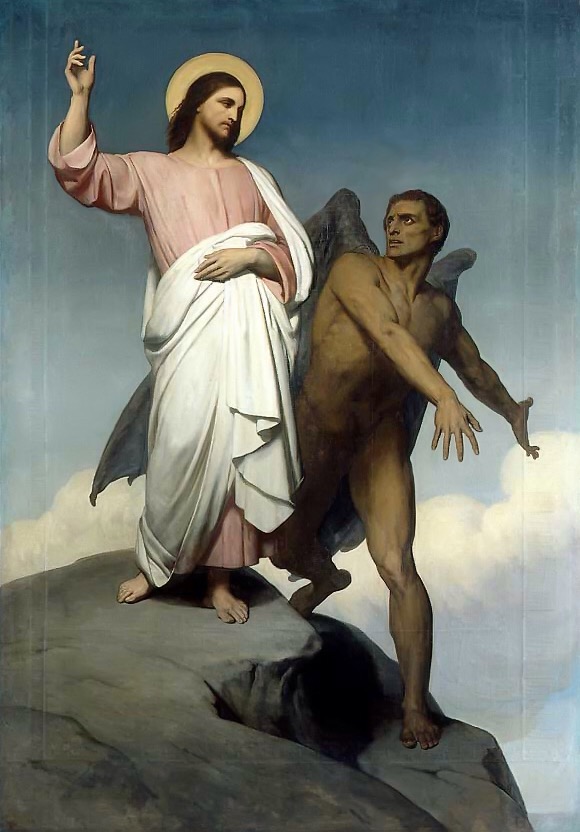
The Temptation of Christ
Ary Scheffer, 1854
The Devil depicted in the Temptation of Christ, by Ary Scheffer, 1854.

One such lost wisdom is the understanding of evil, an understanding that evil all pervasive and constantly needed to be countered. St. Augustine’s conception of evil as ignorance or not knowing God is easily misunderstood today. Obviously the members of Isis know God but still commit horrible atrocities. What they claim is that they are the true followers of God, who are opposed to kafirs or those individuals who do not know God and are therefore not worthy of humane treatment. However knowing God is not knowing as its usually understood, it’s far more than a knowledge of the correct religious tracts. It’s a knowing that is beyond words and cannot be explained in the words of the everyday language of the world of human experience. A knowledge and understanding the religious texts is just the first stage towards knowing God. Knowing God is a transforming life experience, knowing God means accepting a life changing experience through religious enlightenment. Perhaps it can be described as an engagement with God, an emotional commitment or living a life informed by God. However one tries, words remain inadequate for explaining the experience of knowing God. As Plato writes once a person knows good (God) they never want to know anything else, it is a sufficient principle for life. The sufi’s explain knowing God as moving beyond religious ritual and practice to a higher level of understanding, an understanding that can only be achieved with the guidance of a teacher. One Christian text that explains this level of knowing, is medieval Christian classic ‘The Cloud of Unknowing’, in which the author describes the various clouds of misunderstanding and misapprehension that obscure a knowledge of God.

What I am arguing for is a Christian sensibility to be part of the mainstream of human thinking. A perception of the world that is infused with the language of morality, but the sophisticated moral practice of the past. The Christian Fathers such as St.Anthony, Athanasius and Augustine spent a life time trying to understand what it meant to lead a good life. Unfortunately the language in which they write makes them seem alien to today’s readers. The sin about which they write should be understood as human fallibility or weaknesses, a weakness which makes a person liable to commit act badly. It takes a determined act of the will to act well. Christian belief and practice gave them the strength to overcome their very human fallibilities and act well. This lifetime of study and prayer gave them an intuitive knowledge of the good, but they were never so naive that they did not realise that they had to constantly revise their thinking in terms of what they understood to be the good, as they were constantly beset by human weakness that plague us all. Augustine while being a caring father to the people of Carthage who looked after their welfare, could also,support the cruel persecution of heretics. However they had a better grasp of human psychology then today’s generation of leaders and how to better overcome its flaws.

The Christian sensibility of Augustine is founded on a very different psychology to that of today. He sees the human personality divided between two opposing drives. There is the sensory or appetitive drive that tends to the indulgence of selfish interests. Then the soul which is the self reflective drive that directs the individual towards a higher level of behaviour be it spiritual or philosophic. These two parts of the personality are tendencies within the human personality and not a literal description of that personality. Accepting Augustine’s theory of human personality does not mean rejecting later theories of personality, it’s just a different perspective on human behaviour.

Walter Benjamin offers a different approach to the past. He writes that the past is that part of the past that lives within contemporary culture. Europe for centuries embodied this past in the form of Christian culture living within the mainstream of society. Christianity and with it the learning of the past has been now been expelled from the main stream of contemporary culture. The fundamentalist Christianity of the American mainstream or the Wahhabism Islam is a contemporary creation. It is the crude reimagining of a golden religious past, it is religion in monotone, it excludes the kaleidoscope of understanding that is real religion. Whether a state is secular as with contemporary Britain or religious in practice as with the USA or Saudi Arabia, all are bereft of the learning of the past.

In Saudi Arabia and Western Europe and the USA, what is happening iis the removal of all traces of the past learning from contemporary culture. In Saudi Arabia it takes the form of the physical destruction of the buildings of the old Islam. Their presence is regarded as a temptation to heresy, Muslims who identify Islam with particular holy sites, are behaving like the pagans who identified their temples as the dwelling place of God, confusing idols and icons with God. In Western capitalist countries the destruction of the thinking of the past, is through the teaching of post modernism which teaches that a philosophy or belief system are only valid for a particular time and place. There can be no universally valid belief systems, and those of the past should have no claim to validity in contemporary Britain. Britain is a post ideological society, a society that believes in nothing or perhaps whatever is considered right at a particular moment. There is no great inclusive vision such as the Christian belief system of previous generations, a belief that gave politicians an vision of what makes a good society.

IMG_0427

Philip Jacques de Loutherbourg:Battle Between Richard I Lionheart 1157-99 and Saladin 1137

This is not to deny that in the Christian past there were not leaders who committed horrendous atrocities in the name of God. Richard the Lionheart slaughtering thousands of Arabs when he captured the Acre. There was the lesser known Arnaud Amaury, Abbot of Cîteaux the leader of the Albigensian crusade who went his forces captured the city of Béziers ordered the killing of all the inhabitant with the immortal phrase “Kill them all. God will know his own”. About 20,000 were slaughtered in this brutal massacre. Yet throughout this period there was a moral counterweight opposed to the brutality of the medieval knight. Churchmen tried to civilise the barbaric knighthood by trying to persuade them to accept the code of chivalry, which insisted that the victorious Knights treated the defeated with compassion. One of the great stories of the Middle Ages, that of the Holy Grail, was an attack on brutal ways of the medieval knight. The greatest knight of Christendom (Lancelot) is denied any vision of the Holy Grail because of his sins, which included adultery. Only three Knights who are pure in spirit get to see the Holy Grail and unlike the Knights of the Round Table they accept martyrdom at the hands of a Saracen king. Any other of the knightly heroes would have fought there way out of such situations with the slaughter of hundreds or thousands of their enemies. There were always great churchmen and women such as Saint Francis or Hildegard of Bingen who lived lives that were a constant criticism of the knightly ideal.

With the relegation of Christianity and ideologies such as socialism to the history books, there is no longer this moral counter weight to the self seeking actions of the political and financial elites. Some of the most brutal of the medieval leaders accepted the Christian critique of their actions and endowed the churches with money to build great cathedrals, or money to relive the suffering of the poor. Unlike today when only monuments the great and good will leave behind are shopping malls and offices blocks. The super rich of today no longer have to contend with the criticisms of a thriving moral counterweight in the community. Instead contemporary culture lauds them as the heroes of the age, they are the ‘movers and shakers of society’. A view expressed at its most extreme by Ayn Rand (Atlas Unchained) a book in which the heroes of our age are the billionaires and the poor are nothing but the dregs of humanity, worthless beings who must die their thousands to relive society of the burden of providing for such worthless beings. This book despite its inhumanity is a book popular with with people of this new uncaring world.

Perhaps this problem is best expressed in the words of Hannah Arendt in her book on the trial of Adolf Eichmann, when she writes of the ‘banality of evil’. What astounded her was the very ordinariness of this monster who had been responsible for the gassing of millions of Jews during the holocaust. Evil did not give him any distinguishing features, there was no hint of evil in this appearance of this very ordinary looking man. Even his speech was undistinguished,he was unable to give more than a matter of fact account of his activities. If this was the Nazi superman, he was indistinguishable from the ordinary clerk, the myth of the superman was merely that, a propaganda exercise. Judging by Eichmann evil is extraordinarily average, evil comes with a smile on its face and with a modest demeanour. Eichmann could easily be a member of the British Parliament, he is indistinguishable in appearance and demeanour from the average British MP. He has no understanding of morality that went beyond being kind to his family and friends, which is also characteristic of the majority of our politicians. Having no concept of evil politicians are extremely poor judges of what is wrong. They are products of the Neo-Liberal society of the 1980’s that declared that there is no such thing as society. In a society of individuals there can be no public morality, there can only be the morality of friends. It’s a society in which tax avoidance and evasion becomes elevated to a moral good. Through avoiding tax, the family income and assets are maximised for the benefit of its members and its contributions to that meaningless abstract, society are minimised. What is lacking from the public and political debate is common moral belief against which the actions of the great and good can be measured. Perhaps which could be best achieved by reintroducing the sophisticated Christianity of Augustine into the mainstream belief system.

Britain’s policy towards its ageing population, an example of the inhumanity of current economic practice.

IMG_0423

Cassandra by Evelyn De Morgan (1898, London); Cassandra in front of the burning city of Troy at the peak of her insanity.

Being an economist you are given an insight to society’s social and economic problems denied to others. There are times when like Cassandra you regret that insight, as apart from feeling anger there is nothing that you can do to prevent the disasters you foresee happening. Cassandra could not prevent the fall of Troy and alternative economists such as myself are powerless and are unable to change the foolish or cruel economic policies of governments.

One of the problems obsessing the current generation of politicians is how to afford the pensions and care demanded by an ever growing number of elderly people. Given the predominance of Neo-Liberal thinking, the only option considered is how to reduce the cost of incomes and care of the elderly. What is never considered is how to enable the elderly to maintain a reasonable standard of living and to enjoy a reasonable level of care when they become physically frail. As a consequence, the current generation of politicians have decide to reduce the cost of pensions by increasing by stages the age at which state pensions will be paid until it reaches the age of 70. They are at the same time freeing employers from their obligations towards their employees, which includes paying a pension. Only one option occurs to this current generation of politicians, which is to reintroduce poverty as a necessary accompaniment to old age.

Increasing the pensionable age to 70 is promoted as a positive change as most people will live to an increasingly old age and their years enjoying a pension will remain unchanged. However this ignores the problems of old age; while medical,advances have extended the life span, what they have not done is abolish physical frailty. Given the arduous physical nature of much work there are many occupations in which work is not practicable beyond a certain age. In the building trade it has been the custom that once a worker through ageing becomes to infirm to work as a bricklayer or labourer, they are given the job of tea boy. There are only a limited number of such tea boy type jobs available. No politician has considered the cost of transferring the burden of income from pensions to welfare payments. Although to be fair to the government welfare payments are considerably lower than pensions and are discretionary, so their is plenty of scope to refuse or reduce payments to reduce the cost of the elderly.

When Bismarck the German Chancellor was faced with the demand for pensions from the veterans of the 1870 Franco-Prussian war, he asked at what age do the veterans die? When he was told 65, he said that will be the age at which pensions will be paid. Similarly when in the 1960’s most male teachers who retired at 60 died at 63, there was no concern about paying pensions. The government was making a healthy profit out of the public sector pension scheme, as payments into the fund greatly exceeded payments. Increasing the pension age to 70 has the unspoken intention of decreasing the number of claimants. The average age of death for men is 78, which means 50% of men die before the age of 78. Increasing the pension age to 70 will deny an increasing number of the elderly of a pension. It is no surprise that given these figures there are a number of politicians arguing for the pensionable age to be increased beyond 70. To put it simply if the pension age is increased to an age at which the majority of an age cohort do not live to collect them, the government pension fund will be in surplus.

Unremarked on by commentators is the other approach to reducing the cost of pensions and that is to reverse the trend toward an ever ageing population. If there is a gradual reduction in the average age of death, the cost of pension provision will be much reduced. Rather than an explicit policy, this is one British governments have drifted into unconsciously, through their indifference to the welfare of their people. There are precedents for this most notably in post communist Russia, where in the chaos of the post Soviet years the life expectancy of men fell. There the average life expectancy of men has fallen to 64 years and of those men that die before the age of 55, 35% die of alcohol related illnesses. (BBC News 31 Jan 2014). In Britain the government has stumbled into a social experiment in which the people are now subject to unrestricted alcohol sales. Alcohol sales have increased and anecdotal evidence suggests that the British are the binge drinking champions of Europe. Excessive alcohol consumption is damaging to health as alcohol includes a toxin (ethyl alcohol). There is evidence for the damaging effects on health, but it’s effect on life expectancy have not yet become evident. There is one tragic victim of the British booze craze, the child that suffers foetal alcohol syndrome. These children suffer brain damage and possibly physical disfigurement. Government estimates suggest that there may soon be a million such children in the UK. None of these damaged children will live to the average British life expectancy of 81 for men and women (World Bank 2012). While the numbers in Britain that have similar drinking habits to the Russians is still relatively small, the number is growing and will impact negatively on life expectancy. A government that is indifferent to the welfare of its people, but overly concerned with the welfare of the private alcohol business (doing all they can to facilitate their profit making) can expect to preside over a declining life expectancy.

Glasgow is notorious the heavy drinking of its male population and in 2013 the average life expectancy of the Glasgow male was 72.6 years, six years less than the UK average. (The Guardian. 16.04.2013) Obviously with the English drinking habits increasing resembling those of the male Glaswegian, the government will get a bonus when having increased pension age to 70, an increasing large minority of the age cohort never claim their pensions.

The main factor in increasing life expectancy has been the improvements in the standard of living, which was particularly marked in the years of social democracy. I as a one of the many ‘baby boomers’ benefitted from this benign period in British society and it is us healthy sixty year olds that are pushing up the average life expectancy. However Britain has embarked on a policy of reversing the rise in the standard of living for an increasing large minority of the population. If the current impoverishment of the middle classes continues it could be the majority that experiences a decline in their living standards. Governments have adopted the policy of making Britain the low cost or low wage capital of Europe. This has involved the deregulation of industrial practice allowing businesses to only have minimal regard for the welfare of the workers. Gresham’s law states that bad money drives out good money, but it should be better applied to British business where bad employment practices drive out the good. This is illustrated By this example, Sir John Randal announced the closure of his department store in Uxbridge. One of the main reasons for closure was his inability to compete with other retail outlets that used all the unfair working practices of low cost Britain, zero hour contracts, split shifts etc. His business was penalised for treating its staff well. In low wage Britain poor diet and poor housing will lead to an increase in poor health and a consequent reduced life expectancy.

While it would be wrong to accuse our leading politicians of deliberately embarking on a policy to reduce the life expectancy of many British people, they cannot be excused from not knowing the malign effects of their policy decisions. They as a group have opted out of any responsibility for ensuring the welfare of the people. What they are collectively guilty of, is desiring a return to the society that prevailed in the 1930’s one of low wages, poor health economy and a limited lif expectancy. In the Britain of this time it was regarded as a boost to health, as if all teeth were removed when w person in their twenties still had healthy test, they would avoid all the problems of bad teeth in later life. Politicians may use words that minimise the inhumanity of their policies, removing labour protection legislation is renamed the creation of a flexible labour market. Just like the American politicians who during the Vietnamese war called civilian deaths collateral damage, so in modern Britain the collateral damage of our leaders economic policies are poor health and a reduced life expectancy. I can find no other words for it that as a social experiment in the practice of ‘cruel economics’.

In Praise of Idleness

2015/01/img_0418.jpg

Aristotle writes an the end of the ‘Ethics’ that the greatest possible human good is contemplation, a life lived remote from endless activity. Another example of the benefits attributable to idleness is the life of Socrates, possibly the greatest of the Greek philosophers. He gave up his work as a stonemason to engage the citizens of Athens in discussions on philosophy. He wanted to educate them as to the real nature of good and so reform the behaviour of their behaviours. This meant he neglected his work as a stonemason and his family were left in want. Xanthippe his wife got an unfair reputation as a scold, as was constantly trying to persuade him to work. Despite his neglect of his family Socrates was revered by the citizens of Athens as their greatest teacher. Yet while the ancient Greeks could value leisure as one of the greatest goods, the rich countries of contemporary Europe look on leisure or idleness as an evil. Germany is trying to impose a work culture on the work shy Italians who take three hour lunch breaks. Good is equated with the hard working German labourer not the idle Southern European. What Germany and the European Union is attempting to do is to remove those rights workers have to create in Italy a British style flexible labour market where workers only right is to receive payment for their work. A country where Tesco’s the largest supermarket chain is applauded for scrapping it’s worker’s pension scheme.

There is an unfortunate axiom of business practice which states that if something has to be done, give the task to a busy man. Probably the task will get done sooner but probably not very well. The culture of overwork is now thoroughly embedded in British institutions,and the example I shall give us the one that one I am most familiar and that is teaching. When I started teaching in 1972 the breaks for play and lunch were periods in which teachers got a respite from the students. Children were discouraged from coming to the staff room and disturbing teachers during their rest period. Now any sense of break from work is strictly discouraged, teachers are expected to spend those periods of break on productive activities. Activities defined as productive by the management. The freedom to have time to think and speculate is strictly discouraged; what they don’t want is teachers questioning today’s battery hen methods of educating children. If they can fill teachers time with relatively mindless paper work, they can prevent this questioning and discontent.

Teaching is one of the professions most unsuited the production line methods. Contemporary teaching practise is good at instructing but poor at educating. When I was in teacher training I learnt that the process of learning was incredibly complex and could not be reduced to one simple method of teaching. This truth eludes education managers and politicians who want one simple method of instruction that yields quantitative measurements that can be checked to ensure that teachers are not slacking. What matters now is appearance, work that matches up with some externally imposed standard or concept of goodness and one that is easily recordable. A good teacher is now one that has excellent records, not one that inspires children with the love of a subject.

The problem idleness poses for the economist

Idleness is one human activity that economics have difficultly coming to terms with. For the economist any activity that leads to human satisfaction counts as contributing to human welfare. Socrates sitting at the rivers edge speculating on the nature of philosophy with a friend was enjoying himself and adding to the sum total of human happiness in classical Athens. Yet to the economist this idling by the river adds counts as nothing unless Socrates charges his friend for his time. Then it would be a recordable cash increase in the income of classical Athens. They would not recognise any inconsistency in their reasoning.

Economists have used the concept of opportunity cost to value idleness. They say what would it cost to persuade an individual to give up one hour of leisure time to work for one extra hour. If they demand £20 extra that is the value of leisure to that individual. However it is an inadequate response as in reality the vast majority of workers have little discretion as to whether or not they work extra hours. In contemporary Britain increasing numbers are on poverty level wages and are desperate for any extra hours of work. Often overtime is not at the discretion of the employee but the employer. Not to work overtime can put one’s job in jeopardy, so the coerced worker provides a very bad example of opportunity cost. Also in many of the professions many hours of unpaid overtime is the norm and refusal can harm job prospects or even out one’s job in jeopardy.

Obviously Socrates is an extreme example and reducing his family to penury is not perhaps the best example. Idleness I do believe when taken in moderation is one of the greatest of all human goods. It is a time to reflect and enjoy the pleasure of thinking, which contributes immeasurably to human happiness. The cost benefit analysis of economics has no role in valuing idleness. If sleep is necessary for human welfare and good mental health so is idleness.

The case for idleness

There is another historical example of the benefits of idleness that I would like to cite. Idleness has always been the weapon of choice of the poor and weak in their struggle against the over-powerful. Even the slaves of Rome managed to organise go slows, an action noted as ‘mumurings’. Roman slaves were one of the most oppressed groups in history. Unfortunate slaves could end up in the arena being killed for amusement in gladiatorial contests, yet they discovered an effective weapon of resistance. However the example I want to use is the one quoted by Anthony Beevor’s in his history of a World War II. Officers in the British army in the initial days after D-Day were frustrated by the habit of their men stopping for brew ups and so delaying the advance. He as with these junior officers had a very poor view the quality of the British fighting man. He is writing from the perspective of the officer corp and as so frequently in history ignores the views of the ordinary soldier. He ignores the fact that these officers were often referred to as ‘Ruperts’, a negative comment on their leadership skills. How many men were killed through poorly thought out plans or tactics? What he ignores is the stoicism of the British infantry man, who even when having little confidence in their leaders would attack the enemy regardless. Brew-ups etc. were one of the ways in which the infantryman coped with the horrors of war. Much has been made of the Polish cavalrymen attacking German tanks (which never happened), yet similar incidents occurred in the British retreat to Dunkirk. There on at least one occasion British infantry regiments bayonet charged German tank regiments. Taking time out has been the time honoured way in which the working men coped with the horrors of a situation into which they had no control, as well as being the best method for striking back at their over mighty rulers.

In today’s Britain when workplaces are becoming more and more oppressive, taking time out is is the one way of copping with the stress. It is also an effective way as the Roman slaves demonstrated. Once Britain had trade unions that effectively organised go slows to curb abusive work practices, with an increasingly disaffected labour force and worsening conditions of work perhaps a modern day equivalent of the Roman ‘mumurings’ is needed.

However I want to praise idleness for its liberating effects, when you reflect or idly speculate you are freed from the constraints and oppressions of everyday life. Even the most oppressive of employers cannot control an individual’s thought, only the public expression of that thought. Individuality and human freedom for me is best expressed by Socrates idling the time away with a friend on the river bank on a hot summers day. I see no freedom in the frenzied round of activities of the supper rich who go from one ‘to be seen at’ approved event to another. J.S.Mill defined liberty as the freedom to think free of external constraints, the chance to escape from the thought police.