Category Archives: Philosophy

The Pleasures of Old Age

IMG_0422
Nicholas Lancret :The Four Ages of Man: Old Age: The National Gallery

Although I’m not sure when old age starts, I’m sure being 68 enables me to speak authoritatively on this subject. Cicero was probably the first to write on this subject. What strikes me is his words on no longer being distracted by the thoughts of young women, which when young had prevented him from focusing on the more serious business of life. Although I think he was perhaps overstating the case, as older men do still notice pretty young women. Cicero was correct in that in old age the removal of the distractions of youth meant he had the time to do those things that really mattered. For Cicero this was mastering his Greek philosophy texts and rendering them into a form suitable for his Roman readers.

Cicero carefully omits to any of the downsides of ageing, the chief of which is the physically disabling illness that come with age. Perhaps as old age occurred at early age in classical Rome, he was spared these illnesses or perhaps he realised all of his readers were so aware of them that they did not need repetition. However I do feel there is a certain dishonesty to an account of ageing which leaves this out. Ageing for me means an intermittently crippling neurological condition that prevents me indulging in one of my favourite activities, that is walking in the Yorkshire countryside. However such problems are more than offset by the pleasures of ageing. Slowing down because of physical infirmities forces on a you a different kind of sensory pleasure, one that which is associated with doing things slowly. In my case spending time savouring coffee in my favourite coffee shop, a pleasure when young which was spoilt by the constant need to be somewhere else.

Freedom means being freed from the constraints of having to conform to the rules and conventions that govern working and social life. To be a success in a chosen career or at social gatherings one has to conform to these rules. Now being freed from the need to impress my superiors and peers I have the freedom to do as I please. What I hated about my younger self was the need to conform to the conventions in clothing. I wore jeans long past my youth trying to retain the pretence of a former youthful appearance. What I tried but soon gave up on was the baseball cap. Fashionable it might be but I’m not an American high school student or rapper. Now I wear in preference the impracticable British flat cap. An item of headwear that blows away at the first gust of wind, but it’s establishes my British identity. If I was to describe my appearance, it would be that of a slightly down at heel ‘Edwardian gent’. Sensible but stylist jackets in the winter and blazers in the summer are my choice for coats. Never the summer T-Shirt of youth. When in Italy I am paid the supreme compliment of being mistaken for an Italian, although to be honest I’m not as stylish as the average Italian man. What I do try to do is conform to a certain concept of ‘smartness’ that is alien to today’s culture. Is not the Englishman at home distinguished by his ‘dress down’ appearance? This dressings down is not so much a sign of indifference to appearance, but fear of looking different from one’s friends. Respect is earned by dressing down and drinking too much, both of which I can now disregard through not caring.

However the real gain from ageing is the retirement and the freedom it confers. A freedom to do nothing, although that pleasure soon dissipates after the first few days of retirement. It’s the freedom to indulge in those pleasures that the time constraints of working life denied you. Aristotle is right when he says the greatest good of all human activities is contemplation. It’s the freedom to think, a right increasingly denied in my former profession of teaching. Now head teachers, education managers and politicians are terrified of independent thinking, as it might expose the fallacious nature of many of their actions. J.S.Mill defined freedom as the freedom to think as you please without constraint. Now in so much of public service, that pleasure is denied as the individual that thinks independent thoughts might inadvertently express them much to the discomfort of big brother and their career. As a retired teacher I am free from this restrictive self policing. Only when you are old can you really appreciate the pleasure of allowing you thoughts to meander in any direction, as you no longer have to think to someone else’s order.

This freedom from self policing is not what Cicero was writing about in his discourse on old age, but the freedom to have the time to re-evaluate one’s life. To consider what is important and discard those activities that are unimportant. The trivia that clutters up life when working, which detracts from the pleasure if living can be discarded. One such trivia was unnecessary travel, I spent many hours stuck on the motorway going to or from work. Now I only travel for pleasure and usually that only involves a short walk to my favourite coffee shop, where I spent my time in active contemplation over numerous cups of coffee. It’s not true that you need quiet for contemplation, people such as myself require noise, as my whole working life was spent in the noise and bustle of the classroom. Much of my time is spent on meditating on the writings of such past philosophers and religious thinkers such as Ficino and Farid Ud-Din Attar, that I read for pleasure not work. Cicero is right in this respect when you are distracted by the pleasures of youth you lack the time and inclination for the pleasures of study. The classical Greeks valued their time off for contemplation, the Greek citizen deferred work to others. They could spend the day arguing and discussing matters of concern in the agora (the market place). One hallmark of the Athenian citizen was to attend the assembly of the citizens and actively partake in decision making. Work was for slaves, not citizens. Thinking or contemplation now has become thoroughly professionalised and only professional philosophers have the right to think. Only a paid for activity is considered valuable in our society; yet it is retirement that makes you realise it is the unpaid for activities that are really valuable. In a society that values work and despise time off as being for wimps, only the aged are allowed the privilege of time off.

Montaigne in one if his essays writes of the pleasure of engaging in thinking with his old friends. Except in his case these old friends are the philosophers whose books he keeps in his library. In this I concur, there is no greater pleasure than in dipping into a book that you have read and becoming reacquainted with an old friend. Revisiting a text such as ‘The Protagoras’, where Socrates goes to meet his philosophically minded friends who are staying at a friends house and meets them when they are rising from their beds and from then on the discussion ensues on the nature of man and the Gods, gives me constant pleasure. As with Montaigne I feel that I am a privileged but invisible observer at this discussion.

Briefly the pleasure of ageing is time, time to think and stand back observe the doing of others. Not to feel the necessity to participate in the frenzied activity that is contemporary society, ageing allows to you be yourself.

Notes
Socrates Classical Greek philosopher died 399 BCE
Aristotle Classical Greek Philosopher 384 – 322 BCE
Cicero Classical Roman Statesman and Philosopher Assassinated 44 BCE
Ficino Italian Philosopher 1433 – 1499 CE
Farid Ud-Din Attar Persian Muslim poet, theoretician of Sufism. 1145 -1220 CE
Montaigne French Essayist and Philosopher 1553 – 1592 CE
J.S.Mill British Philosopher 1806 – 1873 CE

Religious mysticism and economics

IMG_0420
Javanese Mystical Beliefs The New York Times

All my adult life I have been trying to come to terms with what I learnt in my undergraduate philosophy classes. Coming from a relatively isolated rural Anglican background I had a belief in moral absolutes such as good and truth. Such terms where regularly used in conversation in my rural community, local villains were known as such and there was no ambiguity in our moral understandings. However at university I was introduced to a critical philosophy that undermined my belief in moral absolutes. One such example were the writings of Gilbert Ryle in which he dismissed the concept of a moral good. Good he explained was a term incapable of definition, as people would give differing explanations of what good meant, therefore could could be no more than an emotion. The same philosopher dismissed human consciousness as the ‘ghost in the machine’. He was sceptical of the notion of a special quality called consciousness existing apart from the biological mechanisms, which produced emotions and feelings. The idea of self was suspect, it did not fit with the understanding that biologists had of the human being. Consciousness and self were unscientific, their existence could not be proved, so it was illogical to believe in them. I guess I like many students felt the moral tectonic plates shift beneath my feet and realised the moral truths in which I believed had no firm foundation. Using the biblical analogy I was living in a house built on the shifting sands of contemporary morality.

However these relativist philosophers had not abandoned any notion of moral good. In practice they saw good as having some functional value, they behaved as would good men and women. They were fair in their treatment of us, turned up regularly to lectures etc. If they had behaved immorally the whole system would have collapsed. The first lesson I absorbed as that even if they did not see good and truth as moral absolutes, they saw them as having a practical utility.

I never really abandoned my Anglican beliefs, although I ceased to be a practising one. The 1960’s and 1970’s were an age of secularism and I used to enjoy discomforting my friends by telling them I was a Christian. Christians were for them a kind of pre-modern being, who were as distant from modern man, as were the Neanderthals from Homo Sapiens. Intelligent people for them could not believe in the myths and fairy stories of which organised religion was composed.

What I have sought since my university days is some intellectual underpinning or substance for my pre-modern beliefs in good and bad. I could not accept that there only purpose was that of enabling men to live together in an organised society. Interestingly I did learnt of one community in the Pacific, where stealing and dishonesty were valued. However this particular community, because of its dysfunctional nature was dying out.

Obviously I read widely, there is probably not a major philosopher of whom I do not have some knowledge, but it was not until I studied theology as a postgraduate that I began to make progress in finding solid ground on which to found my beliefs. The answer lies in the paradoxical nature of the unknown God, whose is both unknown and known. All theologians are to some degree negative theologians, they admit God is beyond human understanding, yet they claim some knowledge of this unknown God. Bertrand Russell scoffed at these theologians who believed in an unknown God as he pointed out that it was absurd to claim belief in a being that had no existence. However he misunderstood what theologians mean when they say they have no knowledge of God. God is unknown because he cannot be known through the usual methods of human understanding, as he exists beyond human existence. There can be no book of God as it is impossible to describe or explain what God is in language. There can be no science of religion, the science of observation or the laws of cause and effect have no relevance to the study of God. Yet this God can be known to the individual, but not through the usual means of human understanding.

Knowing God is a peculiarly individual experience, it is not as Kierkegaard states something that can be picked up from an afternoon’s study. There are no texts of instruction as such or a required reading list. Following Kierkegaard we cannot use direct language to speak of God, he cannot be described, but instead the language of God must be indirect language. The great religious teachers of the past are largely ignored but to learn the way to knowing truth or God it is to them that one must turn. It’s a knowledge quite unlike the knowledge of science or the humanities. Indirect learning or knowledge is the means of accessing these higher truth. The twentieth century philosopher Jasper explains that myth is one very successful way in which these truths can be accessed. Probably he’s thinking of Plato’s myth of the cave, in which he compares humanity to a group of men chained in a cave facing a wall behind which is a fire. Behind that wall are passed images which cast shadows of the cave wall and the chained men believe that those shadow images are reality. When one of the chained men escapes and goes into the sunlight and returns to tell the chained men what he has seen they refuse to believe him; they prefer the shadows or appearances with which they are familiar. What Plato is demonstrating is that the knowledge for understanding everyday existence is inadequate for the task of understanding what he and his Islamic successors (Sufis) would term the real. Plato has another a myth that explains the link between the real and the world of appearances in which we live. The creator God fashions the world and humanity out of clay and he uses as his model for creation the ‘real’. We are but copies of what the creator God could see, but which are concealed to us. Plato never believed the myths he created were ‘real’ but they was the only way he could explain, the complex nature of reality and existence. Jaspers put it more succinctly, there are some truths that can only be told through the use of myths.

Plato’s separation of the world into two spheres that of appearance and reality has remained influential. It is an understanding of existence that has been developed within the religious traditions of both Christianity and Islam. Rather than myth the Sufi sages use poetry, metaphor being a substitute for myth. One of my favourite phrases is taken from Rumi’s poem ‘The North Wind’

‘No matter how hard you stare into muddy water
you will not see the moon or sun’

It’s one of the best summaries of the Platonic need to search for truth beyond the world of ‘appearances’. However describing this world as one of ‘appearances’ does contradict our understanding of reality. Doctor Johnson gave the best retort, when he criticised Bishop Berkley’s theology, which saw the world as a product of God’s imagining. He said the pain he felt when stone he knocked his foot against was all too real, and was not a product of somebody’s imagining. All I can say is that Plato was trying to describe a level of reality that as it was not immediately visible and it could be distinguished from a reality that was all too apparent, which appears to us.

A person such as myself is described as a mystic, a term which I feel is derogatory as I believe my approach to knowing truth is quite rational. There is however a good reason for writing about my understanding of mysticism as a economist. Mysticism gives a very different understanding of the world to that of a practitioner of a science of the world of appearances. Economics judges the world in quantitive terms, using terms such as cost, loss and profit; it has no place for values. Therefore its practitioners are capable of making the most inhumane decisions, as they lack any sense of value. Milton Friedman could approve the torture and killing of trade unionists because their destruction paved the way to the free market. Ian Duncan Smith the minister for welfare can pursue a policy that through the removal of benefits impoverishes the poor and which even in extreme cases has led to suicide, as a means of incentivising people to return to work. To an economist misery and suffering are good if they produce the right result. Religious mystics could never accept such an inhumane belief system, they value the individual human too highly. Inflicting suffering is never an option for them, one hungry child is never the justification for this cruel method of incentivising work. Only an economist of the Neo-Liberal persuasion could be indifferent to human pain. Economics will constantly fail as it lacks a value system that would enable it to satisfy human wants. What economics so lack as a contemporary science is a knowledge of the old.

Notes
Plato (428/427 or 424/423 – 348/347 BCE) Classical Greek philosopher
Jelaluddin Rumi (30 September 1207 – 17 December 1273) Islamic jurist, theologian and mystic
Søren Aabye Kierkegaard (5 May 1813 – 11 November 1855) was a Danish philosopher, theologian, poet, social critic and religious author
Milton Friedman (July 31, 1912 – November 16, 2006) American economist

In Praise of Idleness

2015/01/img_0418.jpg

Aristotle writes an the end of the ‘Ethics’ that the greatest possible human good is contemplation, a life lived remote from endless activity. Another example of the benefits attributable to idleness is the life of Socrates, possibly the greatest of the Greek philosophers. He gave up his work as a stonemason to engage the citizens of Athens in discussions on philosophy. He wanted to educate them as to the real nature of good and so reform the behaviour of their behaviours. This meant he neglected his work as a stonemason and his family were left in want. Xanthippe his wife got an unfair reputation as a scold, as was constantly trying to persuade him to work. Despite his neglect of his family Socrates was revered by the citizens of Athens as their greatest teacher. Yet while the ancient Greeks could value leisure as one of the greatest goods, the rich countries of contemporary Europe look on leisure or idleness as an evil. Germany is trying to impose a work culture on the work shy Italians who take three hour lunch breaks. Good is equated with the hard working German labourer not the idle Southern European. What Germany and the European Union is attempting to do is to remove those rights workers have to create in Italy a British style flexible labour market where workers only right is to receive payment for their work. A country where Tesco’s the largest supermarket chain is applauded for scrapping it’s worker’s pension scheme.

There is an unfortunate axiom of business practice which states that if something has to be done, give the task to a busy man. Probably the task will get done sooner but probably not very well. The culture of overwork is now thoroughly embedded in British institutions,and the example I shall give us the one that one I am most familiar and that is teaching. When I started teaching in 1972 the breaks for play and lunch were periods in which teachers got a respite from the students. Children were discouraged from coming to the staff room and disturbing teachers during their rest period. Now any sense of break from work is strictly discouraged, teachers are expected to spend those periods of break on productive activities. Activities defined as productive by the management. The freedom to have time to think and speculate is strictly discouraged; what they don’t want is teachers questioning today’s battery hen methods of educating children. If they can fill teachers time with relatively mindless paper work, they can prevent this questioning and discontent.

Teaching is one of the professions most unsuited the production line methods. Contemporary teaching practise is good at instructing but poor at educating. When I was in teacher training I learnt that the process of learning was incredibly complex and could not be reduced to one simple method of teaching. This truth eludes education managers and politicians who want one simple method of instruction that yields quantitative measurements that can be checked to ensure that teachers are not slacking. What matters now is appearance, work that matches up with some externally imposed standard or concept of goodness and one that is easily recordable. A good teacher is now one that has excellent records, not one that inspires children with the love of a subject.

The problem idleness poses for the economist

Idleness is one human activity that economics have difficultly coming to terms with. For the economist any activity that leads to human satisfaction counts as contributing to human welfare. Socrates sitting at the rivers edge speculating on the nature of philosophy with a friend was enjoying himself and adding to the sum total of human happiness in classical Athens. Yet to the economist this idling by the river adds counts as nothing unless Socrates charges his friend for his time. Then it would be a recordable cash increase in the income of classical Athens. They would not recognise any inconsistency in their reasoning.

Economists have used the concept of opportunity cost to value idleness. They say what would it cost to persuade an individual to give up one hour of leisure time to work for one extra hour. If they demand £20 extra that is the value of leisure to that individual. However it is an inadequate response as in reality the vast majority of workers have little discretion as to whether or not they work extra hours. In contemporary Britain increasing numbers are on poverty level wages and are desperate for any extra hours of work. Often overtime is not at the discretion of the employee but the employer. Not to work overtime can put one’s job in jeopardy, so the coerced worker provides a very bad example of opportunity cost. Also in many of the professions many hours of unpaid overtime is the norm and refusal can harm job prospects or even out one’s job in jeopardy.

Obviously Socrates is an extreme example and reducing his family to penury is not perhaps the best example. Idleness I do believe when taken in moderation is one of the greatest of all human goods. It is a time to reflect and enjoy the pleasure of thinking, which contributes immeasurably to human happiness. The cost benefit analysis of economics has no role in valuing idleness. If sleep is necessary for human welfare and good mental health so is idleness.

The case for idleness

There is another historical example of the benefits of idleness that I would like to cite. Idleness has always been the weapon of choice of the poor and weak in their struggle against the over-powerful. Even the slaves of Rome managed to organise go slows, an action noted as ‘mumurings’. Roman slaves were one of the most oppressed groups in history. Unfortunate slaves could end up in the arena being killed for amusement in gladiatorial contests, yet they discovered an effective weapon of resistance. However the example I want to use is the one quoted by Anthony Beevor’s in his history of a World War II. Officers in the British army in the initial days after D-Day were frustrated by the habit of their men stopping for brew ups and so delaying the advance. He as with these junior officers had a very poor view the quality of the British fighting man. He is writing from the perspective of the officer corp and as so frequently in history ignores the views of the ordinary soldier. He ignores the fact that these officers were often referred to as ‘Ruperts’, a negative comment on their leadership skills. How many men were killed through poorly thought out plans or tactics? What he ignores is the stoicism of the British infantry man, who even when having little confidence in their leaders would attack the enemy regardless. Brew-ups etc. were one of the ways in which the infantryman coped with the horrors of war. Much has been made of the Polish cavalrymen attacking German tanks (which never happened), yet similar incidents occurred in the British retreat to Dunkirk. There on at least one occasion British infantry regiments bayonet charged German tank regiments. Taking time out has been the time honoured way in which the working men coped with the horrors of a situation into which they had no control, as well as being the best method for striking back at their over mighty rulers.

In today’s Britain when workplaces are becoming more and more oppressive, taking time out is is the one way of copping with the stress. It is also an effective way as the Roman slaves demonstrated. Once Britain had trade unions that effectively organised go slows to curb abusive work practices, with an increasingly disaffected labour force and worsening conditions of work perhaps a modern day equivalent of the Roman ‘mumurings’ is needed.

However I want to praise idleness for its liberating effects, when you reflect or idly speculate you are freed from the constraints and oppressions of everyday life. Even the most oppressive of employers cannot control an individual’s thought, only the public expression of that thought. Individuality and human freedom for me is best expressed by Socrates idling the time away with a friend on the river bank on a hot summers day. I see no freedom in the frenzied round of activities of the supper rich who go from one ‘to be seen at’ approved event to another. J.S.Mill defined liberty as the freedom to think free of external constraints, the chance to escape from the thought police.

Is not ‘Black Friday’ but a symptom of a sickness that infects British society?

/home/wpcom/public_html/wp-content/blogs.dir/c1e/54687079/files/2015/01/img_0417.jpg

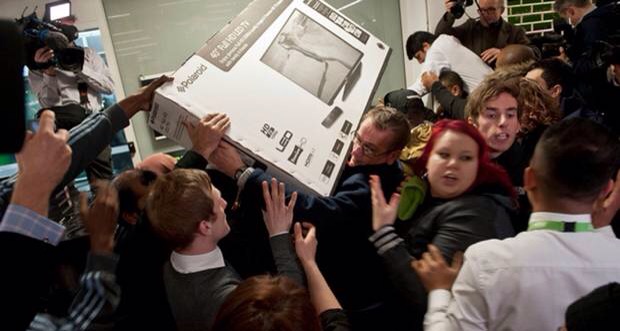
Shoppers competing to get discounted televisions on Black Friday. (London Evening Standard)

Seeing the gardarene swine like behaviour of the Black Friday shoppers, with customers fighting each other to get bargains, reminded me so much of the emptiness of contemporary Life. Thus behaviour longer attracts much criticism of these it is more likely the competitive zeal of these shoppers will earn them admiration. If this frenzied hyperactivity was restricted to shopping, it would be a problem but one with limits. However this frenzied hyperactivity is not limited to bargain hunters but is a behavioural practice characteristic of contemporary Britain. This practice is at is most dangerous when practised by our politicians who rush out a frenzy ill considered legislation to meet whatever crisis or problem occurs. Criminal law reform is one such example it seems that each successive government has to make major changes to criminal law to satisfy the apparent public demand for new laws to protect them from dangerous criminals. Reflection not something practised by contemporary politicians, no contemporary politician would copy would as did Prime Minister, Harold MacMillan read Trollope’s novels while in office, reading would either be some serious economic or political tome for fear of not being seen to be ‘on the job’ or a collection of DVD’s, acceptable frivolity. They are truly the ‘One Dimensional Men’ as described by Marcuse. Men with no depth or breadth of vision. One unfair but a comment with some truth in it is that legislation is rushed out to meet tomorrow’s media deadlines.

Politicians have a philosophy to justify their behaviour, it’s the market led theory of politics. They are as with businesses just there to respond to the demands of their customers. If their consumers suffer from a fear of crime, what is needed is more laws to reassure the voting political customer that their concerns are being met. Whether this crowd pleasing legislation has any impact on actual crime is debatable. What matters is reassuring the customer. Draconian anti drug legislation has had little impact on actual drug taking, but it’s there to reassure the public that the government takes drug abuse seriously. The unintended consequence of this legislation is to eliminate the small time (easily caught) drug dealer from the market, leaving the trade in the hands of major criminal cartels who are able to evade detection through either corrupting the law enforcement agencies or through using expensive sophisticated methods to avoid detection. The fact that current drug laws have inadvertently led to the creation of rich powerful criminal gangs is of no relevance to the government of the day. The fact that there are better alternatives is irrelevant as they lack the crowd pleasing factor.

One thought that occurs to me is that any drug baron would want the current laws to continue in operation as by eliminating many smaller rivals it enables them to remain a monopoly supplier.

A possible explanation

What I want is an explanation of why so many in society indulge in this frenzied purposeless activity. Kierkegaard (The Concept of Anxiety) does offer for me an explanation of this behaviour. His explanation was in part based on self analysis and in part in from observation of his contemporaries in 19th century Copenhagen. In his youth he could be described as a ‘party animal’ a person who was a popular guest at parties, because of his ready wit. However he was aware of an inner emptiness which frenzied social activities could not remove, a behaviour he observed in his friends. However he realised that this emptiness was not apparent to his friends and contemporaries who were content to live life on the ‘outside’. Yet even these apparently happy people would experience an anxiety of something missing, but suffer from not knowing the cause of their anxiety. The solution for them was to engage in more social activities to offset this feeling of anxiety.

This anxiety was consequent people’s failure to understand their true nature. *There is within the human psyche a longing for a different life, an aspiration for a more satisfying spiritual life. He identifies two forms of better life, the first a life lived in conformity to the norms of religion and the second superior a life lived in knowing God. This life may be achieved, through the individual opening themselves to God. They become as a mirror reflecting God in their lives. It is only this final group who are truly free from anxiety, they know happiness, all others know an inferior or counterfeit happiness.

It is not necessary to accept Kierkegaard’s Christianity to see the value of his analysis. Contemporary culture whether it be political or that of wider society fails to recognise the need for spirituality or any form of life that is not based on the consumption of goods or services. It is a barren and empty culture. A market society in which everything is up for exchange lacks any sense of higher value. There can be no universal value system such as Christianity which values compassion, agape (love of mankind) as they have no place in a society of aggressive self seeking traders. There is no market in agape, fairness or compassion, instead they are seen a barrier to wealth making as they demand restrictions be imposed on the businessman. Only recently the Chairman of the Confederation of British Industries spoke out against fairness and compassion. Imposing the living wage on employers or ending the cruel zero hours contracts he said would make the British economy uncompetitive in world markets. The economy demands the immiseration of the majority, if it is to prosper. It is the worship of a strange inhuman God, that is not too different in nature from the Aztec Gods that demanded human sacrifice.

A possible solution

While it is tempting to say that a happiness is dependent on a redistribution of material wealth; this fails to recognise why one of the richest world economies has descended to a level where an increasing number live impoverished lives. Why does the miserablist philosophy of Neo-Liberal dominant the political discourse? Quite simply because the majority of politicians exist at the lowest level of life as identified by Kierkegaard. Their realist philosophies have taught them that there can be no higher values as all that matters are the practical and graspable truths, so we have an opposition campaigning to reduce energy prices and ignoring the problems of a dysfunctional economy that created the misery associated with low incomes. Focus groups are set up to find what are the simple wants of the the electorate. The questions are designed to elicit simple responses that can be transferred into easily marketable policies. Never do politicians offer more than a few simple and banal phrases in place of a political philosophy, a something that is easily sellable.

Kierkegaard for me offers an answer to this malaise, that is how do you stop politicians behaving like moths flitting from one policy light to another. He writes of two religious types, religious A and B. The first practise religion without real understanding they know that they must conform to certain religious practices otherwise they will suffer the wrath of God. If fear of God made politicians believe that they should conform with the rules of Christian practice then the mindless inhumanity of Neo-Liberalism will be dropped. A minority would achieve the understanding necessary achieve to become religious B. They have the understanding necessary to develop policy in conformity with the highest moral and spiritual standards. They would be the leaders or natural aristocrats who would lead society in towards a change that would benefit all.

However Kierkegaard admits that his truly spiritual man would be more likely to be an outsider. His criticisms of society would make him an uncomfortable companion to the rich and powerful. Thus man would have to be prepared to suffer in return for a life lived in imitation of Christ. Father Gleb Yakunin a Russian orthodox priest was one such man. He was a fierce critic of the old soviet regime for its persecution of christians, for which he suffered imprisonment and exile. Yet his actions led to a change in government policy, first the destruction of churches ceased and a policy of toleration adopted towards the Orthodox Church. The role of such critics in society needs to be tolerated, beneficial change only follows from listening to them. In Old Testament Israel these men were the prophets. The Jewish people had a schizophrenic attitude towards their prophets they both accepted and rejected them. They recognised the need for such men as only they kept them true to their faith, yet they also hated them for their criticisms. One of the Isaiah’s was sawn in half by angry Israelites and another John the Baptist was beheaded.

In Britain there is a need for such critics, yet their their voice is silenced. The judiciary is going through one of its most repressive phrases, critics of powerful businesses can be silenced by super injunctions or through expensive libel actions. Police spies are used to infiltrate and disrupt opposition groups. The same police through the misuse of bail conditions can effectively silence activists through making avoidance of political protest a condition of bail. Any organised opposition is emasculated and marginalised through repressive laws. Recently legislation makes it impossible for charities and other groups to campaign on policy issues during an election campaign. While the voice of opposition is so effectively silenced there will be no change in society.

It is too easy to criticise Kierkegaard by claiming that he had an unrealistic view of mankind’s potential. Even when he was alive it was said of Kierkegaard that his definition of a Christian as a life lived in imitation of Christ was practically impossible to achieve. Rather than hoping for an unrealistic change, there is an alternative. I want a return to the age of ideology, an ideology such as socialism that celebrates the potential of man, one that should replace the inhumane Neo-liberal ideology that celebrates the brutal nature of man. There can be no more depressing philosophy than that of Neo-Liberalism that sees man as a grasping egotistic animal seeking only to advance their own interests. An ideology that encompassed hope, compassion would constrain the behaviour of politicians. They could no no longer claim indifference to to what can only be described as the evils in British society. They could no longer ignore the plight of the low paid, the least cost philosophy would be replaced by the criteria of fairness. It could easily be achieved by insisting that all businesses that are in receipt of government contracts or funding pay the living wage to their staff.

The emptiness at the centre in to the political debate would be replaced by an ideology that celebrated humanity. There have been plenty such ideologies in the past such as evangelical Christianity, socialism, the ‘One Nation Toryism’ of Benjamin Disraeli and the compassionate social liberalism of Herbert Asquith and Lloyd George. Such ideologies would constrain the behaviour of politicians, their behaviours and policies would be judged against a set of higher standards. Who would not judge the parliaments of the reforming 19th century and early 20th century superior to those of today. Contemporary parliaments are where self interest in the guise of Neo-Liberalism is the only moral standard. These are the no hope parliaments of today, inhabited by politicians whose attitude is ‘that I would like to help but …’ the but being the cruel moral imperative of Neo-Liberalism.

*i have edited and simplified Kierkegaard’s psychological analysis of human spirituality

Why economists would benefit from a little Christian sensitivity

Why do economists need a Christian sensitivity? The obvious answer would be to instil in them a sense of compassion, while the suffering caused by economics does not compare to that caused by the most brutal of political ideologies it is on the same suffering causing spectrum. The spirit of the Reverend Malthus has always inspired economists and never more so than today. Population growth he believed would always tend to outstrip the resources needed to food, clothe etc. the ever growing population. Therefore his first conclusion was that there must always be the poor, as there was never sufficient wealth in any economy to enable all to have an adequate standard of living. He also saw disease, famine and war as the saviours of mankind as they kept the population within bounds. While economists particularly those in the British Treasury have persuaded politicians of the need for the first, they have not yet tried to persuade of the need for the second. There is another answer and that is economics is one of the best examples of arrested thinking, so common in contemporary Britain. What concerns me is the immaturity of thinking of contemporary economists, their overly simplistic reasoning.

/home/wpcom/public_html/wp-content/blogs.dir/c1e/54687079/files/2014/12/img_0410.jpg

The inspiration for my reasoning is Kierkegaard (Fear and Trembling), in that book he bemoans the practice of Christianity in 19th century Denmark. He writes that the Christian intelligentsia regarded an afternoons reading as sufficient to acquaint them with the essentials of Christianity. This he compares unfavourably with the Christian Fathers who spent a lifetime trying to understand Christianity and who even at the end of there life said their understanding was limited and flawed. Just like Kierkegaard’s Christian intelligentsia economists suffer from the same intellectual arrogance. They just know, they have at hand the answer to all society’s problems. The comment that the answer was worked out on the back of an envelope is intended as an insult but with economists as a statement, the truth of economics can be distilled down to a few sentences that could be written on the back of an envelope. The best metaphor that describes contemporary economics is that it arrested thinking that has never really progressed beyond that if the schoolboy. This school thinking is demonstrated in the words of the Shadow Chancellor, who spoke with glee when he said his cuts to public spending would leave the public sector reduced to its bleeding stumps. As with a schoolboy no thought of the consequences of his actions for the people of an austerity hit economy. Military terminology can be applied as for the modern economist the people are unfortunate collateral damage, who suffer for some greater good.

Economics unlike contemporary theology is a closed subject, the truths are already known and its the work of the economist to apply those known truths correctly in their analysis of any given problem. In a closed subject such as economics, no new thinking is needed because all the fundamental truths have been discovered, all that is required is some tinkering to achieve perfection. Theology by contrast is an open subject, all the truths are not known and those that are are but imperfectly known. It would be ridiculous for any theologian to claim to know the mind of God, yet Christianity has been a closed subject many times in the past, when it claimed this knowledge. It has an unfortunate past record of persecuting and killing those who did not accept the acknowledged truth. Galileo Galilee was silenced by the church for challenging the prevailing orthodoxy, that the earth was the centre of the earth, by the simple expedient of showing him the instruments of torture. Unlike my predecessors as a theologian I claim to know little about God, I am a negative theologian a theologian who admits that God is unknowable. However this does not mean negative theologians have no knowledge of God. They have knowledge of the presence of God in human society, the means by which the unknown makes themselves known. They can glimpse aspects of God’s nature and explain it to others. The aspect of God that I know is the good, the good that characterises all good actions. Good can never be explained except through good actions and as a Neo-Platonist I believe that within all these good actions, there runs an indefinable good. It is a good I know but whose essence I can never adequately explain. All I would claim is that I know something of God’s nature as in is known through the medium of human existence. I am looking through a very dark glass which obscures most of the truth, what a much better theologian than myself called the ‘cloud of unknowing’. What I do know is the limits of my knowledge. I only know a little of one aspect of God’s nature and I shall spent a lifetime trying to develop that understanding.This is unlike an economist who does know and they even know what forms of economics are in error, something I would never claim about other religions. To paraphrase Uriah Heep, I am ever so humble, whereas the good economist possesses the arrogance of truth.

A negative theologian such as myself is keenly aware of the limitations of their knowledge, whereas all economists are positive theologians, who are aware that they know everything and have little if anything to learn about the world. Whereas the truth is the opposite the theologians have spent centuries studying the nature of God and the few truths they know are greater than the imagined truth of economics. Economists have discovered one economic truth, the market and having achieved that they think they know all economics. What they need instead is the perspective of the negative theologian, which one of ignorance. The truths of theology are but a small part of the truths of Christianity, and therefore they are open to any approach that might shed new light on the ultimate truths. Economics needs similar enlightenment it needs to seek new ways to go beyond the few truths it has discovered. When doing a thousand piece jigsaw I always try to fit together first the pieces that make up the edge of the jigsaw and give it its shape. Having put together the outline it is tempting to think that the main task has been done, yet the jigsaw remains a hollow square, with most of the content missing. Economists are in the same position they have some awareness of the outline of the economy, but they are largely ignorant of its content. The pieces that make up the content are missing from the jigsaw economy. Only arrogance prevents them from seeing the truth. What economists lack is humility, if they acquired this very Christian virtue the practice of economics would improve immeasurably.

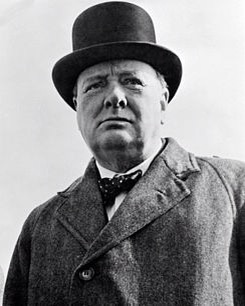
Why there will never be another British Winston Churchill, the theory of political dwarfism

IMG_0406.JPG

Political dwarfism explained

Politics in the UK is dominated by a set of mediocrities, not that this is new, if you read history there is frequently despair about the quality of political leadership. What is not new is the depths to which our current leadership has plunged. They seem to be indifferent to the problems besetting UK society, seeing it as not their concern. At the risk of using an over employed metaphor, they are the band playing on the deck of the Titanic, although unlike that band they are oblivious to the dangers that surround them.

There is one startling example that demonstrates this indifference. In London a housing estate has been taken over by an American property company; that will make the current tenants homeless through the simple expedient of tripling the rents on existing properties to bring them in line with current market rates. Fortunately the tenants have secured a stay on the rent rises which will enable them to stay in their homes over Christmas. Originally the estate was established to provide housing for people on low incomes, a good intent that matters little in a residential property market driven by speculative greed. Despite the publicity given to the plight of these people in the media, the political classes as a whole have remained indifferent to their plight. Even the Mayor of London a man ever eager to court publicity has remained aloof from the tenants campaign. The only public figure to have sided with the tenants is a comedian, Russell Brand. A man demonstrated the commitment that should be expected from the politicians. Instead they are all to keen to demonstrate their helplessness in the face of ‘market forces’. What is so puzzling is why even the publicity seeking mayor like his Westminster colleagues is so eager to embrace this culture of ‘political dwarfism’.

Politics should be about doing, however British politics is about not doing, postponing decision making to the distant and ever receding future or making ‘faux’ decisions. (A decision that turns out to be less than it appears, often nothing more than ‘soundbite’). If decisive action is ever taken its at the behest of some superior force, either the world’s superpower or more usually a large business corporation. So eager are our politicians to embrace insignificance that they are negotiating the Transatlantic Trade and Investment Partnership. This a treaty that will give business corporations a major voice in policy making and the power to veto decisions they dislike. When the treaty is in place, business corporations will be able to bid to run various public services and if denied the that opportunity they can sue the government for compensation for lost revenues. A good example of this is the private health care provider who is suing a local health care trust for turned down their bid. The bid was rejected because because the price was too high. They are asking for a judicial review of the decision because in making its decision the health care authority had not taken into account the private health care providers need to make a profit. Quite probably in the near future private corporations will be deciding what public services will and should be provided by them. The only role for the government will be to sign cheques promising tax payers money to these corporations.

Probably there any many reasons for the popularity of adopting ‘political dwarfism’ as a persona amongst our current generation of politicians. The one most normally cited is the popularity of Neo-Liberal ideology, which relegates politicians to the role of bit players on the world stage. However explanation that interests me is language and the culture that determines how politicians use that language.

Contemporary Political Language

Greek philosophers originally put their philosophy into verse believing that the language of poetry was the best means of explains the ultimate truths of existence. In contrast political language today has very different functions rather than being the language of challenging truths its that of complacency, one of non enquiry, the means for reciting pre-agreed truths and pre-agreed propaganda. A language that obscures and hides truth. The current Chancellor of the Exchequer is a master of rephrasing his language to hide the failure of his policies. We are living in the fastest growing economy in the developed world according to his speeches. What is hidden is that it’s a recovery of statistics, a sleight of hand to hide the emptiness of his political rhetoric. The recovery is a debt led property boom, inflating property values and the property trade, which generates an inflationary increase in national incomes, demonstrating what appears to be a rise in the average incomes of all. Yet the truth is that for the vast majority there has been no increase in incomes, either they are experiencing slow or no growth in their incomes, or working for poverty wages.

One would expect the opposition to make the most of this growing inequality and inequity in incomes, yet all they can offer is a ‘faux’ policy alternative. They will generate a faster growth in the economy, which will boost incomes for all. However it is a policy so light on detail that it is practically meaningless, more a hope than a policy. Politicians seem to have lost the ability to express meaningful truths in language, language for them is the language of non truths, the language of evasion and obscurantism.

Why this decline in the spoken language?

IMG_0407-0.JPG

Politicians have always used language for propaganda purpose or evasion or what parliament calls dissembling (lying), but it was never in the past the predominate use of language. This example provides an interesting illustration of this. When a young man was asked by Lloyd George at house party what he hoped to do with his future, he answered that he was undecided between a career in the navy and politics. Lloyd George advised him to go into politics as he would experience more ‘boardings and mutinies’ than he would in the navy. This politician had a reputation for deviousness, he was the Welsh wizard, yet he introduced the beginnings of the welfare state and led Britain to victory in a world war. Today’s politicians could probably match him for deviousness, yet not for vision. His vision came from an upbringing in Welsh baptism, that imbued him with a sense of justice.

If I can go back to Churchill I can make the point more clearly. Churchill would have studied classics at Harrow and many of his contemporaries would have gone on to study classics at one of the Oxbridge colleges, whereas today contemporary politicians study PPE at an Oxbridge college. This is a significant factor as the education of today’s politicians and the past differs drastically. One classical writer studied on both classics and politics courses is the Roman philosopher Cicero, but who is treated very differently in each subject. Students of classics particularly of Churchill’s time would have seen Cicero as a heroic figure whose command of language was one to emulate. A man whose courage was matched by his oratory. The Cicero they studied was the Cicero who at risk to life and reputation defended in court a man who was the victim of a friend of the dictator Sulla. (Sulla was a dictator who had killed hundreds, when taking over the Roman Republic.) This was also the man who gave up his life to defend the restored Roman Republic. He was such a significant opponent of Mark Anthony (one of the triumvirate of politicians seeking to overthrow the Republic), that he had the murdered man’s hands nailed to the Senate door to demonstrate his command of Rome. In my politics course as is so of contemporary politics courses, Cicero was dismissed as a plagiarist, whose books were copies of better Greek originals. A man who rather than being a heroic defender of the Republic, was a man who took many ignoble actions to advance his career. In the space of 50 years Cicero had been diminished from being a man to aspire to to being to yet just another very ordinary politician motivated by the spirit of self advancement, all be it a good self propagandist. With an education devoid of heroes or heroic figures, an education that trashed the value driven figures of the past, future politicians educated in politics courses were lacking the language of value. A realist education that sees only human frailty and failure cannot but give a very downbeat view of the world.

An observer of the 19th century parliament would have noted that speeches were liberally sprinkled with Latin phrases, speakers tried to out do each other in their command of rhetoric. Observers could drop into parliament to be amused by the wit of Disraeli or the eloquence of Gladstone. The latter a man who on his campaign trails could speak to an audience of thousands for an hour or more and yet command their attention. Today’s politicians could not speak for ten minutes and hope the attention of an audience for that time span but instead they sprinkle their speeches with brief ‘sound bites’ (always of less than a minute’s duration) to capture their audiences attention.

Obviously the decline of the teaching of classics cannot be held responsible for the decline in the quality of parliamentary debates. It is just one factor but one that I think is a predominant factor. Now There is an intellectual culture that values mundanity and the accepted over creativity and originality of thought. A culture that equates any value system or ideology as a fantasy, at best useful for getting out the vote, but nothing more. This culture of mundanity goes by many names, the most popular are post modernism and Neo-Liberalism. While the first is a both a philosophy and a literary theory and the second is an economics, what they both have in common is a contempt for any value driven system, seeing instead a society of things in which values are an alien intrusion.

Why how language is used matters

Language is both a servant and a master, and it is the extent to which it is the latter that explains the mediocrity of the present political class. It is a servant when I use language to get something done, as when I order my cappuccino at my favourite coffee shop. Using it is this way has no impact on my behaviours, it’s nothing more than a request. However language is much more than a means of making requests, it is determines my perception of the society in which I live. Society is one of those strange objects that is both intangible and tangible. I know it’s there it is a given in my life, but it’s not something than I can readily comprehend. I just know it’s there, I know it’s an organised system of social relationships, whose meaning I understand through language. When I go into my coffee shop I am immediately aware that I’m entering a place of structured inter relationships. I know to order my coffee from the barista and not the manager or the chef. All have a identity disclosed in language, which tells me how I should interact with them or even not at all, as is the case with customers to whom I am a stranger. The coffee shop etiquette is something we all learn, and that etiquette is expressed in language. Anybody who fails to understand that etiquette will get bad or poor service.

Similarly the politician has come across a language which explains to them their role and that role within the greater network of social relationships that is the political system. If as at present it is the language of Neo-Liberalism, it is a language of can’t does. Neo-Liberals believe humankind has discovered the perfect social organisation, the free market and their only role is to remove any obstacles that prevent the free market operating. Consequently the voter that expects their MP to do something about the pitifully poor wage they receive is doomed to disappointment. The MP believes in the long term, in the long term the market will right itself and all will receive a living wage.

This stance of ‘doing nothing’ is reinforced by contemporary post modern philosophy that teaches that the higher moral order of which past philosophers such as Marx spoke are only the wishes of a particular age. Socialism was only had meaning in the Industrial Age of great factories, when labour protection and wage legislation made sense, because all did similar jobs in large industrial units. Now when all do very individual jobs in very different work environments, universal legislation covering all workers makes no sense and so it’s right to abolish all worker protections. Also there can in the post modern age there be no universal values as it is an age of extreme individualism. Values are relative to the individual and their unique social circumstances. Although it rarely said any notion of universal human rights is contrary to post modernism. All there can be is a democracy of rights, a competition of rights. Alistair McIntyre when speaking of a debate between two people debating the rights of their own ethical position, likens it to a shouting match. If they have different ethics, there can be no common ground between them which make any meaningful communication between them impossible. They might both be English speakers, but as for any chance of communication between them, they might as well be speaking different languages.

If the members of our political classes, particularly the leadership have been schooled at the elite colleges that teach post modernist philosophy and Neo-Liberal economics they will have been schooled in a culture that has little belief in the efficacy of human agency. Values have no place in the pseudo-science of Neo-Liberal economics and values for a post modernist are little more than an individual’s chosen life style, they have no universal validity. How can the product of such a culture, be value driven as was aWinston Churchill who had a belief not only in the rightness of British democracy, but in Britain’s unique role in the world. In an education system that excludes any education in values from its curriculum it is not surprising that it produce politicians that are only capable of having a mundane hum drum vision of the world. John Major the British PM summed up the current way of thinking, when he spoke of the need for a ‘vision thing’. He was unfairly characterised by cartoonists as a grey figure, when in fact it was a characteristic he shared with his generation of politicians.

How can such language of universal,dullness produce and thinkers of great thoughts? Whether the politician be David Cameron, Nick Clegg or Ed Miliband, all will be indistinguishable to the future historian, just a group of indistinguishable mediocrities that will fail to leave their mark on history.

Mass Men and Exceptional Women or Foxes and Lionesses

Jose Ortega y Gasset (The Revolt of the Masses) when writing in the 1920’s made some acute observations about society that are more relevant for today’s society than when he made them then. He bemoans the rise of what he calls mass man, a man of limited vision who because of the material wealth and plentitude in developed western societies has become self satisfied, sees no need for change. This vision less man he compares to primitive man who accepts the natural environment in which he lives as a given, one that he is incapable of changing. What mass man never sees is that society is not a permanent construct that will be there for ever yielding a plethora of material goods, but that it is a fragile human construct that needs to undergo a constant process of renewal and change if it is to deliver for its members. The danger of mass man society is that the complacency of vision will lead to an ossified society one that is incapable of change or adjusting to the challenges that it faces. Societies leaders now having discovered what believe is the perfect society in Neo-Liberalism see no change to the model, failing to recognise the dangers inherent in this very human fallible human construct.

If he lived today Ortega y Gasset would recognise in the political class the dominance of the mass man, a man incapable of seeing any threat to their current beneficent existence from either the natural or made made environment. Despite the obvious threat of climate change because the current society delivers in terms of material wealth and human comfort, they see no urgency to act. Last year the London barrage was raised so many times to prevent flooding that engineers were unable to conduct essential maintenance, so that if this year and following years continue in the same pattern the barrage will eventually fail and London will flood. No matter what the evidence politicians will never conceive of a situation in which the economy they manage never delivers for them. Their time frame is limited to the present, they cannot consider a time when the present parameters no longer apply and because of their inaction the circumstances which were benign will then turn malign. Climate change will not stop with producing warm winters and hot summers but will instead cause food shortages and with concomitant threat of mass starvation.

IMG_0395.JPG

One of the guiltiest groups of mass men are the economists. Ortega y Gasset claims that scientists are exemplars of mass men, they know just one thing, their science and for them it is sufficient. Scientists have succeeded by specialising in ever narrower and narrower fields disregarding the wider realm of human knowledge philosophy and history for instance. Having succeeded in one very limited field of human endeavour they assume they know all. Of all groups in contemporary society economists are the most guilty of this arrogance. They as with the medieval theologians see their’s as the queen of sciences, politics, ethics philosophy must all bend their knee to the greater realism that is economics. Bill Clinton’s aides comment that when asked what will determine the result of the election said ‘it’s the economy stupid’ has become the accepted political truth of our times. All politics has become as a consequence a branch of economics, particularly in the Neo-Liberal Anglo Saxon economies. Here politician’s have outsourced decision making to the free market. However this free market does not exist except in the imagination of economists and politicians, what does exist is the large business corporations that dominate the energy market and an are becoming increasingly dominant in the health care market. Blindness to reality, they see only the imagined world of beneficent free markets.

IMG_0396.JPG

Only a contemporary Jonathan Swift could describe the contemporary political leadership.in the country of Lilliput the chief ministers are chosen by their according to their ability to skip and dance on a rope, this being the primary qualification for managing the affairs of state. In the age of mass man the skills needed for high office in the UK are similarly irrelevant to the skills needed to manage the current troubled society. Just as with his sky city of Laputa floating above the earth, where the scientists try to capture moon beams in cucumbers, the debates are actions of our parliamentarians cocooned within the Westminster bubble are equally fruitless.

What Ortega y Gasset failed to see that mass man would predominate amongst the political classes, while outside that class there would be many who defied that category. Only in the Westminster/Whitehall village could the screening process be effective in only selecting mass men for positions of power and influence. There number of candidates are so small that it is easy to screen out exceptional men. Outside the privileged environs of power the influences on men are so diverse and the gene pool so wide that mass men don’t predominate to the same extent. Exceptional men and women rise to the top in institutions that are remote from Westminster or marginalised by the Westminster power bloc. In trade unions now marginalised and emasculated, exceptional men and women occupy leadership roles. People such as Francis O’ Grady (General Secretary of the TUC), the late Bob Crow of the railway union, Natalie Bennet leader of the Green Party. However such people are remote from the seats of real power and lack the influence and power of mass men.

However Ortega y Gasset does offer hope for society in the form of the exceptional men. These are a natural aristocracy, the men dissatisfied with society. Men such as Giuseppe Mazzini the Italian revolutionary thinker who spent his life largely in exile as he was thought to be a constant threat to socially conservative Italian governments. The exceptional men believe in a higher order, possibly a higher spiritual order, that of a God. These people are dissatisfied with the assumed natural order of things, they see the need for change and want to make it happen. Without them society ossifies into fixed model incapable of change. The USA demonstrates what happens when mass men dominate politics to the exclusion of exceptional men. In Washington there is legislative gridlock, a government that is unable to offer policies for change, only policies for a retreat into a safer imagined past.

IMG_0397.JPG

When trying to think of exceptional men in the field of politics it is exceptional women that spring to mind, Elizabeth Warren (US Senator) or Wendy Davies who successfully filibustered the Texas Senate on abortion law. The mould breakers tend to be women, probably because they have been so long excluded from the seats of power that they have an innate dissatisfaction with the system that marginalises them and a desire for change. In the UK the existing power structures effectively exclude women from power. The exception being Nicola Sturgeon leader of the Scots Nationalists, a former marginalised party. Theresa May the current Home Secretary who is spoken of as a possible leader of the Conservative party, is a women who has positioned herself squarely in the mass man camp. If she becomes leader she will be no challenge to the dominant political complacency.

There is another writer Pareto who tried to understand why politics was dominated for long periods by clever mediocrities, men good at playing the political game but incapable of initiating or managing change. Such men were good at winning elections but they would leave society untouched or unchanged after their period of office, if was as if they had never held office. Gross inequities were never challenged and society remained in the hands of its corrupt rulers. He called such men foxes, however these men were unable to resist the challenge of the men he called lions, men of character and bold vision. These men only came to power when circumstances permitted, in times of revolutionary upheaval. One such man was Garibaldi the military leader of the Italian revolutionary forces. However these men of vision only remained in power for a short while as the would inevitably be ousted by the machinations of the cunning foxes.

Whatever the complexion of government politics in the Anglo-Saxon countries is dominated by the clever mediocrities, who have cleverly manipulated the political system to exclude any possible lions entering government and disturbing the current political complacency. In the UK the leaders of the opposition party, the Labour Party have the power to exclude unsuitable candidates from the process for choosing MP’s. Only people that subscribe to the current political complacency will be accepted as candidates. Similarly the corrupting power of money is effective at excluding able candidates (the exceptional men) from the political process. The demands of the large party funders mean that nobody who challenges the current orthodoxy can be selected as a potential MP or leader. Since so many of the exceptional men are able women, there is a further barrier which keeps them distant from the seats of power and that is institutionalised sexism. Demonstrated when a conservative MP asked the newly elected female MP for Walthamstow to get out of the MP’s lift, as she should be in the one reserved for secretaries and admin staff. He could not conceive of a young woman being an MP. One key factor preventing women politicians reaching the top of British politics is the sexism of Westminster and the media. Any female politician that puts her head above the parapet risks being in receipt of a torrent of sexist abuse from the media. Only female politicians that are not tainted with feminism can hope to avoid the worst of this abuse. The only way of ending the destructive complacency of the mass men is to open up politics to those who they currently exclude, the exceptional men and women. However that would require an act of imagination and boldness generally lacking in the mass man.

What is the USA and the UK need desperately if not to be pushed into a long period of decline through the follies of mass men, is a more open society one that allows exceptional men and women access to power. Unfortunately what is happening is the reverse both the Anglo-Saxon societies are becoming more and more closed societies. Both Anglo Saxon democracies are turning to an imagined past. Although they would be unwilling to admit it our current political leaders have a mindset not too different to the religious fundamentalists of Islam, they both want a return to a past untroubled by modernity.

Thinking ourselves into poverty

If there were two words that I could use to describe the current state of economic thinking, they would be pessimism and helplessness. All economists can offer is an indefinite period of continuing misery, which they call austerity and that this misery is unavoidable and necessary given the conditions that prevail in the world economy. The Europeans in particular must suffer for indulging in a frivolous life style in which they squandered money on welfare, education and health services, money which would have been better spent on investing in industry. Now it’s payback time. What Europeans did not realise that there is an economic Darwinism, that governs the world economy. Those nations that are uncompetitive fall by the wayside and must suffer the consequences of which the main one is a dramatic fall in living standards. Europe having become uncompetitive through increasing its labour costs by taxing employers to pay for welfare spending etc. must now pay the price. The price is increased unemployment, poorer working conditions and lower pay and only then will Europe become competitive in the world economy.

What economists never say is that they are advocating for Europe a return to what used to be called the ‘second world’ standards. In the initial period after the Second World War there was a category of development status between first and third world, it was the second world. Second world economies were those of Eastern Europe where the standard of living was modest, people were poor but not in want, that is they were fed, housed and clothed but lived a life devoid of luxuries such as car ownership. Labour was cheap in these countries and businesses would never lose out to foreign rivals because of high costs.

The best way of understanding contemporary economics is by way of metaphor, contemporary economists can be compared to high priests in the blood stained Aztec, Mayan and Inca cultures. Then the people believed that the natural catastrophes that they suffered were the actions of malevolent Gods, who punished the people for offending them. Only the priests understood how to manage these supernatural malevolent forces which was through human sacrifice. The priests decided when sacrifice was necessary and how many should perish. The Mayan had one cruel ritual in which two teams of young men played a form of hand ball, in which the losing team were beheaded. This ritual blood letting would appease the Gods and stop them inflicting suffering on the Mayan people as a whole. Today rather than priests it is the economists who understand and manage the malevolent forces that threaten our well being. Only they have the knowledge necessary to appease the angry Gods of the free market and that is yet another form of human sacrifice. Fortunately the sacrifices to be made are of income not life. People must be prepared to accept drastic cuts in their standard of living for the betterment of all. In a world beyond human control the only way to control or assuage those violent forces that threaten human well being is to appease the Gods of nature or market through human sacrifice.

IMG_0386.JPG

There is a crude economic determinism that governs economic thinking. People are pawns in the game of competing market forces, if those forces turn against a people they must expect to suffer. Economists can read the runes and advise that sacrifices have to be made to avoid the direst of economic consequences. Any reading of an economics textbook demonstrates the view that the economy is a force outside or beyond human control, and that human life must be managed according to its dictates. There are the laws of supply which demonstrate that if prices are too high (incomes) demand will fall and products will remain unsold (unemployment). Only when prices (wages) are cut will demand rise (employment levels increase). This even has a name it’s called Say’s Law.

IMG_0387.JPG

One example is the economic austerity that is deemed necessary to reduce the out of control government deficit. It makes sense that if we reduce our spending our debts are reduced and as government debt total is about 80% of GDP, obviously we the British must cut our spending until the debt is back under control. Actually this is nonsense economists are lying. They are well aware of the much greater national debt and that is the one run up by the banks which totals about 400% of GDP. If the UK GDP was £1.5 trillion government debt would total £1.2 trillion while bank debt would total £6 trillion. Economists rarely mention the latter, it is deemed irrelevant relevant to their analysis. What matters is not the truth but what authoritative voices say is the truth. Economists as with the ruling caste of priests in Mayan culture could manipulate data to further their interests. If there was a bad harvest the solution was not to arrange a fairer distribution of food, but to appease the Gods by increasing the number of human sacrifices. Economists as with the Mayan priests practice a philosophy of non answers, ritual substitutes for action. Enforcing a policy of austerity on the majority benefits the economists and the financial elite of which they are members, as it is a ritualised substitute for taking sanction action against the real debt, bank debt. Cutting bank debt would mean reducing the cash balances of the banks and as the largest depositors are the rich they would suffer disproportionately.

Rather than seeing us as the victims of economic forces beyond our control, the economy should be seen as a human creation subject to human control. The economy is a organised set of human relationships designed by people to achieve particular ends. If it is a human creation, it is infinitely malleable and it can be designed to serve a variety of ends. Either the economy is designed to benefit a privileged elite or to benefit the majority. There are
There are other ways of understanding of economics other than accepted Neo-Liberal model. To outline the alternative I want to borrow from the writings of the 19th philosopher Hegel on phenomenology. He believes what we experience as reality, is reality as perceived through our conscious mind a reconstruction of reality, nothing more. We live in the world of our imagination. Hegel’s theory of phenomenology is fraught with difficulty when applied to the natural world, as our perceptions of cold and heat are not subjective. However it does offer insights into understanding society, something not visible but understood through our consciousness. Is it not true that we know the social world subjectively? It is a projection of our minds, yet it is also a imagining rooted in the common reality of our culture. If we admit that any individuals understanding of society is subjective, the apparent realism of free market economics with their laws of supply and demand disappears, it becomes just one of many understanding of social reality. Admittedly an understanding that one of the most authoritative groups in society that the interlocking elites of economists, financiers, traders and economists. There can therefore be other equally valid understandings of the economy. Why should the understanding of Andy Haldane (Senior Bank of England economist) be privileged over the understanding of a joiner, engineer or doctor. This economists understanding of the economy is but one of the valid views, there is no reason why the joiner should not have an equally valid of the economy. What I have in mind is the ends or purposes of an economy, rather than the techniques of economic management, in which Andy Haldane will be superior. Ends do inform technique so the separation is not complete. The joiner would see making people unemployed in large numbers as an invalid technique of economic management.

Rather than there being one authoritative understanding of economics there needs to be an acceptance of their being a number of equally valid interpretations. In a free society there would be representatives of different economic understandings participating in the political debate that decides economic policy making; instead of as in the UK where only representatives of the Neo-Liberal economic tendency are heard in the political debate. Holders of dissenting views are not usually imprisoned in the UK, the exception being is if their campaigning is perceived to be too,effective. Yesterday representatives of Occupy London and Jenny Jones London Green Party Assembly member were arrested for demonstrating in Parliament Square and intimidating the MP’s going about their business. Other ways are usually found to exclude or marginalise holders of dissenting views.

In a democracy the economic understanding of the economist or financier would be challenged by the holder of an alternative view. The financier would want freedom from regulation which which restrict their entrepreneurial activities arguing that by so doing the society as a whole would benefit from their wealth creating activities. This would be opposed by a trade unionist who would argue that the removal of restrictions on the entrepreneur would harm the community. They may want to use low cost methods of manufacture that are dangerous and pose a threat to the health of the workers. They may want freedom to employ labour as and when they need them, but the trade unionist would point out that this would be extremely harmful to the individual worker who would be denied a regular wage with which to support their family. The needs of people cannot be switched on and off to suit the whims of an employer. While neither side would ever accept the standpoint of the other a compromise could be achieved whereby the excesses of each could be curbed. A process not too similar Aristotle’s mean, whereby he saw virtue situated between two extremes. Courage was the virtue equidistant between foolhardiness and fear. Courage has elements of both, the courageous person knows fear but has the ability to overcome those fears. Perhaps the ideal state is one that practises Aristotle’s mean, all be it an economic mean.

Why economics needs a religious underpinning

Perhaps it is coming from a rural community in which religion was part of the backdrop to rural life, that causes me to regret the absence of religious thinking from the contemporary debate. In the countryside you are aware of a continuity with the past, it is always visible in the present. The school I attended was a church school and it stood next to the church which was centuries old. We were told that the reason for the church’s high spire was that it was to inform distant travellers that here was a welcoming Christian community. A welcoming beacon amongst the wilds of the forests of the Weald. Later I learnt that this was a Victorian romance as there would have been no forests in the Weald when the church was built. Sometimes fantasy is more real, certainly to an impressionable child. The various seasonal rites of passage were marked by religious ceremonies, the beginning of the farming year was marked by the Plough Monday Service, harvest by harvest festival and the end of the year by Christmas. Christmas was marked by a children party at the big house at which mummers performed.

IMG_0384.JPG

Coming into a secular world at my urban secondary school and later at a sixties university quite destroyed my childhood religious ethic and practice. The rural community of my childhood was being destroyed by commerce and my similarly religion seemed to be an echo of my past, a thing remote in a lost past. It was not helped by the undistinguished quality of the religious thinkers of the sixties, that is Teilhard de Chardin and Hilaire Belloc. Both of which were dismissed by my tutors as serious thinkers, the first for his woolly mysticism and the second because he wanted to return Britain to the Middle Ages. However my religious belief had deep roots and re-emerged from the depths of my consciousness after leaving university. Much as I loved the religion of my childhood, I came to realise that the magical realism of my childhood religion was not the religion for an adult. It was a religion that relied too much of the magical props of the supernatural, it is possible to be re-enchanted with Christianity without having to accept the magical supernatural props of a former age. Christianity can be compatible with any of the cultural manifestations of modern, it becomes the same truths can be told in a different manner.

When Caputo (The Weakness of God) writes of the weakness of God, he is expressing the strength of God in a way differently to that described in the Old Testament, his God does not have to destroy cities to be all powerful. God for him has chosen to refrain from intervening in men’s lives. This God treats men as adults, not children to be forced to coerced by supernatural terrors. Although he does not state this he implies that Christian officialdom, be it popes or priests have failed to understand the message of Christ. Dostoevsky’s grand inquisitor exemplifies the thinking of much of the priestly hierarchy. The Grand Inquisitor criticises Christ for giving men the choice of either accepting or rejecting an absolute set of values which on their salvation depends. There can be no choice in deciding whether or not to accept a Christian morality that embodies a series of absolute values, free choice means that some will unwittingly condemn themselves to eternal damnation. By torturing and killing heretics the Grand Inquisitor is more effective at fulfilling Christ’s mission that Christ himself, as people are scared into being good Christians, as death by torture and fire faces those who are not. What the Grand Inquisitor and most churchmen fail to understood is that God manifest’s his power in a different way. He he strong enough to allow men the freedom of choice, only a weak God would feel the need to coerce mankind into believing in him. Caputo’s God is the unknown God who makes himself known by pushing into human society, making his presence is known through his values. These values are known to all and it is up to men to choose to accept those values and acknowledge God’s existence. Christ (God) wants followers who choose him freely not a group of scared rabbits.

Theologians such as Caputo only claim to be offering one understanding of God, they realise that there can be others. They don’t need the threat of fire to suppress possible heresies. It is an understanding best expressed by Hick (The Metaphor of God Incarnate) as the ‘universal salvic’. His salvic includes the deities of other religions as he believed that they all express the same essential religious truth. Strength comes from the persuasiveness of argument not through the exercise of power.

The default assumption is that theology has to learn from the contemporary sciences and modify its content in the light of current changes in philosophy etc. John Caputo in the spirit of the times has written a post modern theology, entitled ‘What would Jesus a Deconstruct?’. Movement in the other direction is never assumed necessary yet it is an equally valid to assume that social scientists such as economists could learn from the theologian, could they not learn from some borrowing from the learning of the past. The Christian father’s such as St. Augustine wrote about the nature of evil, something that an emotion and moral free economists never recognise as existing in human societies.

What Christian theology should be influencing is not the methodology of economics, but something more fundamental. Economists always see there subject as free floating, it’s abstract truths are ungrounded they don’t need social context or reference to the wider society. What they fail to see that the economy is part of a greater whole, unlike Christians who see human society as but part of God’s greater creation, a cog in the wheel not the wheel itself.

Their needs to be a reorientation in the basics of economics as can be demonstrated by an analysis of welfare economics. Welfare economics despite its name has little to do with the welfare of mankind, it is only a theory of how to optimise production. It is possible in theory to draw a production possibility frontier, which represents maximum output of different combinations of goods. Peoples welfare is maximised at any point along the frontier as that represents the largest amount of goods that can be produced by a specific combination of the factors of production it is up to society to choose the desired combination of goods, as to the economist any point along that frontier is equally desirable as it maximises the output of both consumer and capital goods (a,b,c d is inefficient and e is impossible)

IMG_0385.GIF

Their needs to be a reorientation in the basics of economics as can be demonstrated by an analysis of welfare economics. Welfare economics despite its name has little to do with the welfare of mankind, it is only a theory of how to optimise production. It is possible in theory to draw a production possibility frontier, which represents maximum output of different combinations of goods. Peoples welfare is maximised at any point along the frontier as that represents the largest amount of goods that can be produced by a specific combination of the factors of production it is up to society to choose the desired combination of goods, as to the economist any point along that frontier is equally desirable as it maximises the output of both consumer and capital goods. What is notable is what it leaves out, it’s only a two dimensional diagram that can only show a tiny part of the desired outcomes for human society. Christianity reminds us that there are other goods that are desirable. In the words of the gospel of Matthew (6, 19-24)
“Do not lay up for yourselves treasures on earth, where moth and rust [a] destroy and where thieves break in and steal, 20 but lay up for yourselves treasures in heaven, where neither moth nor rust destroys and where thieves do not break in and steal. For where your treasure is, there your heart will be also.
This is the command not to overvalue material goods, but to invest time and money in those activities that directly benefit humanity now. It is a reminder that economists undervalue those services that cannot be priced, the caring and health services. Why do economists advocate private health care, because of intellectual laziness? It’s easy to value the contribution of health to the economy when it is sold as a commodity like any other marketable good. Profit or private profit is easy to calculate when health care is a matter of calculating costs and prices. The fact that the majority of the population is excluded from good health care under systems of private health care, because they are priced out of the market is irrelevant. A Christian underpinning to economics would remind economists that there are some goods that cannot be priced and that the price cost benefit matrix is often irrelevant to the valuation of goods and services.

Free market or Neo-Liberal economics values inequality, income inequality is justified in the sense that each gets paid according to the value the Market places on their services. Therefore the neurological surgeon gets paid far more than the cleaner. However the market makes some strange decisions that seem hard to justify. Why are financiers and other speculators paid such huge salaries when their contribution to society seems so minimal? Why are workers in the caring industry paid so little (often less than a living wage), when their contribution to society is so great. A different measure is needed of the value of labour. One clue to this revaluation comes from the Bible. In Genesis, God is said to have created man in his own image, not an exact physical copy as Maimonides (The Guide to the Perplexed) states, but a being that as with God has consciousness. A being that is conscious of the consequences of its actions, a being that is capable of directing its actions to,achieve a particular end. If all are created in God’s image this implies an equality between human beings all are valued equally by God as he made them in his image. This suggests that their needs to be a value system that counters the harsh inequality of the market. A system that sanctions the regulation of wages to ensure that all that work can earn a living wage.

What a religious or Christian origin would give economics is a different starting point, a starting point rooted in the valuing of humanity. Then perhaps a Milton Friedman could no longer justify President Pinochet’s torture and slaughter of dissidents as a necessary first step to establishing a free market society. There are some economic policies that can never be justified.

Philosophical scepticism the antidote to Neo-Liberal fantasies

IMG_0372.JPG

Although I have read economics, philosophy and theology at university, I am not an academic and I want a description that distinguishes me from the professional philosophers and economists. I think I can best be described as a ‘Hedgerow Philosopher or Economist’. It is a steal from Thomas Hardy’s ‘The Return of the Native’, at the end of that novel Clym Yeobright becomes a hedgerow preacher. Lacking the formal qualifications necessary to become a preacher in an established church, he takes to the roads literally preaching to the country people in the fields. The hedgerows being the walls of his church and the place where he sleeps most nights. He is a figure that has always fascinated me and I Identify with Clym. I am a hedgerow philosopher because I speak as an outsider, looking in from outside the academy. This is not a viewpoint soured my malice or envy, but a viewpoint that expresses freedom and my independence, as outsider I am not obliged to follow the disciplines of any school. It is this distancing that gives me a different perspective on the practice of economics.

IMG_0373.JPG

Country people such as myself believe that our being in constant contact with nature gives us an understanding of the world denied to town folk. It is the experience of witnessing the sunrise or sunset over a country landscape that makes us feel we are closer To those elemental forces that govern nature and the world. Probably this arrogant assumption is totally unjustified, but nevertheless country people do assume a superiority over their townie cousins.

As a philosopher I would suggest that economists are making a similar error to that made by philosophers as described by Nietzsche. One of the assumptions that under pins any moral philosophy is that humans are responsible for their actions, they make choices good or bad. However as Nietzsche write psychology demonstrates so many of actions that an individual makes are predetermined, so how can they be responsible for their actions? He accuses moral philosophers of falsely attributing behaviours to men which are absent in reality. They fall at the first hurdle in constructing their their moral philosophies. Similarly economists fail as they fail to understand the relationship between the economy and the host society of which it is part. One exception to this common misunderstanding is the economist Michael Polyani.

Contemporary economists know the writings of Friedman, Schumpeter, Hayek and Rand, yet never Hayek’s great rival those of Polanyi. Polanyi is absent from the economics curriculum of universities. Probably because he puts the economy back into the society of which it is part, he makes it one social science among many, relegating it from it’s position as the Queen of social sciences. He writes that the market economy is a threat to the social order and must be regulated so as to control its destructive tendencies. The example he use to demonstrate this is the Industrialisation of Britain in the late 18th and the threat that posed to society. The new textile factories produced cheaper and better cloth and in greater quantities than the home workers, That is the hand loom weavers. With the collapse in demand for their cloth these weavers were impoverished and faced the very real threat of starvation. The government responded to their misery by introducing the ‘Speenhamland system’, which as with today’s working tax credits was a supplementary payment made to the weavers to enable them to pay for the necessaries of life. He suggests that it was the system that prevented there being an English revolution to match the French one. Desperate starving weavers would have had no option but to resort to violence to obtain the food for their families. It was a series of bad harvests and hunger that drove the Parisian mob to violence and it was that mob that was one of the driving forces behind the revolution. Any economist that preaches a message contrary to the ‘feel good’ philosophy of Neo-Liberalism is unwelcome in today’s economics departments and Polanyi would not be found on any departmental book shelves.

Fear of the damage an unbridled free market can wreak on society is slowly becoming better understood within the governing classes. Recently the Head of Transport for London spoke of his fears that the high price of transport could provoke social disorder. He feared that what happened in Brazil could happen in London, when the poor took to violent street protest to express their anger at high fares. Neither economic or social history intrudes on the unreal world of Neo-Liberal economics; if it did they would know that the propertied classes of Victorian London lived in constant fear of the mob. A similar fear seems to be developing now with the spread of gated communities in London whose intent is to keep out the violent feral underclass of popular imagining.

If economists were also philosophers they would be familiar with philosophical scepticism, which teaches that all schools of philosophy are flawed and blind faith in one such system is an error. Neo-liberal economics as one such grand theory of everything is flawed. Human knowledge is at best limited, they are unaware of Socrates dictum that he as the cleverest Athenian knew that he knew nothing. The practice of economics would be improved if it’s dictums were subject to a healthy degree of scepticism.

What economics lacks is any understanding of ethics, which is essential for any human science. In the 1960’s, Says Law was discredited because of its very lack of humanity (and because of the existence of better alternatives). Says law states that governments should never control wage rates, as if wages are allowed to fall to their natural level, employers will start to employ this new cheap affordable labour. Employment will pick up and competition between employers will push up wage rates and all will be well. Without openly acknowledging it the British government has been an advocate of this law. By removing all protections from the labour market they have allowed wage rates to fall to such a level that employers can buy lots of this new bargain priced labour. It matters not a jot that many of these new jobs pay less than the living wage and the recipients of the new poverty wages live a life of misery. This is why in the UK there is a recovery that few experience as they are stuck on poverty wages with no chance of increasing them. Rather than the recovery pushing up wages, employers will use agency workers who they can employ at less than minimum wage, by adopting various legal subterfuges. The government and the community of economists are unaware that an economy which fails to work for the majority of people in reality works for no one. Having a childlike or naive faith in Neo-liberalism and lacking the perspective of a philosophical sceptic they will also mistake the fantasies of Neo-Liberalism for reality.