Tag Archives: George Osborne

The function of the political lie

Fairy dust the magic ingredient that makes for successful policy making

 Edit   


fairy dust – Fairies Photo (17694885) – Fanpohttp://www.fanpop.com


Economics is a subject that is never related to the childhood world of fairy tales, yet Tinkerbell* and her magic dust is a useful concept to use in economic analysis. I can illustrate this with reference to the financial crisis of 2008/9. Everybody knows that the government borrowed the billions of pounds to bail out the banks, but very few understand how the government borrowed that money. It was in the borrowing process that drops of magic fairy dust were applied, it might seem strange to apply such childish concepts to economic policy making, but they are apt.

When the government borrows money it does it by issuing government bonds, which are then bought by members of the financial market. Those members of the financial markets which buy these bonds are the banks and those banks included the those that are receiving the bail out funds from the government. It may seem surprising that banks such as the Royal Bank of Scotland and Lloyds which were literally bankrupt could buy these bonds, however virtual bankruptcy is not quite the same as actual bankruptcy, so there was no bar on them buying bonds to raise the money, which would then be given back to them as part of the bail out loan. This is where the magic comes in, when a bank uses its bad money to buy government bonds, what it gets back in return is good money. It as if the government had sprinkled fairy dust on to the bad money to transform it into good money, much as Cinderella’s fairy grandmother turned the pumpkin into the coach.
Just as Tinkerbell only comes back to life when all the adults in the audience shout out that they believe in fairies, the government’s magic only works as long as the people  believe in it. This financial sleight of hand only works as long as the public believe.  In countries such as Greece where this belief has long since disappeared this type of conjuring trick would be impossible.
What is little realised is how important ‘fairy dust’ is in economic policy making. A good example is the bank rate. Bank rate is the rate of interest which the Bank of England charges on loans that it makes to other banks. It is the rate at on which all banks base their interest rates, their rates are the Bank of England rate plus a percentage add on. This way of calculation interest rates seems very sensible as it is common sense to add a mark up to a loan to cover the cost of borrowing money in case of trouble from the central bank. However most financial institutions are ineligible to get loans from the Bank of England, so it’s a convention or a fiction, but one which is widely believed. The belief in this fiction is so strong that the monthly setting of the bank interest rate once a month is believed to be the key determinant of the level of economic activity. If the rate goes up it is believed that this will effectively slow down the level of economic activity and prevent the economy overheating. As if this one key rate goes up all other interest rates go up so borrowing becomes more expensive, so individuals borrow less and demand falls and so in consequence does inflation.
However some doubt must be cast on this policy as Bank rate has been at near zero for the past five years and economic level has been at its lowest level for decades. Yet cheap money should mean demand rises, as money is cheap to borrow and the economy should be experiencing record rates of growth. Obviously something is missing and that missing item is economic fairy dust, businesses and people have stopped believing in the magic practised by the economic policy makers.
Perhaps the best illustration of this is Black Wednesday in 1992, when the Chancellor of the Exchequer North Lamont increased the central bank interest rate from 10% to 12% and then to 15% in an attempt to stop the speculators from selling the pound. These speculators by selling the pound were trying to force the pound down in value to make a profit. He lacked credibility as there was no ‘fairy dust’ making his policy credible. All he achieved was to nearly bankrupt the UK. By the end of the day he admitted defeat and said that the pound sterling would leave the European currency union and no longer be fixed in value in relation to the German Deutsch mark. The pound fell like a stone in the money markets and the speculators were able to buy cheaper pounds in exchange for the dearer pounds they had sold earlier. (The government had guaranteed the value of the pound sterling in terms of Deutsch marks, so all the speculators had to do was sell their holdings of billions of pound sterling at the rate guaranteed by the government, forcing it dispose of most of its holdings of foreign currency to pay the speculators. If the trade in pounds had gone on for much longer the countries foreign currency reserves would have been exhausted and it would have been bankrupted.) The point I am trying to make is that is not the policy that matters but the belief in the efficacy of the policy and the policy makers. If the market does not believe that the policy makers possess economic ‘fairy dust’, the policy will not work. 
Giving a more contemporary example Britain’s economic growth rate is well below its trend rate only averaging 0.7% a year. If Britain’s manufacturers really believed that the Chancellor possessed that economic magic miracle maker fairy dust the economy would be booming. Last week 100 top industrialists wrote a letter to The Daily Telegraph, stating how important it was that policies of the coalition government were continued because it was the road to economic recovery. Yet there very actions demonstrate the reverse, investment in British industry is at a record low as is productivity, by any rational measure of economic success the UK economy is still failing. Business leaders whistling in the dark will change nothing.
Our political leaders lack the skills that successful politicians need, that is the ability to make people believe in them. The mockery with which our politicians are subjected to in the media is not a product an age that  believes in nothing but the product of any leading politician to give the people anything to believe it. They offer various varieties of the same story to a sceptical public who sees it not working, yet politicuans believe that by endlessly repeating the same formulas people will believe and things will improve. In desperation the British people are turning to political mavericks such as Nigel Farage in the belief that they possess the magic. Unfortunately success only comes from good policy plus magic not magic alone.


Liars or fools? A pessimistic view of today’s politicians

20140325-130204.jpg

Sometimes I am puzzled, are the intelligent people on my television screen lying or are they really much less clever than I think? Last week two politicians with good degrees from elite universities both made a nonsensical statements about welfare spending, which either they knew to be untrue and in which they both displayed an incredible degree of cynicism and contempt for the electorate. Or more incredible still they believed in what they were saying.

20140325-130400.jpg

George Osborne stated that he will impose a financial cap on welfare spending. Later Ed Balls for the opposition intimated that Labour would support the proposal. Whatever both really thought, it is impossible to guess. It is difficult to believe that either could think that they could predict welfare spending with any certainty in the future. A more sensible approach would be to commit to limiting welfare spending to reasonable levels, without committing to a fixed cash sum. Unfortunately a reasonable rational approach to political decision making makes bad headlines.

If both politicians believe that they can limit welfare spending to a particular figure; they are assuming that little will change in Britain in the five years following the election. They both must be claiming to know what demands there will be on the welfare system in the years 2015 – 20, which is impossible. There are a number of possible events that could occur which would make it impossible to keep within the cap.

There is some evidence that the British economy is running into one of its periodic periods of decline. The most obvious manifestation of this is the growing disparity between earned incomes and housing costs, either rent or purchase price. A recent article I read suggested that a young nurse who lived in Central London would have to pay 75% of their income in rent. Even Islington the former desired choice of home for metropolitan professionals is now being rapidly divested of them as they seek more affordable tenancies in other areas. House purchase in London now prices average £600,000 must be impossible to all but a privileged minority. The UK housing crisis is one of the lack of affordable housing, either for the young, median income families, the disabled, or increasingly the new elderly suffering from draconian cuts to their pensions. Whatever the government does it cannot avoid a spiralling housing benefit bill from the increasing large numbers of people unable to afford the costs of even modest housing.

The government has succeeded in selling a cap on housing benefit, (together with the bedroom tax) as a means of limiting the costs of housing benefit to the nation and eliminating the dependency culture prevalent amongst the work shy. However the line cannot be held as increasing numbers particularly in the South East and London will need help with housing costs, who will obviously not the the work shy inhabitants of the dependency culture. At present an inhumane policy toward benefit claimants has worked, by depicting them as several varieties of scrounger. There will be a time when the hostility towards these claimants abates. It is not inconceivable that this will happen when in the near future the majority of families in London will be claiming help with housing costs. Then it will be no longer an option to put families on the street, as these will be the ‘hard working families’ so beloved of the government. Even the most hard hearted of politicians will be forced to make concessions in face of the popular reaction against the mean spirited housing policy of today.

There is an alternative, governments in the past took action to control house price and rents. However that occurred in the despised 1960’s and none of the current generation of politicians would wish to go back to the time of social democracy.

What could be an endless list of events that could break the welfare cap will be limited to one more, climate change. This year the Thames barrier has had to be raised a record number of times preventing the carrying out of essential maintenance, making a possible failure of the barrier in future likely. The welfare costs of a flood that devastated London would be huge. While the government could afford to be complacent about flooding in the far away North or Somerset. The hysterical reaction of the media and politicians when it was possible that flooding in the Thames valley, threatened both their homes and constituencies demonstrates that there would be no limit to the welfare spending to help distressed Londoners.

One writer whose name I forget (probably Samuel Johnson) said that ‘all politicians are either fools or rogues’ understood all to well the nature of politicians. They either cynically propose solutions which that they know that of no relevance to the numerous crises at hand but which suit their political agenda or seem unable to comprehend their seriousness of these crisis’s and go along with any plausible solution made by their leaders or the media. How many of the political opponents of climate change are paid advocates of the energy industry, who will do anything for money and who are really flat earth proponents it is hard to know. All one can say is that as never before the political classes are overwhelmingly made up of cynical liars and the fools.

>

Is George Osborne the greatest economist of the 21st century

20140321-180538.jpg

Describing George Osborne as this century’s greatest economist, is to choose a deliberately provocative title. While it is intended to be a title that catches the eye, I do have a more serious purpose in drafting this essay. There from the perspective of this writer a certain admiration for George, he is the supreme Machiavellian politician. He can persuade others to accept that black is white, even if they know he is wrong. As Chancellor he has set the agenda for the political debate. Labour politicians have responded to his agenda, rather than trying to set out their alternative approach. There are differences but these are intended magnify the difference in the eyes of the beholder (electorate), for an economist they are but trifling differences. Last week’s political debate illustrates this all too clearly. George Osborne announced that because of budgeting restraints that all NHS staff other than receiving annual increments would not get an increase in their pay. In his eagerness to appear responsible he said that if he became Chancellor he would follow George’s lead and implement a pay freeze.

20140321-181211.jpg

20140321-181255.jpg

There are two types of great economist, the first are economists such as John Maynard Keynes or Milton Friedman who revolutionise economic thinking and change the way governments approach economic policy. Secondly there are those such as Mao Tse Tung who set the economic agenda and policy making through sheer force of personality. (Often accompanied by the threat or use of violence.) Both are great in the sense that they revolutionise the practice of economic decision making and policy implementation. Communist China experienced several changes in the direction of economic policy under Chairman Mao. He tend to favour a razing to the ground of the economy and to be followed by a remaking of the economy in a purer communist mode. By doing so in the Great Leap Forward in 1958 he intended to take the control of the economy out of the hands of the bureaucrats and return control of the the economy to the workers and the peasants. The policy was disastrous which according to one source caused 60 millions deaths through starvation caused by reducing agriculture to a state of chaos. This use of greatness has no moral dimension, but views greatness as the power to revolutionise and change economic policy making for decades.

George Osborne is one of the Chairman Mao type economists. While knowing little about economic policy making he has through sheer force of personality changed the way economic policy making is viewed and discharged. He has made deficit reduction the central plank,of his economic policy. Unlike previous Chancellors he has made this the priority, other targets such as reducing and ending child poverty have been scrapped as being incompatible with this end. He has sold to the nation the belief that a continued and possibly constant programme of national austerity is necessary for national well being. Ed Balls I initially opposed this policy (as having a better understanding of economics he should have known that the policy was flawed from the start), yet after a few more squeals of protest he fell into line. He has promised that he will continue the programme of national austerity if Labour is elected. Quite an achievement for a ‘no nothing’ economist to dictate the direction of economic policy for at least 10 years and possibly more.
Having called George Osborne’s thinking flawed it is necessary to demonstrate these flaws. In 2009 Paul Tucker, Deputy Governor of the Bank of England produced a highly significant but little read report. He expressed concern not about the size of the government deficit but the size of the deficit in the banking sector. Then as now the deficit in the banking sector was just over 500% of GDP, while even today the government budget deficit will peak at 80% of GDP. George has closed his eyes to the potential crisis in the banking sector, where a ‘run on the pound’ will cause a catastrophic economic crisis that has the potential to reduce the incomes of British citizens to less than that of the impoverished Greeks. Is George hoping along with the entire Parliamentary community that nobody will notice this omission in his deficit reduction programme?

There other great flaw is his belief in ‘expansionary fiscal contraction’, one of the most nonsensical phrases coined in the debate on economic policy. His argument is that if the government to fund its deficit has to borrow large sums from the banks, it deprives industry of the money it needs for investment. Therefore if government borrowing is cut it will free funds for investment and the economy will grow and all will benefit. There has been no evidence of this ever happening (except in wartime), what has reduced the flow of money for investments, is the banks preference for speculative financial activities over long term investment. Banks prefer to lend money for speculation in the commodities, financial, equities and property markets. It this speculation that reduced the money for investment in industry. In fact 80% of all bank loans are to the property market, that is why they have no money to lend to industry for investment. A problem ignored by George Osborne who has preferred to give the banks £200 bn. A programme in quantitive easing, while announcing just £1 bn. for investment in the national infra structure.

20140321-181636.jpg

20140321-181709.jpg
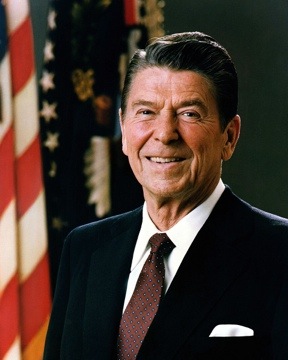
George Osborne’s success recalls to mind that other great non economist who rewrote the economics agenda and that was Ronald Regan. His rival George Bush Snr. denounced his economics as ‘voodoo’ economics, only to eagerly embrace it as Regan’s Vice President. Despite all the evidence to the contrary Ronald Regan’s economic policy was hailed as a success by politicians. He as with George Osborne preached the virtues of small government and he cut taxes and claimed to cut government expenditure. While he cut domestic spending on welfare he exponentially increased defence spending. Billions were wasted on his Star Wars programme. He funded this excessive expenditure through government borrowing and when he finally left office, the USA had its greatest budget deficit ever. George by comparison will by the time of the next election leave Britain with an ever spiralling banking deficit, leaving Britain at the mercy of predatory financiers.

However this essay is written in praise of George Osborne, so I must remain to central theme of why he is a great economist. While I could write about his Machiavellian skills in manipulating political friends and foes, there is a more interesting approach.

Economics is a subject that lends itself to charlatanry, because politicians are desperate for that one policy that will deliver success. When in conversation with economists their normal degree of scepticism is abandoned, they are so willing to believe that the proposed policy is the one that will deliver success. George Osborne must have realised early in his career that any well packaged and presented economic nonsense would sell. He would have had as a prominent politician have seen close up how the Treasury manipulated economic statistics and how whatever sleight of hand the Treasury used there would always be a coterie of economists praising the Chancellor’s policies. The reason economic charlatanry is so widespread is that economists only have the vaguest understanding of how the economy really works. To admit this as an economist would be to invite ridicule and so everybody pretends black is white even if they suspect that black really is black. Modesty is never a characteristic of any economist, bluster is the more usual characteristic. I am not suggesting that economists are ignorant of the working of the economy, so much as that they vastly overstate their understanding of the economy. If I can use an analogy into this pool of preening fish a predatory shark arrived, who realised how easy it would be to manipulate the consensus of views to suit his ambitions.

He would have found that politicians such as Ed Balls who play by the rules of the economic game were easy to manipulate. What any economist knows is that the future is uncertain, so predictions for the future have to be hedged around by ‘maybes’ and ‘perhaps’. Yet George Osborne has torn up the rule book, he knows what the future holds. He has set limits to future spending, including a welfare cap all of which Ed Balls as shadow chancellor has signed up to. If events turn out differently, George Osborne will happily abandon all his pledges giving some plausible explanation. While if Ed Balls becomes Chancellor he will be the hapless acolyte following the master, whatever happens he will stick to George Osborne’s targets.

At it’s worse economics as practiced in the UK is an invented game and those who stick to the rules in this imaginary game will always be at a disadvantage compared to those who have a complete disregard for the rules.

Charles Dickens’s was a far better economist than either Nick Clegg, George Osborne or Ed Balls

20140211-161851.jpg

If I wanted to understand the nature of our current economics problems I would be better turning to the novels of Charles Dickens’s than by reading articles on economics by the current generation of politicians. Rooted at the heart of the political consensus is a misunderstanding of the current economic crisis. Any politician if asked will say that its a crisis brought on by government overspending, which can only be resolved by a prolonged period of austerity which will reduce the deficit that is at the heart of the problem. This week this misunderstanding has been put into words by Ed Balls, George Osborne and Nick Clegg. They have all stated that the priority of government should be to reduce or eliminate the government deficit. All claim ‘responsibility’ as their guiding principle, all must suffer because of the foolishness of past governments. They all assume a highly principled stance of statesmen making the painful but necessary decisions to secure the nations future.

The cleverest of them must know that they are spouting nonsense, but go along with it as they it’s what everybody or so they believe, in the gilded circles of power believe. (The speculative frenzy that resulted in the crash that bought society to its knees in 2008/9 is never mentioned.) Lying was never a barrier to a successful political career. What we most need now is a Charles Dickens’s to expose the charlantry, hypocrisy and foolishness than passes as informed political debate.

Nick Clegg Deputy Prime Minister, a millionaire owner of luxurious homes on the continent preaches the need for self restraint on an impoverished people, as do the fellow members of a cabinet of millionaires. The country cannot afford to pay the living wage to workers on part time contracts but instead pays the minimum wage or less if agency workers; but it can afford to allow Barclay’s Bank to pay bonus’s of £1.8 billion to its staff. (most of which will go to top executives and highly paid traders). I read somewhere that City bonuses this year could top £80 billion. A word has been coined to characterise such behaviour ‘Pecksniffery’. Seth Pecksniff was a character in one of Dickens’s novels, an unpleasant hypocrite who affected benevolence and high moral principles. Best illustrated by the Conservative Minister who characterised the large numbers going to food banks as going there because the food was free. Those who would rather depend on charity than work for a living. Conveniently ignoring the fact that free food is only given to those in possession of vouchers given by a charity to certify real need, many of whom were the working poor.

20140211-162155.jpg

Self deception and hypocrisy should be regarded as two of the principles that inform economic policy making. These two attitudes are embodied it what is called supply side economics. It states that people are unemployed because of regulation and restrictive practices in the labour market. Trade unions, regulations on hours worked and on conditions in which people are employed only serve to push up the cost of labour, meaning that fewer workers are employed that might otherwise be the case. If trade unions are emasculated or abolished, labour protection laws removed the cost of employing labour will fall (wages) and many more people will be employed. All benefit because more are employed and the economy becomes more productive. This increased productivity will push down prices, so wages become worth in terms of what they can buy. Actually this has elements of a fairy tale in it. In the 1960’s when wages were relatively high compared to the other costs of production unemployment averaged 2%, today when wages are relatively low as a cost of production unemployment is 7%. If the unemployment measure used in the 1960’s was used, unemployment would probably be about 10%. Many of those now employed struggle to make ends meet.

There is one beneficiary from this change, the better off upper middle classes. Mark Harper the recently resigned immigration minister was able get as a cleaner for four hours a week at the cost of £22. This woman was an illegal immigrant who was probably desperate for the money. One consequence of the change in the labour market is that people are now cheap to buy. The Mark Harpers and Nick Clegg’s of this world can now benefit from a plethora of cheap services provided by people on poverty wages. I imagine there is much less concern about the servant problem today. In the sixties I lived on a country estate and my social betters were concerned about two things, the high cost of servants today and the insolence and less than respectful manner of those servants. Lack of respect deriving from the fact that servants would have no difficulty finding another job, so they were unwilling to adopt the demeaning behaviour expected of them. They as human beings had rights and exercised them to the perceived detriment of their betters.

Charles Dickens’s would have understood the behaviours of our governing classes and predicted that their economic policies would be designed to benefit the better off no matter in what guise they appear. Nick Clegg, George Osborne, Ed Balls etc. are all blinded by hypocrisy, unable to recognise that they govern in their own interests and that of their friends and not the nation. One image from ‘David Copperfield’ characterises today’s society for me. While David Copperfield and the other orphans sup on thin gruel, Bumble the Beadle and his friends enjoy sumptuous meals funded by money intended for the orphans. What better image to capture the nature of today’s society.

Economic Primitivism, a doctrine for the 21st century

20140117-181737.jpg

George Osborne (British Chancellor of the Exchequer) words on the EU prompted me to write this essay. He said that unless the EU modernised it would decline. What struck me was his understanding of the verb to ‘modernise’, what he meant by this was the freeing of the labour market and society from those regulations that hamper business. He wants the end of employment protection laws, those that limit the ability of firms to hire and fire workers as they please and that those keep wages unnecessarily high, the elimination from the workplace of all organisations such as trade unions which limit the freedom of the employer to innovate (particularly in employment conditions, insisting on minimum and maximum hours of work as opposed to the flexible British practice called ‘zero hours’ contracts.) There was a recent example of what George Osborne means by ‘modernising’ in Scotland. Jim Ratcliffe the owner of Ineos a petro-chemical plant in Grangemouth, Scotland, wanted a change in working conditions that would benefit the company but of little benefit to the employees, he wanted the ending ‘final salary pension schemes’, a no strike deal etc. To get the workers to comply, he shut down the plant, threatening unemployment for all the staff employed there. Added to this was pressure from both the UK and Scottish government’s on the employee’s union to agree terms which included government ministers supporting the company in media appearances. Obviously the unions and workers gave into to the employers demands. It was a good example of that effectiveness new phenomenon, the employer’s strike. Ineos now has a modern flexible labour force, willingly adopting modern work practices which enable Ineos to extract the maximum profit from each worker. It is this new barbarism of contemporary labour relations that I find unacceptable.

Society must also be modernised to achieve a good fit with modern industrial society. One enemy of the modern economy is the settled community. The British Treasury has long complained that the pattern of housing tenure limited labour mobility. Security of tenure, either long term tenure in social housing or as home ownership, stopped workers from moving from areas of high unemployment and low wages to areas of low unemployment and high wages, because they did not want to give up their good homes for less desirable ones in the areas of high growth. The Treasury achieved its aim through changes in government policy; now increasing numbers are living in private rental accommodation with little security of tenure. This means such housing can be put to its most productive use. When the Olympics came to East London, hundreds of tenants could be evicted to make room for higher paying Olympic visitors. Modernism in society means the breaking or dismantling up of any community organisation that might threaten ‘economic progress’. Perhaps the best example is the remorseless attack by all governments on local authorities, all changes in legislation have prioritised the needs of the business corporation over the local community. The powers that local authorities have to control unwelcome planning developments have been constantly diminished by government after government. Even if the council rejects an application from a ‘fracking’ company on the grounds that it was environmentally damaging, all the firm has to do is appeal to the government minister. It is extremely unlikely their appeal would be rejected.

From what I have written I cannot be called an economic moderniser; I need to find a term to describe myself. Reflecting on this I remembered a city trader who described the restrictions imposed on some dubious trading practice as Neanderthal and that made me realise that I am an economic primitive. As a believer in the regulation of the market place, I must be a believer in economic primitivism, or better put as economically regressive and socially progressive. I am amused by the screams of protest that echo round the board rooms, when it is suggested that their should be quotas for women on their boards. Obviously these men don’t recognise women as fully functioning human beings, capable of making the decisions necessary to run a successful company. Not much has changed in the City of London since I worked there in the 1960’s, when one senior member of the company explained his opposition to equalities legislation by saying ‘women are for the night’. What economic progressives such as George Osborne want is an end to all that regulation that has modernised society that is incompatible with business profitability. Gay marriage is fine but legislation that improves the conditions for women, ethnic minorities and disabled people in the workplace is wrong because it places burdens on business. All that most of us believe that makes modern society the good society he wants removed. What is his demonisation of the sick and disabled other than socially regressive. This is the same attitude as that of the Parliamentarians in the nineteenth century who opposed regulation to protect children in the workplace on the grounds that it would place an intolerable cost burden on employers. The economic moderniser is the one who opposes any social improvement that could possibly adversely affect the profits of any business.

Legislation to reduce the harmful effects of excessive alcohol consumption are vigorous opposed by the economic moderniser. They employ the strange argument that a minimum price for alcohol would penalise the poorer sensible drinker; ignoring the fact that the whole purpose of increasing the price of alcohol is to reduce consumption by making it more expensive. Also alcohol includes a toxin, ethyl alcohol and it can be damaging at even low levels of consumption. In fact the modernisers in government are very supportive of the drinks industry, ensuring that local authorities lack the power to regulate this industry in their own city. Both modernisers and the drinks industry think there is nothing wrong in recreating the conditions that gave rise to Hogarth’s 18th century painting ‘gin street’. A policy that looks to the 18th century for its inspiration is retrograde.

Unlike the members of the political class I don’t want Europe to be ‘modernised’, the modernity experiment has gone far enough. A good society cannot be one in which the average income is insufficient to pay for good housing. Does George Osborne really believe the modernisation of Greece, Italy and Spain has brought any real benefit to the people of those countries? Yet he wants the modernity experiment to continue.

If George Osborne is right, there is at choice between being an economic moderniser and a social regressive or being an economic regressive and social moderniser. There for me is no choice, GB business must accept some cut in its paper profits and some ‘regressive’ social legislation to bring about the good society. Paraphrasing George Osborne, if there has to be a choice between the ‘good economy’ and the ‘good society’, I would always choose the latter.

Osborne-oenomics explained

Nietzsche’s dictum is that philosophers are in error because while they write about man they never study real man, only their idealised construction of him. They construct ethical systems but never look at the source of those ethical systems, man. He demonstrates how the concepts free will and moral responsibility are of little use in explaining human behaviour. His psychology demonstrates that much of human behaviour is pre-determined, it is their physiological makeup that determines people’s actions not rational thought. Criminal behaviour is more likely to derive from an individual’s biological drives which they cannot control than from conscious decision making. Commentators would do well when commenting on George Osborne’s economic policy to observe Nietzsche’s dictum. Most would see his policy being derived from his reading of the Neo-Liberal commentators of whom they assume he is familiar with. This ignores two key facts, one is that he studied history and probably had but a nodding acquaintance with Hayek etc. and that he is a son of a baronet and it is this latter fact which provides a key to understanding George Osborne.

The baronet is at the lowest level in the aristocratic pecking order and being aware of their nearness to the masses, they have always been the most zealous in defending their privileges of social rank. They are all too aware of what a fall from social grace means. It is these people who have provided the backbone of the Conservative party. The defence of their position often led them to developing the most reactionary of principles. Any improvement in the lot of the servile classes is a threat. A guest at the dining tables of the baronetcy would be aware of the servant problem. The insolence of the lower orders making them such poor servants and the difficulty of recruiting servants as most of the lower orders rejected a life of servitude.

The greatest threat was progressive taxation, particularly taxes on capital. The latter threatened their holdings of wealth and they saw around them the break up and disappearance of many large estates. The social order of which they were part seemed to be disappearing. Since social democracy is dependent on progressive taxation to fund its activities; they hated social democracy as it was that progressive tax system that threatened their existence. They also hated the public services which made such taxation necessary. One service that attracted their ire was the National Health Service. Why should they make such a large and disproportionate contribution to a service that they use but only occasionally. As they would resort to private health care so as to avoid contact with the masses. Is it at wonder that coming from such a background the guiding principle of all George Osborne’s policy is the destruction of what remains of the social democracy of former years? The privatisation and destruction the NHS being the iconic government policy that by which it will be known in history.

Self interest lies behind the desire for a small state, rather than the desire to free enterprise from the the burdens and regulations of the nanny state. A small state does not require large tax revenues to fund its activities. Any policy which shrinks the tax burden on the better off will meet the approval of a baronet’s son. Is not likely a man from his cultural back ground would want to cut taxes? It is no coincidence that one of the first acts of this government was to let Vodaphone of it’s £6 billion tax bill and it is now letting the self same company avoid tax on the multi billion profit from the sale of its shares in Verizon. Tax avoidance is no longer an activity to be discouraged by government but one to be encouraged by the Chancellor. He has decided that multi-nationals that have off shore subsidiaries can channel any profits they make in the UK through these subsidiaries to avoid tax.

One cannot underestimate the impact of the culture of the baronetcy on George Osborne’s thinking. Some members of this social grouping in the heyday of the Social Democracy feared their extinction through a loss of their wealth and position because of what they saw as a penal tax system. Growing up in the sixties on a country estate with family friends in service; I could not but be aware of how this group saw the state as the author of their misfortunes. Any society will suffer periodic crises and the UK society suffered from an economic crisis in the 1970’s culminating in the extraordinary high annual inflation rate of 1974 which topped 27% . It was the OPEC inspired rise in petrol prices which largely caused this spike in commodity prices which caused the high level of inflation. Taking advantage of the weakness of the state in this crisis, the political right forced/persuaded the government to adopt Neo-Liberal policies that would ultimately lead to the demise of the social democratic state.

It is probably no coincidence that the doyen of Neo-Liberals Joseph Schumpeter was an aristocrat. Neo-Liberalism as espoused by George Osborne is the guise through which the baronetcy and others wreaked their vengeance on social democratic state.