Tag Archives: Ayn Rand

The Immorality of Current Economic Practice

Jeremy Bentham one of the more influential figures in 19th century economics was also one of the founders of the philosophy of utilitarianism. The foundational principle of utilitarian philosophy is that good actions are those that give the greatest pleasure to the greatest number. Those of an older generation of economists such as myself, will remember how utilitarian principles were used in the construction of market theory and in particular the laws of supply and demand. I think that utilitarian principles still influence economic theory and practice, although they have been modified with time. Welfare economics is still an accepted part of economic theory, a theory that tries to explain how the optimum levels of production can be attained in a particular economy. However the practice of economics has led to a very modified form of utilitarian theory, economic practice still aims at maximising the pleasure and happiness of people, but it is not always the maximising of pleasure of the majority, all to often economic practice can be directed at maximising the happiness of a privileged group.

Economic utilitarianism can now rewritten as follows,

happiness can only be maximised for the few through the pain and suffering of the majority’,

A recent example from business demonstrates this principle. Sir Phillip Green was only able to buy his third super yacht at the expense of his staff at BHS. There is  a rough equivalence between the money that he took out of the retail chain BHS and that which he paid for his new yacht. His yacht cost the jobs of 11,000 BHS workers. It can be argued that this one example of bad business practice is not representative of the theory of economics. However the most popular of current economic theories is supply side economics, which has been practised by both government and business over the past thirty years. This teaches that the major obstacle to maximising economic welfare are restrictions that the limit the supply of the factors of production, the principle factor being labour, that is people. Governments have since the 1980’s have successively removed employment protection legislation, so that today there are very few restrictions on how employers can use their workers. Given the removal of these protections Sir Phillip Green had few obligations towards his workers and could pass on his near bankrupt company to another knowing that he could avoid having to make redundancy payments and having to honour the pensions payments promised to BHS staff. This is not a unique example but just the latest in a long line of business owners of refusing to take any responsibility for their staff. If it had not been for the adverse publicity in the media and the hostile reaction of some MPs, his actions could have been put down to yet another failure of a UK business that failed to adapt to the times.

The name Ayn Rand is little known outside political circles, the media and the profession of economics.Yet this novelist cum prophet is the inspiration for much of current government policy.  What she preached was a crude social darwinism. The poor did not deserve to survive in society to which they contributed little. The poor through their low incomes and poverty demonstrate their unfitness to survive ,as they cannot even provide for themselves. In her novel ‘Atlas Unchained’ she sees the death of so many of the worthless people as a necessary means of social cleansing. The heroes of her books are the billionaires and the money men, those who through their own efforts have made millions. Any restriction on their activities such as  taxes on their incomes only makes society the loser, as it limits the creative and wealth making activities of these individuals.

‘Randian’ philosophy is applied to welfare policy. Those who claim benefits are part of the dependency class. These people who have come to depend on the state for their income and who in consequence have lost the incentive or will to provide for themselves. The harshest of sanctions are required to get this class of people into work, any suffering of benefit claimants is justified, as it the stick required to make this class of people work. This why the government can be indifferent to the suffering of those deprived of benefit for a number of weeks for a minor infraction of the rules. They don’t mind if these hungry and desperate claimants have to resort to food banks to survive, as they provide a useful example to others.  Hunger is the best spur for making people work.

Even in the benign 1960’s this malign philosophy was active within economics. At that time unemployment was around 1% of the workforce, it hovered around 100,000. People thought that the full employment of the post war period was a success. I believed that myself and was shocked to discover at university that there were economists advocating an increase in unemployment. They wanted the government to take action to increase unemployment to about 3% of the workforce. This they claimed would reduce the pressure of prices and cut inflation. Yet this was a time when the majority of people remembered the horrors of the Great Depression of the 1930’s. They found little support at first in government, because there was no desire to return to the 1930s and the misery of that period. Then for these economists the utilitarian maxim would have been

the happiness of the majority can only be achieved through the suffering of a minority’, now with ‘Randian’ philosophy dominating government it can be rewritten, as ‘the happiness of the minority can only be achieved through the suffering of the majority’.

This may seem an overly pessimistic assessment of government economic policy, when the majority of people are well fed, well housed and living well. The misery seems to be confined to the precariat, that is those in insecure low paid employment such as cleaners and shop workers. However the impoverishment is slowly seeping upwards. Large numbers of whom would have been the future well off middle classes, university graduates of whom large numbers are looking forward to an insecure future of low pay and insecure work. The government is actively working to reduce the privileges and protections enjoyed by the professional middle classes in their employ. Teachers and doctors are just two groups that are expressing discontent with the negative impact of government policy on there working lives.

There is no reason why economics should be directed by such a malign philosophy. Economic policy in the 1950s had the aim to maximising growth, employment and the welfare of the people. Apart from a small minority economists shared these goals. Only bad economics as practised today aims to immiserate the many and enrich the few.
Why does our government seem to be determined to increase the levels of criminality in our society

claudeduval

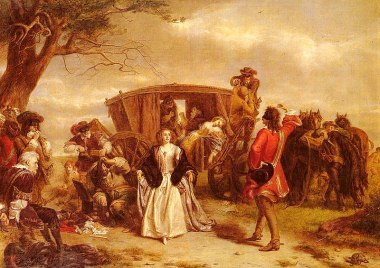
The famous incident in which Claude Duval the notorious highwayman tells a lady  whose coach that he has just held up that in exchange for a dance he will refrain from robbing her.

Our current government claims to be one that is tough on crime, yet in practice it seems to being doing the opposite. What I am going to suggest that the government through its policies is reverting back towards an earlier model of society, one similar to that of the 18th century. In that century policing was massively under resourced. Crime prevention and detection was in the hands of the Parish Constable. A man who had to rely on the support of his parishioners to arrest criminals. Policing was so ineffective that the government had to resort to the extreme measure of making most offences capital offences as a means of deterring crime. The Black Act of 1723 tried to compensate for the lack of an effective police force by making some 50 offences punishable by hanging, for example the punishment for breaking a farmer’s gate was hanging.The only way the to keep one’s household safe was to ensure that all the doors where secured by good locks and a variety of loaded guns where at hand to fend off any intruders. Ominously I was told by a member of the police force that his recommendation was to secure one’s house with good locks and stay in at night, he thought the policing levels were inadequate to guarantee the public’s safety. One senior police office ventured the opinion that he would not go into the centre of Manchester at night because it was not safe.

The combination of weak governments and under resourced policing is all to evident in Eire. Even before the financial crash and the austerity programme that forced large cuts on the Garda (Eire’s police force), this force was struggling to cope with the criminal activities of both terrorist groups and criminal gangs. These gangs were then so powerful that they could shoot a campaigning journalist at a busy cross roads and get away unhindered. Now an even more depleted police force is unable to prevent tit for tat killings that are occurring between these criminal gangs. Yet in spite of the evidence of the evident dangers of relying on an under resourced and undermanned police force to contain these dangerous criminal gangs the government is insistent on following the unwise path already trodden by Eire.

There is ominous evidence from my home city that this is already happening. Cuts to the number of the police have meant the ending of an effective pro active drugs strategy. The teams that were used to break up and disrupt the drug dealing gangs have been disbanded and the remaining police officers used to street patrols. The police will now only react to evidence of drug crime and only if it is thought that the individual in question has drugs in excess of a street value of £10,000. This means that the street dealers which are the bread and butter of the organised drugs trade are given a relatively free hand.

Why despite all the evidence of the dangers of allowing the drugs gangs to flourish has the government adopted policies that will encourage these gangs to flourish.

Why?

There are several possible answers but the most likely is the change in the philosophy of the government. The adoption of the brutalist philosophy of Neo-Liberalism, which emphasised the supremacy of free market, competition and the end of regulation. Regulation it was argued did not prevent wrong doing so much as impose additional and unnecessary burdens on business. However Hayek (The Road to Serfdom) who was the founding father of Neo-Liberalism did not argue for the extreme Neo-Liberal system of today. He believed in the good society, a society in which all paid tax for finance those items that made up the common good. He never once in his writings claimed that the ideal state is one in which the tax authorities collaborated with the rich in a programme of tax avoidance. He would have been horrified at the programme of tax cuts that reduced the effectiveness of the police and other public services.

Rather than looking to Hayek it is the writings of a novelist and minor philosopher called Ayn Rand that are the inspiration for the new Neo-Liberal State. In her influential novel “Atlas Shrugged” she wrote that the billionaires are the saviours of society. It is their energy and drive that moves society forward. Any restrictions on the activities of these people negatively impact on society as it prevents them fulfilling their primary purpose which is wealth creation. Therefore in her good society there are to be few regulations imposed on the billionaires or the businesses they run. Regulations that protect workers at their place of work are no more an unnecessary increase in costs as they disproportionately increase the costs of labour far beyond the contribution labour makes to wealth creation. All these high labour costs do is reduce the number of goods and service produced as what might have been produced if labour was fairly priced is now uneconomic. Similarly high rates of taxation on the rich do little more than reduce the amount of money that they have available for investing in the economy. In contrast the poor and the great majority contribute little to the economy, they are merely the simple tools that the billionaire uses to create wealth. Only if the billionaire class is freed from all restriction will they be able to use their energies creatively to add to the wealth of society. It is this author who is the inspiration behind the new Neo-Liberal State, that is the Britain of 2016.

Although her books are widely read amongst students at our elite universities, there has to be another reason as to why she has been adopted as the political philosopher of choice by our political classes. I think part of the answer is that they identify with her billionaire class. They see themselves as much victims of society as the billionaires of Ayn Rand. These leaders are continually frustrated in their great schemes for change and reform by the opposition of the little people. People of little worth, who lacking the skills or even intelligence for government think they have to right to a say in how policy is made. This contempt for the little people is demonstrated in the distain our leaders show for them. One former leader spoke of constantly being stabbed in back by public sector workers who failed to understand that the policies he was introducing were for their benefit and the good of society. Another continually referred to his opponents as the ‘blob’, abusive terms are the common currency of politicians who want to minimise the role of the people in a democracy.

It must also be mentioned that the political classes believed that the political and economic reforms espoused by Ayn Rand would if adopted would lead to a new political and economic dynamism in what they saw as a moribund society and economy , too rooted in the practices of the past.

Rather than continue with a psychological analysis of the political classes, what I want to demonstrate is the impact of what I shall call ‘Randism’ has on society and crime in particular. If the billionaires and their proxies the great business corporations are to be freed from almost controls and regulations, there are other greater predators the will benefit, which are the organised crime networks.

Changes in the legal system, in that is company law and tax law have created a situation in which the big corporations are largely outside the law (at least in the UK). What has been created is an opaque system of company organisation the will frustrate any attempt at regulation or control. However such a system is open to abuse and it offers possibilities for criminal organisations that had not previously existed. Formerly in the UK criminal groups used small businesses as a front for their illegal activities, such as scrap metal dealing, now they have the opportunity given the opaque nature of company organisations to move into large scale legitimate business. What is to be feared that the change or weakening of company regulation could result in a similar situation to that in southern Italy where the criminal gangs have penetrated legitimate businesses.This has already happened in the meat processing trade, there was a recent scandal in Britain where it was discovered that criminal gangs had infiltrated the food processing industry and were able to pass off horse meat as beef. While a few minor wrong doers were arrested the members of major criminal gangs were never arrested. The abolition of most regulation relating to food production has not freed the large supermarkets from unnecessary regulation but opened up a new field of opportunity for organised crime.
Perhaps the fate of the National Crime Agency illustrates best the dangers of an opaque legal system. The National Crime Agency was set up to tackle organised crime or more particularly the large drug gangs. It was to be a British FBI, with some of the best detectives seconded to it. However it has been largely ineffective in its main purpose which is to seize the assets of the big criminal gangs as a means of rendering them ineffective. Its ineffectiveness is a consequence of legal changes designed to minimise the impact of regulation on the big corporations and it is this lack of legal powers to intercept the flows of cash within big business that means this agency is unable to disrupt the large organised crime enterprises. It is not only in Britain that the law enforcement agencies are unable to confiscate the income of these criminal empires but also in Eire where the crime lords can amass their ill gotten gains without any apparent interference from the legal authorities.

Governments know that the lack of effective financial regulation means that the large income flows that enable the criminal gangs to prosper. What prevents them taking effective action is the corporate interest which is opposed to any stricter regulation of international finance. They see any change as a threat to them, what they want least of all is to be liable for their fair share of taxation. They will continue to work against any effective control of financial transactions, even if it means tolerating the growth of large scale criminal empires.

The political classes in Britain with the belief in Ayn Rand’s Neo-Liberal dream would never countenance any change in law which might disadvantage the billionaires or their proxies the large business corporation. Their rigid adherence this extreme ideology or dogma means that effective action will never be taken against these criminal empires as the consequence of any such actions may have what the big corporations see as negative consequences for them.

This belief is all to clearly illustrated in the actions of the British Treasury who believe that any government spending reduces national income and so the minimum should be spent on public services such as policing. Newspaper columnists can continue to write horror stories about the iniquities of the trades trade but the Treasury would never countenance any increase in spending on the police as they believe it would negatively impact on the nations wealth. They believe that if the price of greater wealth is increased criminality, that is a price worth paying, as its better to live in a dynamic society that has high growth and crime than in one that is the reverse.

Les Miserables and the economics of revolution

  
http://www.dailytelegragh.co
Towards the end of the film ‘Les Miserables’ there is a very moving scene in which the young radical students who rose in revolt against the government are shot by the police. The revolt is doomed to failure as they fail to gain the support of the wider Parisian population and the authorities are easily able to suppress this uprising. This is the popular perception of revolution, that is a futile uprising by the young against the tyranny of the old order one that is easily put down by the authorities. Any history of the 19th century consists of a long list of failed uprising, the Poles in particular participated in number of uprisings against their Russian overlords, all of which ended in its participants being imprisoned or going into exile. However this is a misunderstanding of the nature of revolution, the successful ones usually don’t involve violence and generally take place over a number of years. What I mean by revolution is the shift in people’s attitudes that can be best described as a sea change in their behaviour and attitudes. 
Revolution of the Right
Often this type of revolution is initiated by the right, as instanced by the successful revolution by the right against the welfare state. If Britain is taken as an example when the welfare state was introduced it was seen as a bulwark against the twin evils of sickness and unemployment. It was seen as an individual right that the state should provide an income for those unemployed through sickness or bad luck. The political right in Britain never really concealed their dislike of the welfare state principally because they saw it as an injustice, that the rich were expected to pay more tax than the poor to fund welfare programmes. They ceaselessly campaigned against the iniquities of the welfare state. Now they have practically succeeded, welfare payments are now seem as benefits to a group of undesirables the work shy. The emphasis now is on reducing benefits and targeting the claimants with sanctions to force them into work. Only last week the welfare minister announced to general a claim that he would target the disabled forcing more of them to take work, through making it harder to claim benefits and by reducing individual welfare payments. The assumption is that by making life progressively more difficult for them, they will take up employment to avoid the unpleasantness of life on benefit. As one who has worked with disabled people, I can only see this minister as an uncaring monster largely lacking the human traits of empathy and compassion.
Now the philosophies of such as Ayn Rand are the guides to life for the decision makers in society. While it may seem harsh to suggest that a writer who would welcome the death by starvation of hundreds of the useless poor provides the distorting ideological glass through which these people view the world, evidence suggests otherwise. Recently our rulers withdrew the Royal Navy from the task of rescuing refugees adrift in the Mediterranean, on the grounds that by making the journey across the sea safe it would encourage migrants to attempt the crossing. The unspoken assumption was that if some refugees drowned at sea it would discourage the rest from trying to enter Europe. This policy was not questioned by any of the opposition leaders, so demonstrating that the spirit of Ayn Rand flows through our the veins of all our political leaders. Now it is ‘cool’ to be uncaring, as this is regarded as hard nosed realism, as distinct from the naive sensitivity of the political left. 

Revolutions of the Left

Unlike revolutions of the right which are initiated at the top of society, revolutions of the left are initiated by those in the middle and lower orders of society. This means that they are inevitably doomed to failure as the top orders of society command the instruments of power. The legal system can be directed against the insurgents. Imprisonment being but one of the means of suppressing such people. Yet such revolutions are not futile even if they end in defeat. They can despite their repeated failures change the nature of society and ultimately achieve their desired ends. This can be demonstrated through a metaphor, these revolutionary movements are as a wave from the sea smashing against a rock, the rock at first repulses the wave leaving it to fall back into the sea, yet the constant pounding sea will eventually destroy the rock. Similarly while the revolutionary movements of the left are initially doomed to failure, they can through insurgencies change society. By revolutionary surges I don’t mean violent revolution, so much as oppositional social movements which constantly rise and fall, but which eventually undermine the existing social structure, which leads to change.

The sea metaphor has further applications. British society at present resembles a placid sea but which under the surface there are currents swirling which can change the nature of the sea. One such current which has surfaced in the insurgency which threatens the Labour party. In the current elections to find a new leader it is the outsider Jeremy Corbyn who seems to have an unassailable lead in the contest. He represents a very different politics to that of the main stream party, a politics well to the left of the current parliamentary consensus. It is quite likely if elected his term as leader will be brief, as the parliamentary party will find means of rejecting a leader they don’t want. However he is representative of a much larger social movement, a left insurgency that rejects the harsh austerity programmes endorsed by the parliamentary party. This current which is sweeping through the party will change it whatever happens in the leadership contest. There are other similar examples of insurgency in Europe such Podemos in Spain and Syriza in Greece. Whether these individual insurgencies succeed or fail, what matters is that the initial process of undermining the unequal social order has begun.  
Then there is in the USA the ‘Fast Food Forward’ campaign whose aim is to secure a national minimum wage of $15 an hour, if it succeeds it will transform US society and economy, it is yet another insurgent movement. What these movements have in common is that they form outside the political system, as that system is constructed so as to prevent change, rather than facilitate it. Change of this significance will only take place in response to change from outside the political process. The established political process is dominated by the dogmatists who believe that the existing social and economic order is the the best possible one as it is founded on the universal truth of the free market. Politicians believe their only role is to implement changes to make the market system work more effectively, keep things as they are and if necessary repress those movements campaigning for change.

The economics of change and revolution

Society comprises of competing social groups with conflicting claims on its wealth. Rather than stable social order organised around one universal organising principle  that of the free market, it is a kaleidoscope of competing different groups all wanting very different orderings of the social system and its wealth. Society at best is the ring in which these groups compete, but according to rules of the competition.  Violence for example as a means of effecting change is ruled out. However if the dominant group refuses to recognise the legitimacy of the competing groups and tries to suppress them, violence will be resorted to as the social order or the rules of co-existence have been destroyed by the dominant social group.

Economics to have any relevance must be a dynamic subject one that can accept change, not a subject that believes that it has found the holy grail of social existence in the free market. It must recognise that the society of today can be very different from that of yesterday and so should accommodate that change. Economics cannot be a subject of universal truths, but one of partial truths, it must establish which of those truths in its current content list can be used in the study of different societies. A modest subject that seeks to find truths in very different economic and social systems, rather than have a universal blue print to which all societies and economic systems must conform. 

The Deceivers

 Theology with its emphasis on ‘other worldly’ experiences appears to be at the opposite end of the spectrum of thought to economics which deals with the mundanity of every day existence. It’s a science of facts far removed from the speculative thinking of the theologians. Yet this is a false understanding of theology, as it can be as every day as economics, the only difference being the approach to life. A theology that had no relevance to daily existence would be pointless subject of study. Adopting something of the perspective of theology would be of benefit to economics.


What I intend to do is demonstrate how an analytical framework taken from St.Augustine’s Fifth Century classic, “The City of God” can be used to explain developments in the economy of today.


The City of God & the City of Man | Koinonia palamas.info

Although  Augustine’s book is primarily intended to explain why the eternal city of Rome fell to foreign invaders, what interests me particularly is Augustine’s account of the role of its Gods in Roman society. The Roman’s assumed one of the reasons for their success was their fidelity to their ancient Gods. Castor and Pollux the heavenly twins were thought to have intervened in a crucial battle to assure the Roman army of victory. In gratitude to the two Gods the Romans constructed temple in the forum for their worship. When Rome fell it was thought by some that the cause was the abandoning of the worship of the old Olympian Gods, the Gods who had always stood by Rome and ensured its survival and success. Augustine suggested a very different Christian version of Roman history


The Olympian Gods were for Augustine not Gods but demons who lead mankind astray. Stories about these God’s such as Zeus’s rape of Europa in the for of bull demonstrated their demonic nature. The nature of these Gods was capricious and cruel.  Apollo was for instance challenged to a music contest by the satyr; unfortunately for Marsyas he was judged the loser and for having had the impudence to challenge a God  Apollo hung him upside down and flayed him alive. Roman cities that had temples of Mars, chained the statue to the temple in the hope that the God would not wander  and provoke war with a neighbouring city. 


Augustine saw these God/demons as having bodies of air and circulating around the earth in the atmosphere waiting for the opportunity to intervene in the affairs of men and cause mischief. Misleading mankind was not difficult for them as all men were corrupted by original sin and easily corrupted. Despite pretending to be protectors of Rome, they had according to Augustine in fact allowed it to be sacked in the past by the Gauls; so the sacking of Christian Rome by the Visigoths was little different from the sacking of pagan Rome by the Gauls in earlier centuries. The visions and dreams that Roman’s had of the God’s which they thought gave them insight into future events, were nothing more than trickery intended to mislead the dreamer. On innumerable occasions Roman Emperors and Generals made sacrifices to the God’s to ensure victory. Yet on so many occasions instead leading their armies  to victory they led them to defeat.


The Gods for Augustine were the deceivers of men, leading them into error from their own sense of mischief. This concept of a group of deceivers leading mankind into error by making deceptive promises is a useful concept when it is shorn of its supernatural context.  I would like to recast Augustine’s concept of a world of men mislead by a race of demons into a more human form. Rather than seeing original sin as the corrupting element in mankind, I see ambition as the corrupting element, something best expressed in the term vainglory. Leaders wish to be remembered in history as men and women who changed the world for the better. While this is a laudable ambition it can led them into following certain practices or beliefs which they believe will improve the lot of mankind, but which in fact does the reverse. Unlike the demons of Augustine these deceivers often deceive themselves as they really do believe that they have discovered the holy grail of human betterment. The current race of deceivers are not demons but Neo-Liberal economists and philosophers. 


These philosophers and economists have been campaigning actively since the 1970’s for the adoption of Neo-Liberal economic policies and the creation of a free market society, one largely free of government intervention. The argument in the 1970’s by these economists was that by freeing markets to find their own equilibrium there would no longer be any foreign exchange crisis, as currencies would freely move up and down to their natural level. (This was a time of crisis when the IMF was constantly having to bail out countries such as the UK which were experiencing such crises.) Despite that the world has not seen an end of foreign currency cries. However Neo-Liberal economists would assert that these have been due to governments not wholeheartedly adopting the Neo-Liberal agenda. 


The UK is one of the countries that have most wholeheartedly adopted Neo-Liberal economics, through the practice of supply side economics. Supply side economics stated that the cause of economic under performance were the various restrictions imposed the markets that supplied the factors of production, in particular labour. Following these policy prescriptions the government almost completely destroyed the powerful trade union movement and removed most of the employment protection measures that previous governments had imposed on the  labour market.  The UK now has one of the most flexible labour markets in the developed world, a market in which employers have few restrictions on how they use labour. Yet the UK is not an economic success story, 1 in 3 workers in the UK are receiving less than the living wage, having to rely on government handouts to held them pay for their accommodation, food and clothing for their families. The trade deficit also has spiralled out of control, in the 1960’s it averaged 0.2% of GDP, whereas today it is 30 times larger at 6% of GDP. Despite all the increased flexibility in the labour market, the productivity of the average British worker is significantly less than in our European partners such as Germany or France. However Neo-Liberal economists continue to assert that the economy is healthier than ever, usually citing some statistics to prove their point. They are self deceiving as many of the statistics that really matter show an economy that is performing badly.


However the self deception is largely that of the politicians, as economists have always known that changing to a Neo-Liberal economy would create a substantial group of losers. The deception has been in that they have always dismissed the losers as a small and insignificant minority. Those British economists asking for reform in the 1960’s argued for an unemployment level of 3% and for those  economists this would be made up largely of those people temporarily unemployed and who were between jobs. However the more influential have been the public choice theorists and Neo-Liberal philosophers such as Ayn Rand, who have argued for a more social Darwinist approach to public policy making. Ayn Rand argued that the poor had little place in society as they contributed little to it and saw starvation as one means of reducing the number of useless mouths. (Atlas Unshrugged). She has been extremely influential in British political circles and her followers have been effective in creating a society wide contempt for the poor, which has led to a whole series of measures directed against them. These politicians have never gone so far as advocating the starvation of the poor, but they have implemented policies that have impoverished them. What these deceivers have been successful in doing is portraying the poor as the OTHER, a group to which the majority never belongs. They have successfully concealed from the public imagination that disabling illness is not confined to the poor, but it can affect anybody and only the richest can avoid being driven into poverty by disabling illness.


Perhaps the worst of the deceivers are the public choice theorists who pretend that privatising public services will only create winners as we all will benefit from cheaper public services. However these are labour intensive services and cheaper services can only be delivered through reducing the incomes of the people working in these services and through worsening their conditions of service. One very effective way of doing this is to abolish extra payments for working outside normal hours, or by using zero hour contracts, by rewriting the terms of employment or using temporary agency staff. All of which enables the employer to get more for less.  Today my dustbin was collected by the refuge service on a day which for most is a public holiday. In past I had to wait until the day after the public holiday. While most people will probably appreciate the fact that there is no break in the service; I am concerned that the families of the three men on the lorry are deprived of their company on a holiday. Am I in a minority in preferring to have my bin collection delayed by one day so these men could have a day with their children?


These Neo-Liberal deceivers have succeeded in portraying those who lose as a consequence of their reforms as the losing OTHER. Yet there is a danger that this other might become the majority should society move backwards in recreating the widespread hardship and misery of previous eras. These economists, philosophers and politicians have successfully deceived the majority by portraying their changes as necessary if society and the economy are to prosper and that the only losers will only be the insignificant OTHER, not them. Yet the purpose of a Neo-Liberal agenda is to create a large impoverished serice or underclass to service the deserving better off minority(?). In fact in 2011 a group of politicians published a book which blamed the poor for their plight, they were poor because they lacked the work ethic. I don’t think it’s wrong to compare the Neo-Liberal deceivers of today with Augustine’s demons, as both promise a better tomorrow, while in fact intending the opposite.


Do our leaders still not worship the old pagan Gods?

This short essay is an attempt to answer a conundrum  that puzzles me. All the members of our government would claim if pushed to an extreme to be Christians. There are even some members of the government who demonstrate an extreme piety by being regular church attenders and by being active  proselytisers for their faith. Christianity is foremost a religion of compassion and caring, yet this government treats the most vulnerable of people with inhuman contempt. Today it was in the papers that the government was stoping the personal care allowance for an eight year old girl with a distressing and disabling illness. It is the type of illness that makes the child totally dependent on her adult carers.  With complete inhumanity this government denied the money for care, because the British father worked mainly in Germany and therefore it was up to the German government to provide funding. Even when claimants whose lose benefit commit suicide, this most inhumane of governments remains unmoved. Obviously this government is unfamiliar with the gospel text, in which Christ when surrounded by children and tells his disciples that if anyone harmed these children it would be better for him that he threw himself into the sea with a millstone around his neck, rather than face the wrath of God. (Matthew 18:6)

What kind of God I wondered do the members of this government worship? Obviously it is not the Christian God with which I am familiar. The members of this government see their actions as virtuous so what God can possibly condone such inhumanity? Whatever God it is it cannot be the Christian one. 

One candidate is the secular religion, which goes by the name of Neo-Liberalism. Practitioners of this religion worship the market and believe that it this this very secular deity that will distribute wealth to each according to their deserts. They do realise that the free market will at times create human misery, but they believe that the good the market does outweighs the bad.

However the explanation lies with the religion of entitlement and privilege that has pre-dated Christianity but which has continued to coexist with Christianity. Christianity was a break from the religions of the past, which were little more than state religions. Religions whose role was to validate the social order, for whom the people were just an anonymous mass. The only individuals that mattered to these religions were the kings and the warrior heroes.  In contrast the heroes of Christianity were the common people fishermen, carpenters and tax collectors. Christianity was a religion of individualism, one that threatened the existing social order as it saw merit in all not just the rich and powerful.  A religion that would appeal to the oppressed groups such as slaves and women,  who were the majority of its early members, a religion of the downtrodden.

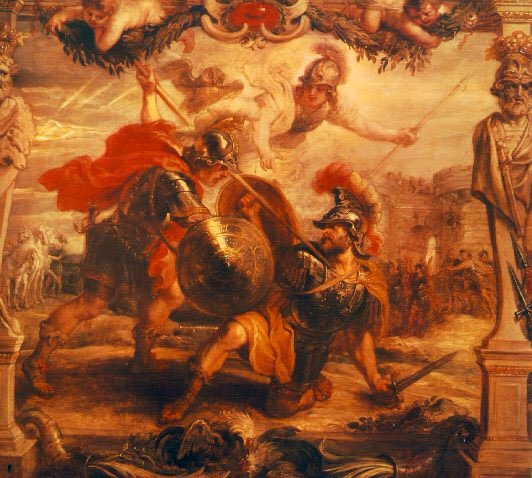
Achilles Slays Hector, by Peter Paul Rubens (1630–35).

One of the  best examples of a pre-Christian religion of entitlement and privilege is the religion of classical Greece, that of the Olympian Gods. Homer in his two poems ‘The Iliad’ and ‘The Odyssey’ gives expression to the beliefs of the classical Greeks. In the Iliad the poor or the ordinary Greeks only get mentioned once. This is when a boastful soldier from the ranks foolishly challenges Odysseus (King of Ithaca) to a boxing match. Odysseus brutally beats the upstart challenger to a pulp, to the approval of the watching Gods and Homer. Throughout the epic story of Odysseus’s return from Troy, the members of his crew, the ordinary seamen are who crew his ship are almost never mentioned. When Odysseus finally returns to Ithaca he has lost all his crew through various misfortunes, yet he never expresses any regret about their loss. For Homer and the Olympian Gods of Greece, all that is of concern or interest are the actions of the heroes, all of whom come from a rich aristocratic warrior class. The masses or majority are merely there to provide a backdrop or audience for these aristocratic warriors. Throughout the Iliad the only conflicts described are those between the various Greek and Trojan aristocratic heroes. The war virtually stops while the ordinary soldiers observe the conflict between Achilles and Hector beneath the walls of Troy. Classical Greece is an aristocratic society whose religion only attributes any worth to the great and the good. Regret is only expressed over the death of the heroes, as with the funeral games held for Achilles. Only aristocrats can be heroes, ordinary people lack the virtues necessary to make them heroes or interesting to the Gods.

Only a religion that treated the common man with insignificance would be of value to our new governing classes. Rather than heroic warriors we are now governed by a class of less than heroic bankers and financiers. George Bush’s advisors who pushed for the war in Iraq were largely ‘chicken hawks’, men seconded from the large corporations who when young dodged the Vietnam draft. This new class of financiers, hedge fund managers and bankers, needs a greater vision to validate their superiour position in society. Something similar to Homer’s Iliad which glorified the heroic aristocrats. These self proclaimed ‘movers and shakers’ need a poet of Homer’s stature to justify their acquisition of vast wealth. Lacking a Homer, their virtues are lauded in such books as Ayn Rand’s ‘Atlas Shrugged’, a book in which her billionaire heroes show the same contempt for the common man, as exhibited by Homer’s heroes. In this book thousands of the useless poor die from hunger, freeing the heroic billionaires from the burden of caring for this group of useless humanity.

What Ayn Rand and others such as Friedrich Hayek proclaim is a philosophy that frees the rich and powerful from the obligations and restrictions that are thought to make for the good society. Tax avoidance becomes a duty as the billionaire is better equipped to spend his money wisely, than is the wasteful state, who will foolishly squander its tax revenue.  Poverty for example is no longer a social evil but a spur to the poor for self improvement.


Posted: Oct 24 Twenty Fourteen

By: Silvia Hoffman


The new class of financiers and politicians want more than the rather unappealing philosophy of Neo-Liberalism, as there are only so many ways that selfishness can be redefined as a virtue. Fortunately for our new governing classes of politicians and financiers, the Christian tradition is sufficiently plastic to be written to favour the rich and powerful. As Constantine proved, when he oversaw a remaking of Christianity as a religion of empire and power in the 5th century CE. These classes have successfully used Christianity as a means of sacralising the social order. The role of monarch is God sanctioned at the Coronation service, any sense of social injustice is dissipated by emphasising that the poor will get their reward in heaven. The campaigning priests of South America who preached liberation theology were silenced by the Vatican. It was a Vatican that preferred the poor getting their reward in heaven than on earth.   

Theologians have used the concept of accommodation to explain how the organised churches drop those parts of their doctrine that are a threat to the established social order, so as to facilitate their acceptance within society. What I am suggesting is that the Christian churches long ago won acceptance by incorporating into their doctrines an acceptance of the old religion of power and privilege. The position of the rich and powerful in society was sanctioned by God.  In England this new God had many of the characteristics of the old pagan Gods such as Odin and Thor. This new Christian God sanctified wars of conquest much like the deities of old.  One of the first Saxon Saints was St. Oswald a warlord and king who was killed by a pagan adversary. Many of the new evangelical churches have so far accommodated to contemporary society in that they preach a doctrine of business success rather than one of compassion. Even the new Archbishop of Canterbury has instituted a reform programme to make the church more business minded. The culture of business targeting  supplementing the existing practice welfare practices


Parish church in Sankt Oswald ob Eibiswald ( Styria ). Statue of Saint Oswald riding a horse.

There has always been an uneasy alliance in the church between what can be called the Christianity of compassion and the Christianity of power. This compromise is represented by two twentieth century Archbishops, Archbishop Temple the social reformer and Archbishop Cosmo Laing a conservative, who wanted to restore the old power and privileges of the church. The first a reformer who said in a speech, that if it was possible the rich would charge us for the air we breathe, while the second wanted to increase the wealth of the church by reinstating the collection  church tithes (a practice that had long fallen into disuse.)  

What I am arguing is that the practice of accommodation has led to the churches accepting, all be it implicitly many of the characteristics of the old pagan religions into their Christian practice. Is not the God of George Bush and Tony Blair who sanctioned the war of Iraq more like Zeus than Christ? The Christ who had an abhorrence of violence, is replaced by one who advocated turning the cheek has been replaced by a Zeus like Christ who hurls thunderbolts to destroy his enemies.  In this accommodating church it easy for a cabinet minister to find an accommodating priest who will be accepting of the most inhumane of policy decisions. The old religion of power and privilege is very alive in today’s  Christian church.