Category Archives: christianity

A God for an Economist

Whenever I confess my belief in a God my friends are incredulous. They cannot understand how a person who they consider an intelligent rational thinker can believe in such a superstition. What makes my position seem even more ludicrous is that I am a negative theologian, that is I believe that God in his essence is unknowable. Bertrand Russell pointed out that is illogical to believe in something or someone that is unknowable as a knowledge of such a being is impossible, it’s a logical contradiction. How could you know if you did not know? However I want to turn these arguments on their head. As an economist I talk about the economy but I as with my thousands of fellow economists don’t really know what the economy is in its essence. I can talk about markets, the balance of payments but they are only certain highly visible parts of the economy. Classical economists and those of a Neo-Liberal persuasion will claim that the economy consists of a number of inter related markets. The falsity of this claim is demonstrated by this simple truth, if economists understood the true nature of the economy they would have at their disposal all the tools necessary to manage and control the economy. Economic crises would disappear instead of occurring at regular intervals and the economy would be on continuous trajectory of growth. The welfare of all would be maximised. History demonstrates the fallibility of economists, all to often they get it wrong. It should not be forgotten that when the financial crisis struck in 2008, the majority of economists were caught by surprise. Only a small minority expected a crisis, but they were a small disregarded and isolated minority.

I do then believe in the existence of two entities neither of which I can really know in essence. It can be argued that while I may not understand the real nature of the economy, I am every day affected by the reality of it, it is not something that I cannot ignore, it is just there. The economy generates the tax revenues from which my pension is funded, everyday I participate in this self same economy that has the shops and chains of distribution from which I buy the essentials and good things that make my life bearable. One such good thing is the cappuccino that I buy daily at my local Salumeria. Similarly nobody would deny that they are affected by the good and bad actions of others. What hurts most, being betrayed by a friend or being unable to buy the latest IPhone through lack of funds? We all participate daily in a network of relationships whose nature determines our sense of well being. However whether they are defined as spiteful, hurtful, mean, bad or evil actions, the consequences of such actions can be devastating for the victim, more so than any economic loss. Similarly friendly, helpful, kind or good actions can transform the life of the beneficiary of such actions.

Fiction provides the classic example of a life transforming good action. The Priest in ‘Les Miserables’ who forgives Jean Valjean for his theft of the church’s candle sticks. If he had not forgiven him, Jean Valjean would have been sent back to the prison galleys where he would have lived out a short and wretched life. Human relationships can be explained or described in many terms, but all too often they are permeated with a sense of good and bad. Theologians such as myself identify that sense of good with God.

There is a tradition of Christian Neo-Platonism that goes back to St.Augustine, a tradition to which I belong that identifies God with the Good. Identifying God with the good, transforms God into a solely moral entity, an identification which I find sufficient. God as the Good, that is the source of that sense of goodness that informs all moral actions. Constantly we speak of good actions that is actions which have in common that thing which we call good. Yet this good is indefinable except through descriptions of good actions. It is this indefinable essence that theologians such as myself call God.

Describing good as a moral sense derived from God is a pre modern concept, but one that is given a contemporary guise by the theologian Caputo. God he sees as a weak God in the sense that his is a God of moral sensibilities not power. This weak God exists outside human society but is constantly pushing in and that pushing in takes the form of a pushing in of moral sensibilities. Sensibilities which mankind is free to accept or reject. Given that all accept that good in its essence is indefinable I see this explanation of the origin of good as the most acceptable. Neither Caputo or I know God but we both know God as this moral sense or good itself. This to me is the most acceptable explanation of the existence of that moral sense known as the good. This understanding of good and the nature of God is a myth in the Platonic sense. It is a truth than can only be spoken of in terms of a myth, the myth of a weak but moral God, exist beyond but in constant contact with human society. Framing truths in mythological terms does not make them less true. Some truths because of their nature cannot be explained in other than the language of religious mythology.

There is a simple story that explains my reasoning. Heidegger was one the greatest 20th century German philosophers, the one who subjected the nature of being (humanity) to forensic scrutiny, yet he almost completely lacked any moral sense. When Hitler came to power he became an enthusiast for the Nazis. He refused to help his Jewish lover Hannah Arendt, he in fact abandoned her to her fate. Fortunately she was able to escape to the USA, but with no help from Heidegger. This supreme rationalist thinker eagerly participated in all the intellectual nonsense propagated by the Nazi regime. He believed that the of the philosophy of ‘sturm und drang’ captured the essence of the Germanic nation. A man who never understood why after the Second World War that is was right that he should be excluded from teaching in German universities. In contrast to him there was the lesser philosopher the catholic Jaspers, who opposed the Nazis and had to flee to Switzerland. What cannot be denied is that Jaspers moral sense was greater than Heidegger’s, although he was the inferior thinker. Jaspers had far more of the nature of goodness about him than did Heidegger. Hannah Arendt later described Heidegger as a man devoid of any moral sense. Perhaps because Jaspers knew that myth was a valid means of demonstrating truth, that he was able to comprehend the true meaning of the Christian myths and resist the evil of Nazism. An understanding denied to a purely rational thinker such as Heidegger.

At the end of his life Heidegger began to turn away from rationalism and began to look for truth as expressed in poetry. He found truth in the poetry of Rilke and Holderlin that was absent from his great work of philosophy ‘Being and Time’. This new searching for truth found him attending Sunday Mass at his local Catholic Church.

If I give an identity to good surely it is necessary to give an identity to evil, a theology such as mine requires a devil as the personification of evil. Admitting the existence of the devil would take my theology back to the Middle Ages. Fortunately Augustine provides an answer as to why there is evil in the world without needing to reference a devil. Evil acts according to Augustine are undertaken by those who do not know good or God. Rather than evil being a thing it is a not knowing, a not knowing God. Men with no moral reference points commit bad acts, because they have no knowledge of good. Knowing good means more than just knowing the word, it a knowing that penetrates the very fibre of existence. It’s a knowing that involves changing one’s persona according to the strictures of good or God. As Plato said once you know good you will not wish to do evil. The most extreme practice for the knowing of good was that undertaken by the hermits such as St. Anthony who spent a lifetime as a hermit living in exile in the desert struggling to know God or good. However Kierkegaard provides a more achievable alternative, he recognises the frailty of human nature. A Christian life for Kierkegaard is one of slipping in and out of that ecstatic knowing if God (good), it is impossible he says to constantly be know good, as we are all moral backsliders. In Augustine’s word we are the ‘not so good, saints but our actions are influenced by our understanding of the good.

The problem with theology as with philosophy is that once one starts to unpick the ideas that make up the content of the subject, the investigation into their significance and meaning can be endless. Rather than undertake such an investigation I prefer to state that this theologian and economist finds it sufficient to identify God with that moral sense we know as good. Other understandings of God are unnecessary, God might be a creator God, the Triune God (the one in three God) or the God that brings the world to an end at the end of days, but they are all irrelevant to how I act. They are questions that I don’t need answering. To put it in the language of the past I am an adept in two separate spheres of knowledge the non rational knowing of God and the rational understanding of economy. As with Jaspers I subordinate the knowledge of the second to the first, as moral sensibility must always take precedence over and inform my rational thinking. Never unlike many current economists and politicians could I subscribe to Says Law which states that in any recession unemployment and falling wages must be allowed to continue until the wages of the unemployed as so low that they price themselves back into employment. The misery that is consequent on adopting this policy disqualifies it as a viable policy option. How can it be right in a rich country such as Britain to have children going hungry and living in squalor? Yet our political class practises a more sophisticated version of Says law under the cover of globalisation, which states that to keep people in work in face of competition abroad it is necessary to reduce incomes to the lowest level to retain employment in this country. There are many alternative policies which could be adopted with better outcomes for all but which are never considered.
Do our leaders still not worship the old pagan Gods?

This short essay is an attempt to answer a conundrum  that puzzles me. All the members of our government would claim if pushed to an extreme to be Christians. There are even some members of the government who demonstrate an extreme piety by being regular church attenders and by being active  proselytisers for their faith. Christianity is foremost a religion of compassion and caring, yet this government treats the most vulnerable of people with inhuman contempt. Today it was in the papers that the government was stoping the personal care allowance for an eight year old girl with a distressing and disabling illness. It is the type of illness that makes the child totally dependent on her adult carers.  With complete inhumanity this government denied the money for care, because the British father worked mainly in Germany and therefore it was up to the German government to provide funding. Even when claimants whose lose benefit commit suicide, this most inhumane of governments remains unmoved. Obviously this government is unfamiliar with the gospel text, in which Christ when surrounded by children and tells his disciples that if anyone harmed these children it would be better for him that he threw himself into the sea with a millstone around his neck, rather than face the wrath of God. (Matthew 18:6)

What kind of God I wondered do the members of this government worship? Obviously it is not the Christian God with which I am familiar. The members of this government see their actions as virtuous so what God can possibly condone such inhumanity? Whatever God it is it cannot be the Christian one. 

One candidate is the secular religion, which goes by the name of Neo-Liberalism. Practitioners of this religion worship the market and believe that it this this very secular deity that will distribute wealth to each according to their deserts. They do realise that the free market will at times create human misery, but they believe that the good the market does outweighs the bad.

However the explanation lies with the religion of entitlement and privilege that has pre-dated Christianity but which has continued to coexist with Christianity. Christianity was a break from the religions of the past, which were little more than state religions. Religions whose role was to validate the social order, for whom the people were just an anonymous mass. The only individuals that mattered to these religions were the kings and the warrior heroes.  In contrast the heroes of Christianity were the common people fishermen, carpenters and tax collectors. Christianity was a religion of individualism, one that threatened the existing social order as it saw merit in all not just the rich and powerful.  A religion that would appeal to the oppressed groups such as slaves and women,  who were the majority of its early members, a religion of the downtrodden.

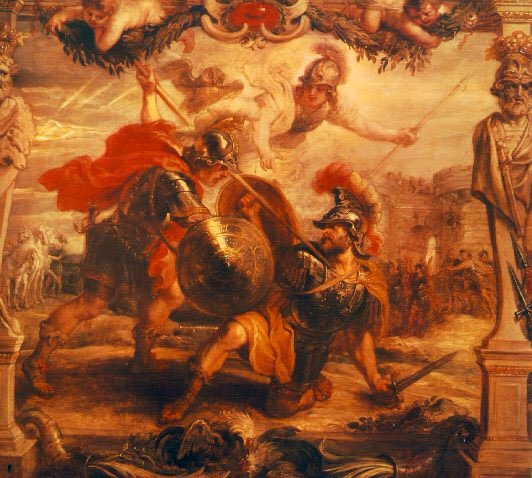
Achilles Slays Hector, by Peter Paul Rubens (1630–35).

One of the  best examples of a pre-Christian religion of entitlement and privilege is the religion of classical Greece, that of the Olympian Gods. Homer in his two poems ‘The Iliad’ and ‘The Odyssey’ gives expression to the beliefs of the classical Greeks. In the Iliad the poor or the ordinary Greeks only get mentioned once. This is when a boastful soldier from the ranks foolishly challenges Odysseus (King of Ithaca) to a boxing match. Odysseus brutally beats the upstart challenger to a pulp, to the approval of the watching Gods and Homer. Throughout the epic story of Odysseus’s return from Troy, the members of his crew, the ordinary seamen are who crew his ship are almost never mentioned. When Odysseus finally returns to Ithaca he has lost all his crew through various misfortunes, yet he never expresses any regret about their loss. For Homer and the Olympian Gods of Greece, all that is of concern or interest are the actions of the heroes, all of whom come from a rich aristocratic warrior class. The masses or majority are merely there to provide a backdrop or audience for these aristocratic warriors. Throughout the Iliad the only conflicts described are those between the various Greek and Trojan aristocratic heroes. The war virtually stops while the ordinary soldiers observe the conflict between Achilles and Hector beneath the walls of Troy. Classical Greece is an aristocratic society whose religion only attributes any worth to the great and the good. Regret is only expressed over the death of the heroes, as with the funeral games held for Achilles. Only aristocrats can be heroes, ordinary people lack the virtues necessary to make them heroes or interesting to the Gods.

Only a religion that treated the common man with insignificance would be of value to our new governing classes. Rather than heroic warriors we are now governed by a class of less than heroic bankers and financiers. George Bush’s advisors who pushed for the war in Iraq were largely ‘chicken hawks’, men seconded from the large corporations who when young dodged the Vietnam draft. This new class of financiers, hedge fund managers and bankers, needs a greater vision to validate their superiour position in society. Something similar to Homer’s Iliad which glorified the heroic aristocrats. These self proclaimed ‘movers and shakers’ need a poet of Homer’s stature to justify their acquisition of vast wealth. Lacking a Homer, their virtues are lauded in such books as Ayn Rand’s ‘Atlas Shrugged’, a book in which her billionaire heroes show the same contempt for the common man, as exhibited by Homer’s heroes. In this book thousands of the useless poor die from hunger, freeing the heroic billionaires from the burden of caring for this group of useless humanity.

What Ayn Rand and others such as Friedrich Hayek proclaim is a philosophy that frees the rich and powerful from the obligations and restrictions that are thought to make for the good society. Tax avoidance becomes a duty as the billionaire is better equipped to spend his money wisely, than is the wasteful state, who will foolishly squander its tax revenue.  Poverty for example is no longer a social evil but a spur to the poor for self improvement.


Posted: Oct 24 Twenty Fourteen

By: Silvia Hoffman


The new class of financiers and politicians want more than the rather unappealing philosophy of Neo-Liberalism, as there are only so many ways that selfishness can be redefined as a virtue. Fortunately for our new governing classes of politicians and financiers, the Christian tradition is sufficiently plastic to be written to favour the rich and powerful. As Constantine proved, when he oversaw a remaking of Christianity as a religion of empire and power in the 5th century CE. These classes have successfully used Christianity as a means of sacralising the social order. The role of monarch is God sanctioned at the Coronation service, any sense of social injustice is dissipated by emphasising that the poor will get their reward in heaven. The campaigning priests of South America who preached liberation theology were silenced by the Vatican. It was a Vatican that preferred the poor getting their reward in heaven than on earth.   

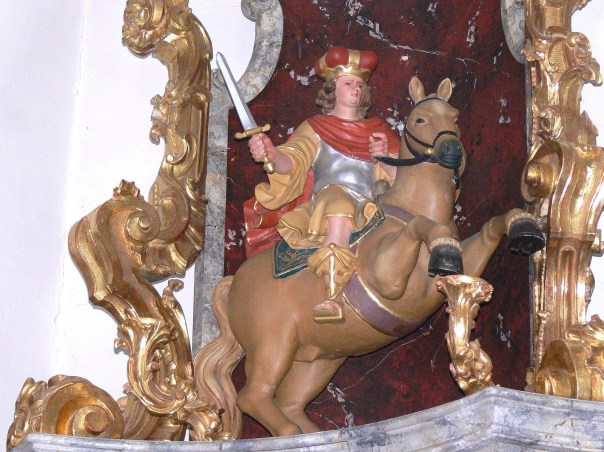
Theologians have used the concept of accommodation to explain how the organised churches drop those parts of their doctrine that are a threat to the established social order, so as to facilitate their acceptance within society. What I am suggesting is that the Christian churches long ago won acceptance by incorporating into their doctrines an acceptance of the old religion of power and privilege. The position of the rich and powerful in society was sanctioned by God.  In England this new God had many of the characteristics of the old pagan Gods such as Odin and Thor. This new Christian God sanctified wars of conquest much like the deities of old.  One of the first Saxon Saints was St. Oswald a warlord and king who was killed by a pagan adversary. Many of the new evangelical churches have so far accommodated to contemporary society in that they preach a doctrine of business success rather than one of compassion. Even the new Archbishop of Canterbury has instituted a reform programme to make the church more business minded. The culture of business targeting  supplementing the existing practice welfare practices


Parish church in Sankt Oswald ob Eibiswald ( Styria ). Statue of Saint Oswald riding a horse.

There has always been an uneasy alliance in the church between what can be called the Christianity of compassion and the Christianity of power. This compromise is represented by two twentieth century Archbishops, Archbishop Temple the social reformer and Archbishop Cosmo Laing a conservative, who wanted to restore the old power and privileges of the church. The first a reformer who said in a speech, that if it was possible the rich would charge us for the air we breathe, while the second wanted to increase the wealth of the church by reinstating the collection  church tithes (a practice that had long fallen into disuse.)  

What I am arguing is that the practice of accommodation has led to the churches accepting, all be it implicitly many of the characteristics of the old pagan religions into their Christian practice. Is not the God of George Bush and Tony Blair who sanctioned the war of Iraq more like Zeus than Christ? The Christ who had an abhorrence of violence, is replaced by one who advocated turning the cheek has been replaced by a Zeus like Christ who hurls thunderbolts to destroy his enemies.  In this accommodating church it easy for a cabinet minister to find an accommodating priest who will be accepting of the most inhumane of policy decisions. The old religion of power and privilege is very alive in today’s  Christian church.   

Evil always comes with a smile on its face

When you write it is because there are certain ideas and thoughts that obsess you and you find that all to often you are reworking familiar themes, no matter what the subject matter of the essay. In my case it is the learning of the past, I cannot dismiss the writings of the Christian fathers or the medieval Islamic philosophers as being rooted in the past and as having no relevance to today. What could be more relevant in the age of Isis, than St. Augustine’s thoughts on the nature of evil. He offers a far better explanation of the actions of Abu Bakr Al-Baghdadi and his followers than any contemporary analyst. Not only that but the hateful ideology of Isis and the Salafist strand of Islam which it encapsulates, obscures the wisdom and learning of the medieval Islamic scholars. What has been forgotten is the debt that medieval Christianity owes to the great Sufi scholars of Spain, who had preserved the teachings of the classical and Hellenistic philosophers in their writings. Without their knowledge medieval Christianity would have been much the intellectually poorer. Yet Islam is now seen as a religion of cruelty and barbarism, a religion of the stoning of adulterers. What has been lost is the compassionate and sophisticated religion of the Sufi’s of Islam. Could anybody today know that the great Sufi thinkers saw Christianity and Islam as two different approaches to one the true religion, religious brothers in arms not enemies?

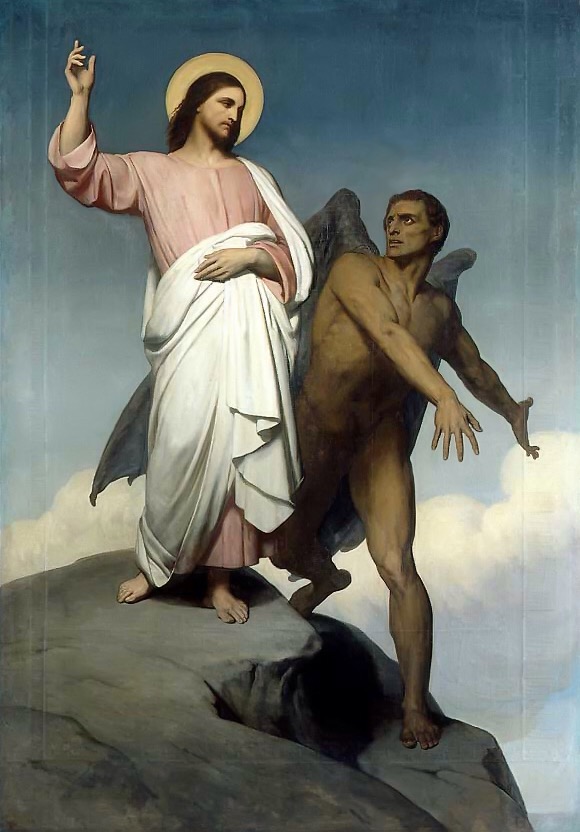
The Temptation of Christ
Ary Scheffer, 1854
The Devil depicted in the Temptation of Christ, by Ary Scheffer, 1854.

One such lost wisdom is the understanding of evil, an understanding that evil all pervasive and constantly needed to be countered. St. Augustine’s conception of evil as ignorance or not knowing God is easily misunderstood today. Obviously the members of Isis know God but still commit horrible atrocities. What they claim is that they are the true followers of God, who are opposed to kafirs or those individuals who do not know God and are therefore not worthy of humane treatment. However knowing God is not knowing as its usually understood, it’s far more than a knowledge of the correct religious tracts. It’s a knowing that is beyond words and cannot be explained in the words of the everyday language of the world of human experience. A knowledge and understanding the religious texts is just the first stage towards knowing God. Knowing God is a transforming life experience, knowing God means accepting a life changing experience through religious enlightenment. Perhaps it can be described as an engagement with God, an emotional commitment or living a life informed by God. However one tries, words remain inadequate for explaining the experience of knowing God. As Plato writes once a person knows good (God) they never want to know anything else, it is a sufficient principle for life. The sufi’s explain knowing God as moving beyond religious ritual and practice to a higher level of understanding, an understanding that can only be achieved with the guidance of a teacher. One Christian text that explains this level of knowing, is medieval Christian classic ‘The Cloud of Unknowing’, in which the author describes the various clouds of misunderstanding and misapprehension that obscure a knowledge of God.

What I am arguing for is a Christian sensibility to be part of the mainstream of human thinking. A perception of the world that is infused with the language of morality, but the sophisticated moral practice of the past. The Christian Fathers such as St.Anthony, Athanasius and Augustine spent a life time trying to understand what it meant to lead a good life. Unfortunately the language in which they write makes them seem alien to today’s readers. The sin about which they write should be understood as human fallibility or weaknesses, a weakness which makes a person liable to commit act badly. It takes a determined act of the will to act well. Christian belief and practice gave them the strength to overcome their very human fallibilities and act well. This lifetime of study and prayer gave them an intuitive knowledge of the good, but they were never so naive that they did not realise that they had to constantly revise their thinking in terms of what they understood to be the good, as they were constantly beset by human weakness that plague us all. Augustine while being a caring father to the people of Carthage who looked after their welfare, could also,support the cruel persecution of heretics. However they had a better grasp of human psychology then today’s generation of leaders and how to better overcome its flaws.

The Christian sensibility of Augustine is founded on a very different psychology to that of today. He sees the human personality divided between two opposing drives. There is the sensory or appetitive drive that tends to the indulgence of selfish interests. Then the soul which is the self reflective drive that directs the individual towards a higher level of behaviour be it spiritual or philosophic. These two parts of the personality are tendencies within the human personality and not a literal description of that personality. Accepting Augustine’s theory of human personality does not mean rejecting later theories of personality, it’s just a different perspective on human behaviour.

Walter Benjamin offers a different approach to the past. He writes that the past is that part of the past that lives within contemporary culture. Europe for centuries embodied this past in the form of Christian culture living within the mainstream of society. Christianity and with it the learning of the past has been now been expelled from the main stream of contemporary culture. The fundamentalist Christianity of the American mainstream or the Wahhabism Islam is a contemporary creation. It is the crude reimagining of a golden religious past, it is religion in monotone, it excludes the kaleidoscope of understanding that is real religion. Whether a state is secular as with contemporary Britain or religious in practice as with the USA or Saudi Arabia, all are bereft of the learning of the past.

In Saudi Arabia and Western Europe and the USA, what is happening iis the removal of all traces of the past learning from contemporary culture. In Saudi Arabia it takes the form of the physical destruction of the buildings of the old Islam. Their presence is regarded as a temptation to heresy, Muslims who identify Islam with particular holy sites, are behaving like the pagans who identified their temples as the dwelling place of God, confusing idols and icons with God. In Western capitalist countries the destruction of the thinking of the past, is through the teaching of post modernism which teaches that a philosophy or belief system are only valid for a particular time and place. There can be no universally valid belief systems, and those of the past should have no claim to validity in contemporary Britain. Britain is a post ideological society, a society that believes in nothing or perhaps whatever is considered right at a particular moment. There is no great inclusive vision such as the Christian belief system of previous generations, a belief that gave politicians an vision of what makes a good society.

IMG_0427

Philip Jacques de Loutherbourg:Battle Between Richard I Lionheart 1157-99 and Saladin 1137

This is not to deny that in the Christian past there were not leaders who committed horrendous atrocities in the name of God. Richard the Lionheart slaughtering thousands of Arabs when he captured the Acre. There was the lesser known Arnaud Amaury, Abbot of Cîteaux the leader of the Albigensian crusade who went his forces captured the city of Béziers ordered the killing of all the inhabitant with the immortal phrase “Kill them all. God will know his own”. About 20,000 were slaughtered in this brutal massacre. Yet throughout this period there was a moral counterweight opposed to the brutality of the medieval knight. Churchmen tried to civilise the barbaric knighthood by trying to persuade them to accept the code of chivalry, which insisted that the victorious Knights treated the defeated with compassion. One of the great stories of the Middle Ages, that of the Holy Grail, was an attack on brutal ways of the medieval knight. The greatest knight of Christendom (Lancelot) is denied any vision of the Holy Grail because of his sins, which included adultery. Only three Knights who are pure in spirit get to see the Holy Grail and unlike the Knights of the Round Table they accept martyrdom at the hands of a Saracen king. Any other of the knightly heroes would have fought there way out of such situations with the slaughter of hundreds or thousands of their enemies. There were always great churchmen and women such as Saint Francis or Hildegard of Bingen who lived lives that were a constant criticism of the knightly ideal.

With the relegation of Christianity and ideologies such as socialism to the history books, there is no longer this moral counter weight to the self seeking actions of the political and financial elites. Some of the most brutal of the medieval leaders accepted the Christian critique of their actions and endowed the churches with money to build great cathedrals, or money to relive the suffering of the poor. Unlike today when only monuments the great and good will leave behind are shopping malls and offices blocks. The super rich of today no longer have to contend with the criticisms of a thriving moral counterweight in the community. Instead contemporary culture lauds them as the heroes of the age, they are the ‘movers and shakers of society’. A view expressed at its most extreme by Ayn Rand (Atlas Unchained) a book in which the heroes of our age are the billionaires and the poor are nothing but the dregs of humanity, worthless beings who must die their thousands to relive society of the burden of providing for such worthless beings. This book despite its inhumanity is a book popular with with people of this new uncaring world.

Perhaps this problem is best expressed in the words of Hannah Arendt in her book on the trial of Adolf Eichmann, when she writes of the ‘banality of evil’. What astounded her was the very ordinariness of this monster who had been responsible for the gassing of millions of Jews during the holocaust. Evil did not give him any distinguishing features, there was no hint of evil in this appearance of this very ordinary looking man. Even his speech was undistinguished,he was unable to give more than a matter of fact account of his activities. If this was the Nazi superman, he was indistinguishable from the ordinary clerk, the myth of the superman was merely that, a propaganda exercise. Judging by Eichmann evil is extraordinarily average, evil comes with a smile on its face and with a modest demeanour. Eichmann could easily be a member of the British Parliament, he is indistinguishable in appearance and demeanour from the average British MP. He has no understanding of morality that went beyond being kind to his family and friends, which is also characteristic of the majority of our politicians. Having no concept of evil politicians are extremely poor judges of what is wrong. They are products of the Neo-Liberal society of the 1980’s that declared that there is no such thing as society. In a society of individuals there can be no public morality, there can only be the morality of friends. It’s a society in which tax avoidance and evasion becomes elevated to a moral good. Through avoiding tax, the family income and assets are maximised for the benefit of its members and its contributions to that meaningless abstract, society are minimised. What is lacking from the public and political debate is common moral belief against which the actions of the great and good can be measured. Perhaps which could be best achieved by reintroducing the sophisticated Christianity of Augustine into the mainstream belief system.

Religious mysticism and economics

IMG_0420
Javanese Mystical Beliefs The New York Times

All my adult life I have been trying to come to terms with what I learnt in my undergraduate philosophy classes. Coming from a relatively isolated rural Anglican background I had a belief in moral absolutes such as good and truth. Such terms where regularly used in conversation in my rural community, local villains were known as such and there was no ambiguity in our moral understandings. However at university I was introduced to a critical philosophy that undermined my belief in moral absolutes. One such example were the writings of Gilbert Ryle in which he dismissed the concept of a moral good. Good he explained was a term incapable of definition, as people would give differing explanations of what good meant, therefore could could be no more than an emotion. The same philosopher dismissed human consciousness as the ‘ghost in the machine’. He was sceptical of the notion of a special quality called consciousness existing apart from the biological mechanisms, which produced emotions and feelings. The idea of self was suspect, it did not fit with the understanding that biologists had of the human being. Consciousness and self were unscientific, their existence could not be proved, so it was illogical to believe in them. I guess I like many students felt the moral tectonic plates shift beneath my feet and realised the moral truths in which I believed had no firm foundation. Using the biblical analogy I was living in a house built on the shifting sands of contemporary morality.

However these relativist philosophers had not abandoned any notion of moral good. In practice they saw good as having some functional value, they behaved as would good men and women. They were fair in their treatment of us, turned up regularly to lectures etc. If they had behaved immorally the whole system would have collapsed. The first lesson I absorbed as that even if they did not see good and truth as moral absolutes, they saw them as having a practical utility.

I never really abandoned my Anglican beliefs, although I ceased to be a practising one. The 1960’s and 1970’s were an age of secularism and I used to enjoy discomforting my friends by telling them I was a Christian. Christians were for them a kind of pre-modern being, who were as distant from modern man, as were the Neanderthals from Homo Sapiens. Intelligent people for them could not believe in the myths and fairy stories of which organised religion was composed.

What I have sought since my university days is some intellectual underpinning or substance for my pre-modern beliefs in good and bad. I could not accept that there only purpose was that of enabling men to live together in an organised society. Interestingly I did learnt of one community in the Pacific, where stealing and dishonesty were valued. However this particular community, because of its dysfunctional nature was dying out.

Obviously I read widely, there is probably not a major philosopher of whom I do not have some knowledge, but it was not until I studied theology as a postgraduate that I began to make progress in finding solid ground on which to found my beliefs. The answer lies in the paradoxical nature of the unknown God, whose is both unknown and known. All theologians are to some degree negative theologians, they admit God is beyond human understanding, yet they claim some knowledge of this unknown God. Bertrand Russell scoffed at these theologians who believed in an unknown God as he pointed out that it was absurd to claim belief in a being that had no existence. However he misunderstood what theologians mean when they say they have no knowledge of God. God is unknown because he cannot be known through the usual methods of human understanding, as he exists beyond human existence. There can be no book of God as it is impossible to describe or explain what God is in language. There can be no science of religion, the science of observation or the laws of cause and effect have no relevance to the study of God. Yet this God can be known to the individual, but not through the usual means of human understanding.

Knowing God is a peculiarly individual experience, it is not as Kierkegaard states something that can be picked up from an afternoon’s study. There are no texts of instruction as such or a required reading list. Following Kierkegaard we cannot use direct language to speak of God, he cannot be described, but instead the language of God must be indirect language. The great religious teachers of the past are largely ignored but to learn the way to knowing truth or God it is to them that one must turn. It’s a knowledge quite unlike the knowledge of science or the humanities. Indirect learning or knowledge is the means of accessing these higher truth. The twentieth century philosopher Jasper explains that myth is one very successful way in which these truths can be accessed. Probably he’s thinking of Plato’s myth of the cave, in which he compares humanity to a group of men chained in a cave facing a wall behind which is a fire. Behind that wall are passed images which cast shadows of the cave wall and the chained men believe that those shadow images are reality. When one of the chained men escapes and goes into the sunlight and returns to tell the chained men what he has seen they refuse to believe him; they prefer the shadows or appearances with which they are familiar. What Plato is demonstrating is that the knowledge for understanding everyday existence is inadequate for the task of understanding what he and his Islamic successors (Sufis) would term the real. Plato has another a myth that explains the link between the real and the world of appearances in which we live. The creator God fashions the world and humanity out of clay and he uses as his model for creation the ‘real’. We are but copies of what the creator God could see, but which are concealed to us. Plato never believed the myths he created were ‘real’ but they was the only way he could explain, the complex nature of reality and existence. Jaspers put it more succinctly, there are some truths that can only be told through the use of myths.

Plato’s separation of the world into two spheres that of appearance and reality has remained influential. It is an understanding of existence that has been developed within the religious traditions of both Christianity and Islam. Rather than myth the Sufi sages use poetry, metaphor being a substitute for myth. One of my favourite phrases is taken from Rumi’s poem ‘The North Wind’

‘No matter how hard you stare into muddy water
you will not see the moon or sun’

It’s one of the best summaries of the Platonic need to search for truth beyond the world of ‘appearances’. However describing this world as one of ‘appearances’ does contradict our understanding of reality. Doctor Johnson gave the best retort, when he criticised Bishop Berkley’s theology, which saw the world as a product of God’s imagining. He said the pain he felt when stone he knocked his foot against was all too real, and was not a product of somebody’s imagining. All I can say is that Plato was trying to describe a level of reality that as it was not immediately visible and it could be distinguished from a reality that was all too apparent, which appears to us.

A person such as myself is described as a mystic, a term which I feel is derogatory as I believe my approach to knowing truth is quite rational. There is however a good reason for writing about my understanding of mysticism as a economist. Mysticism gives a very different understanding of the world to that of a practitioner of a science of the world of appearances. Economics judges the world in quantitive terms, using terms such as cost, loss and profit; it has no place for values. Therefore its practitioners are capable of making the most inhumane decisions, as they lack any sense of value. Milton Friedman could approve the torture and killing of trade unionists because their destruction paved the way to the free market. Ian Duncan Smith the minister for welfare can pursue a policy that through the removal of benefits impoverishes the poor and which even in extreme cases has led to suicide, as a means of incentivising people to return to work. To an economist misery and suffering are good if they produce the right result. Religious mystics could never accept such an inhumane belief system, they value the individual human too highly. Inflicting suffering is never an option for them, one hungry child is never the justification for this cruel method of incentivising work. Only an economist of the Neo-Liberal persuasion could be indifferent to human pain. Economics will constantly fail as it lacks a value system that would enable it to satisfy human wants. What economics so lack as a contemporary science is a knowledge of the old.

Notes
Plato (428/427 or 424/423 – 348/347 BCE) Classical Greek philosopher
Jelaluddin Rumi (30 September 1207 – 17 December 1273) Islamic jurist, theologian and mystic
Søren Aabye Kierkegaard (5 May 1813 – 11 November 1855) was a Danish philosopher, theologian, poet, social critic and religious author
Milton Friedman (July 31, 1912 – November 16, 2006) American economist

Is not ‘Black Friday’ but a symptom of a sickness that infects British society?

/home/wpcom/public_html/wp-content/blogs.dir/c1e/54687079/files/2015/01/img_0417.jpg

Shoppers competing to get discounted televisions on Black Friday. (London Evening Standard)

Seeing the gardarene swine like behaviour of the Black Friday shoppers, with customers fighting each other to get bargains, reminded me so much of the emptiness of contemporary Life. Thus behaviour longer attracts much criticism of these it is more likely the competitive zeal of these shoppers will earn them admiration. If this frenzied hyperactivity was restricted to shopping, it would be a problem but one with limits. However this frenzied hyperactivity is not limited to bargain hunters but is a behavioural practice characteristic of contemporary Britain. This practice is at is most dangerous when practised by our politicians who rush out a frenzy ill considered legislation to meet whatever crisis or problem occurs. Criminal law reform is one such example it seems that each successive government has to make major changes to criminal law to satisfy the apparent public demand for new laws to protect them from dangerous criminals. Reflection not something practised by contemporary politicians, no contemporary politician would copy would as did Prime Minister, Harold MacMillan read Trollope’s novels while in office, reading would either be some serious economic or political tome for fear of not being seen to be ‘on the job’ or a collection of DVD’s, acceptable frivolity. They are truly the ‘One Dimensional Men’ as described by Marcuse. Men with no depth or breadth of vision. One unfair but a comment with some truth in it is that legislation is rushed out to meet tomorrow’s media deadlines.

Politicians have a philosophy to justify their behaviour, it’s the market led theory of politics. They are as with businesses just there to respond to the demands of their customers. If their consumers suffer from a fear of crime, what is needed is more laws to reassure the voting political customer that their concerns are being met. Whether this crowd pleasing legislation has any impact on actual crime is debatable. What matters is reassuring the customer. Draconian anti drug legislation has had little impact on actual drug taking, but it’s there to reassure the public that the government takes drug abuse seriously. The unintended consequence of this legislation is to eliminate the small time (easily caught) drug dealer from the market, leaving the trade in the hands of major criminal cartels who are able to evade detection through either corrupting the law enforcement agencies or through using expensive sophisticated methods to avoid detection. The fact that current drug laws have inadvertently led to the creation of rich powerful criminal gangs is of no relevance to the government of the day. The fact that there are better alternatives is irrelevant as they lack the crowd pleasing factor.

One thought that occurs to me is that any drug baron would want the current laws to continue in operation as by eliminating many smaller rivals it enables them to remain a monopoly supplier.

A possible explanation

What I want is an explanation of why so many in society indulge in this frenzied purposeless activity. Kierkegaard (The Concept of Anxiety) does offer for me an explanation of this behaviour. His explanation was in part based on self analysis and in part in from observation of his contemporaries in 19th century Copenhagen. In his youth he could be described as a ‘party animal’ a person who was a popular guest at parties, because of his ready wit. However he was aware of an inner emptiness which frenzied social activities could not remove, a behaviour he observed in his friends. However he realised that this emptiness was not apparent to his friends and contemporaries who were content to live life on the ‘outside’. Yet even these apparently happy people would experience an anxiety of something missing, but suffer from not knowing the cause of their anxiety. The solution for them was to engage in more social activities to offset this feeling of anxiety.

This anxiety was consequent people’s failure to understand their true nature. *There is within the human psyche a longing for a different life, an aspiration for a more satisfying spiritual life. He identifies two forms of better life, the first a life lived in conformity to the norms of religion and the second superior a life lived in knowing God. This life may be achieved, through the individual opening themselves to God. They become as a mirror reflecting God in their lives. It is only this final group who are truly free from anxiety, they know happiness, all others know an inferior or counterfeit happiness.

It is not necessary to accept Kierkegaard’s Christianity to see the value of his analysis. Contemporary culture whether it be political or that of wider society fails to recognise the need for spirituality or any form of life that is not based on the consumption of goods or services. It is a barren and empty culture. A market society in which everything is up for exchange lacks any sense of higher value. There can be no universal value system such as Christianity which values compassion, agape (love of mankind) as they have no place in a society of aggressive self seeking traders. There is no market in agape, fairness or compassion, instead they are seen a barrier to wealth making as they demand restrictions be imposed on the businessman. Only recently the Chairman of the Confederation of British Industries spoke out against fairness and compassion. Imposing the living wage on employers or ending the cruel zero hours contracts he said would make the British economy uncompetitive in world markets. The economy demands the immiseration of the majority, if it is to prosper. It is the worship of a strange inhuman God, that is not too different in nature from the Aztec Gods that demanded human sacrifice.

A possible solution

While it is tempting to say that a happiness is dependent on a redistribution of material wealth; this fails to recognise why one of the richest world economies has descended to a level where an increasing number live impoverished lives. Why does the miserablist philosophy of Neo-Liberal dominant the political discourse? Quite simply because the majority of politicians exist at the lowest level of life as identified by Kierkegaard. Their realist philosophies have taught them that there can be no higher values as all that matters are the practical and graspable truths, so we have an opposition campaigning to reduce energy prices and ignoring the problems of a dysfunctional economy that created the misery associated with low incomes. Focus groups are set up to find what are the simple wants of the the electorate. The questions are designed to elicit simple responses that can be transferred into easily marketable policies. Never do politicians offer more than a few simple and banal phrases in place of a political philosophy, a something that is easily sellable.

Kierkegaard for me offers an answer to this malaise, that is how do you stop politicians behaving like moths flitting from one policy light to another. He writes of two religious types, religious A and B. The first practise religion without real understanding they know that they must conform to certain religious practices otherwise they will suffer the wrath of God. If fear of God made politicians believe that they should conform with the rules of Christian practice then the mindless inhumanity of Neo-Liberalism will be dropped. A minority would achieve the understanding necessary achieve to become religious B. They have the understanding necessary to develop policy in conformity with the highest moral and spiritual standards. They would be the leaders or natural aristocrats who would lead society in towards a change that would benefit all.

However Kierkegaard admits that his truly spiritual man would be more likely to be an outsider. His criticisms of society would make him an uncomfortable companion to the rich and powerful. Thus man would have to be prepared to suffer in return for a life lived in imitation of Christ. Father Gleb Yakunin a Russian orthodox priest was one such man. He was a fierce critic of the old soviet regime for its persecution of christians, for which he suffered imprisonment and exile. Yet his actions led to a change in government policy, first the destruction of churches ceased and a policy of toleration adopted towards the Orthodox Church. The role of such critics in society needs to be tolerated, beneficial change only follows from listening to them. In Old Testament Israel these men were the prophets. The Jewish people had a schizophrenic attitude towards their prophets they both accepted and rejected them. They recognised the need for such men as only they kept them true to their faith, yet they also hated them for their criticisms. One of the Isaiah’s was sawn in half by angry Israelites and another John the Baptist was beheaded.

In Britain there is a need for such critics, yet their their voice is silenced. The judiciary is going through one of its most repressive phrases, critics of powerful businesses can be silenced by super injunctions or through expensive libel actions. Police spies are used to infiltrate and disrupt opposition groups. The same police through the misuse of bail conditions can effectively silence activists through making avoidance of political protest a condition of bail. Any organised opposition is emasculated and marginalised through repressive laws. Recently legislation makes it impossible for charities and other groups to campaign on policy issues during an election campaign. While the voice of opposition is so effectively silenced there will be no change in society.

It is too easy to criticise Kierkegaard by claiming that he had an unrealistic view of mankind’s potential. Even when he was alive it was said of Kierkegaard that his definition of a Christian as a life lived in imitation of Christ was practically impossible to achieve. Rather than hoping for an unrealistic change, there is an alternative. I want a return to the age of ideology, an ideology such as socialism that celebrates the potential of man, one that should replace the inhumane Neo-liberal ideology that celebrates the brutal nature of man. There can be no more depressing philosophy than that of Neo-Liberalism that sees man as a grasping egotistic animal seeking only to advance their own interests. An ideology that encompassed hope, compassion would constrain the behaviour of politicians. They could no no longer claim indifference to to what can only be described as the evils in British society. They could no longer ignore the plight of the low paid, the least cost philosophy would be replaced by the criteria of fairness. It could easily be achieved by insisting that all businesses that are in receipt of government contracts or funding pay the living wage to their staff.

The emptiness at the centre in to the political debate would be replaced by an ideology that celebrated humanity. There have been plenty such ideologies in the past such as evangelical Christianity, socialism, the ‘One Nation Toryism’ of Benjamin Disraeli and the compassionate social liberalism of Herbert Asquith and Lloyd George. Such ideologies would constrain the behaviour of politicians, their behaviours and policies would be judged against a set of higher standards. Who would not judge the parliaments of the reforming 19th century and early 20th century superior to those of today. Contemporary parliaments are where self interest in the guise of Neo-Liberalism is the only moral standard. These are the no hope parliaments of today, inhabited by politicians whose attitude is ‘that I would like to help but …’ the but being the cruel moral imperative of Neo-Liberalism.

*i have edited and simplified Kierkegaard’s psychological analysis of human spirituality

Why economists would benefit from a little Christian sensitivity

Why do economists need a Christian sensitivity? The obvious answer would be to instil in them a sense of compassion, while the suffering caused by economics does not compare to that caused by the most brutal of political ideologies it is on the same suffering causing spectrum. The spirit of the Reverend Malthus has always inspired economists and never more so than today. Population growth he believed would always tend to outstrip the resources needed to food, clothe etc. the ever growing population. Therefore his first conclusion was that there must always be the poor, as there was never sufficient wealth in any economy to enable all to have an adequate standard of living. He also saw disease, famine and war as the saviours of mankind as they kept the population within bounds. While economists particularly those in the British Treasury have persuaded politicians of the need for the first, they have not yet tried to persuade of the need for the second. There is another answer and that is economics is one of the best examples of arrested thinking, so common in contemporary Britain. What concerns me is the immaturity of thinking of contemporary economists, their overly simplistic reasoning.

/home/wpcom/public_html/wp-content/blogs.dir/c1e/54687079/files/2014/12/img_0410.jpg

The inspiration for my reasoning is Kierkegaard (Fear and Trembling), in that book he bemoans the practice of Christianity in 19th century Denmark. He writes that the Christian intelligentsia regarded an afternoons reading as sufficient to acquaint them with the essentials of Christianity. This he compares unfavourably with the Christian Fathers who spent a lifetime trying to understand Christianity and who even at the end of there life said their understanding was limited and flawed. Just like Kierkegaard’s Christian intelligentsia economists suffer from the same intellectual arrogance. They just know, they have at hand the answer to all society’s problems. The comment that the answer was worked out on the back of an envelope is intended as an insult but with economists as a statement, the truth of economics can be distilled down to a few sentences that could be written on the back of an envelope. The best metaphor that describes contemporary economics is that it arrested thinking that has never really progressed beyond that if the schoolboy. This school thinking is demonstrated in the words of the Shadow Chancellor, who spoke with glee when he said his cuts to public spending would leave the public sector reduced to its bleeding stumps. As with a schoolboy no thought of the consequences of his actions for the people of an austerity hit economy. Military terminology can be applied as for the modern economist the people are unfortunate collateral damage, who suffer for some greater good.

Economics unlike contemporary theology is a closed subject, the truths are already known and its the work of the economist to apply those known truths correctly in their analysis of any given problem. In a closed subject such as economics, no new thinking is needed because all the fundamental truths have been discovered, all that is required is some tinkering to achieve perfection. Theology by contrast is an open subject, all the truths are not known and those that are are but imperfectly known. It would be ridiculous for any theologian to claim to know the mind of God, yet Christianity has been a closed subject many times in the past, when it claimed this knowledge. It has an unfortunate past record of persecuting and killing those who did not accept the acknowledged truth. Galileo Galilee was silenced by the church for challenging the prevailing orthodoxy, that the earth was the centre of the earth, by the simple expedient of showing him the instruments of torture. Unlike my predecessors as a theologian I claim to know little about God, I am a negative theologian a theologian who admits that God is unknowable. However this does not mean negative theologians have no knowledge of God. They have knowledge of the presence of God in human society, the means by which the unknown makes themselves known. They can glimpse aspects of God’s nature and explain it to others. The aspect of God that I know is the good, the good that characterises all good actions. Good can never be explained except through good actions and as a Neo-Platonist I believe that within all these good actions, there runs an indefinable good. It is a good I know but whose essence I can never adequately explain. All I would claim is that I know something of God’s nature as in is known through the medium of human existence. I am looking through a very dark glass which obscures most of the truth, what a much better theologian than myself called the ‘cloud of unknowing’. What I do know is the limits of my knowledge. I only know a little of one aspect of God’s nature and I shall spent a lifetime trying to develop that understanding.This is unlike an economist who does know and they even know what forms of economics are in error, something I would never claim about other religions. To paraphrase Uriah Heep, I am ever so humble, whereas the good economist possesses the arrogance of truth.

A negative theologian such as myself is keenly aware of the limitations of their knowledge, whereas all economists are positive theologians, who are aware that they know everything and have little if anything to learn about the world. Whereas the truth is the opposite the theologians have spent centuries studying the nature of God and the few truths they know are greater than the imagined truth of economics. Economists have discovered one economic truth, the market and having achieved that they think they know all economics. What they need instead is the perspective of the negative theologian, which one of ignorance. The truths of theology are but a small part of the truths of Christianity, and therefore they are open to any approach that might shed new light on the ultimate truths. Economics needs similar enlightenment it needs to seek new ways to go beyond the few truths it has discovered. When doing a thousand piece jigsaw I always try to fit together first the pieces that make up the edge of the jigsaw and give it its shape. Having put together the outline it is tempting to think that the main task has been done, yet the jigsaw remains a hollow square, with most of the content missing. Economists are in the same position they have some awareness of the outline of the economy, but they are largely ignorant of its content. The pieces that make up the content are missing from the jigsaw economy. Only arrogance prevents them from seeing the truth. What economists lack is humility, if they acquired this very Christian virtue the practice of economics would improve immeasurably.

Fundamentalist Religion and the Economics of Fear

IMG_0393.JPG

A Rural Christian Childhood

When I remember when I was young and staying at an aunt’s house I picked up a copy of John Bunyan’s ‘Pilgrim’s Progress’ to read before going to bed. It was a old edition illustrated with what I imagine were wood cuts, which terrified me. Having tried scan the text for parts with interesting stories I gave up. What I read about Doubting Castle and Giant Despair and the numerous beatings that Christian and his companions suffered filled me with despair. I resolved that evening to live a virtuous life and not suffer the fates inflicted on Christian. However the fear that motivated me to adopt the strict lifestyle of my aunt disappeared on my return home. There days spent playing out in the sunlight summer countryside of Kent restored my childish optimism. Even when attending services at the village church, there was little to remind me of the horrors that that abounded in ‘The Pilgrim’s Progress’. Church services were happy affairs reaffirming the good life lived by the inhabitants of our rural community.

IMG_0390.JPG

What I learnt unconsciously as a child was that any religion or morality of fear was only effective as long as that fear was constantly reinforced by repetition. Sunlight and the beauty of the countryside removed the shadow of fear that clouded my mind. Once those influences that made fear so oppressive, that is the strangeness of the dark oppressive city bedroom, the terrible words and depressing images were removed my fears vanished. Instead there was my love of the Christianity of the countryside. Even through my periods of atheism at the big city university, my affection for the Anglican Church never diminished. Unknowingly I took with me to the city my love of the life affirming Christianity of my childhood.

This simple unreflecting religion of the countryside has remained with me. It was not a religion that was unaware of the unpleasantness of life, many from the village were all too familiar with such, having experienced the horrors of World War II. They did not want a religion that told them that they lived within the confines the ‘Vale of Tears’ and the ‘Slough of Despond’. The beauty of the surrounding countryside gave the lie to such perceptions. What they wanted was a religion that celebrated life they knew and experienced. The religion that enabled them to celebrate the seasonal rites of passage that gave meaning to their lives.

There were two vicars in my time in this village. Neither over intellectualised life and were very representative of that strain of bucolic Anglicanism that once characterised the English church. The one vicar I knew well had been a Cambridge Rowing Blue, a man who epitomised the muscular Anglican Christianity of Charles Kingsley, I suspect that as with Charles Kingsley he always slept in a bedroom with an open window, exposed to even the winter cold. Kingsley believed healthy living was an essential part of the Christian life a healthiness engendered by physical exercise and through a rejection of the soft effeminate lifestyle that avoided exposure to the elements. (It should be mentioned that his insistence on always having an open window led to him catching a chill which caused his death.) Our athletic vicar’s sermons were couched in a language that the unsophisticated country dweller could comprehend. There were no difficult intellectual frills, about the nature if the triune God for example. This God only mentioned The Lord’s Prayer a God whose existence was accepted and whose existence was never questioned or explained. Even this twelve year old choirboy as I was then could understand his sermons.

His predecessor commanded great respect in the village, even although I as a child found his manner gruff and intimidating. During the war he had been a padre and when his unit had been captured by the Germans, he refused repatriation which was his right as a non combatant and instead went into captivity with the rest of his unit. This man my father really liked as he would visit him when working in the fields and talk about their shared wartime experiences. I don’t think he once mentioned religion in his conversations with my father. On reflection I think what I mistook as gruffness was in reality the blunt manner of a countryman. A man with a simplicity of manner and directness of speech, who felt no need to add in the unnecessary courtesies of ‘townified’ speech making.

The Economics of Fear

Between the world of my Kentish childhood and that of England today, there is a yawning chasm, it as if the first never existed. All the certainties of my childhood, fair wages (sufficient income to support a family), good housing, security of tenure and employment have disappeared. One story illustrates this, there was on the estate a worker who was notoriously lazy. One day when he heard the church clock strike twelve for lunch, he stopped his hedge cutting mid stroke and left the half open shears on the hedge in the cutting position. Today such action would merit instant dismissal, then the estate management knew that he had a large family to support and they would be the losers if he lost his job. Now the manual work undertaken by my father and his friends is subject to low wages and insecurity of employment. Within the manual trades workers are either self employed or have zero hours contracts, both of which enable the employer to manage by fear, as the hours of work he gives his workers depends upon their good behaviour. Insecurity and the anxiety it brings are now seen as the best means of managing the workers.

Fear is even the most used management practice in the middle class professions. As a former public service professional I witnessed the introduction of the target based culture and the accompanying culture of institutionalised bullying. Neo-Liberalism the dominant political philosophy of our times is a belief system that states that any service or product can best be judged by the quantitative or monetary value it is given by its purchasers. Other than taxes no price is paid for public services such as policing, health care care and education, this meant that politicians had no means of judging the productivity of the public service sector. It did not matter that the service provided was qualitative and had no direct monetary measure. How could a life saved be valued or in my case how could the treatment that cured my infant daughter of meningitis be valued? Ignoring the impossibility of turning quality into quantity, the government decided that they would introduce quantitive measures of output into these services. This was the target culture, there would be a time limit for how long a patient should wait in the accident and emergency department before being treated. There are very valid reasons for reducing waiting times, but the problem is that this directive outweighs the qualitative judgement of doctors. One consequence was those with minor illnesses nearing the four hour deadline for treatment would get priority over those with more serious illnesses.

Global target setting has one major failing, it is a very crude measure of service and can give misleading results. Very soon the politicians realised that these initial global targets were too broad to measure the output of public service workers. If the state was paying a large salary to a doctor, teacher or policeman, how could they be sure that the service provided by that individual was equivalent in value to say, £30,000? To ensure that the state was getting value for money it had to introduce more and more directives to direct the working practices of the public service workers to achieve the desired ends. The consequence is that the activities of all public service workers are now micro managed from Whitehall by bureaucrats at the behest of their political masters, who have little knowledge of the service they manage. Given the mismatch between the civil servants knowledge of working practices and actual working practice, there had to be found a way to ensure a reluctant workforce complied with these centrally imposed directives. Particularly where the workers thought they contradicted good working practice. Coercion or management through fear is the only possible way of making these directives effective.

Managers in the public sector fear now losing those jobs if their targets are not met and they transmit their fears through the workplace. Managers desperate for their jobs will adopt bullying measures to ensure these targets are met, not caring whether such targets improve the effectiveness of the service they are providing, all that matters is that these targets are met. To strengthen their arm the government has introduced job insecurity into the public service sector to improve efficiency. Workers deemed ineffective can be summarily dismissed and quickly replaced with new more effective staff. Such managers are unaware of the evidence from business that high staff turnover reduces the overall effectiveness of the business rather than increasing it.

The system in the public services now resembles the management practices in the old Soviet Union. There the KGB was the inspectorate that ensured compliance with approved management practices and that targets were met. Targets were met but often by producing poor quality goods or services. The same naivety permeates the English public sector, where London rather than Moscow bureaucrats write the service manual by which the inspectorate judges public sector workers. Their belief is that is they draft a sufficiently detailed manual of what the good teacher, doctor or policeman should do, the government inspectorate will ensure compliance with that manual so taking service provision to a higher level. The fact that top civil servants have little knowledge of the practices in the classroom or hospital does not matter, as constant revision of work practices to eliminate error will result in the perfect instruction manual for public service workers which will deliver the highest level of service provision. What they fail to realise is that this practise engenders uncertainty in the workplace and often confusion as this year’s directives may contradict last year’s. Politicians, civil servants, economists and political servants never understand that one model does fit all. The practice of teaching and medicine is as much an art as a science, individual practice cannot be reduced to a pre agreed script. The agreed script cannot produce the great teacher or doctor, but they can both thrive in a very different culture that values individual creativity. Again the Soviet Union provides an insight into the fallibilities of this system. Centrally given directives drafted in ignorance of working practices are frequently unworkable and can work to frustrate their intended purpose. To persuade workers to adopt these practices it was necessary to use extreme measures, failure to comply meant exile to a labour camp and possibly death. The point I am trying to make is that the more and more directive working practices become, the more and more extreme measures have to be adopted to ensure compliance. Is it not possible when the threat of dismissal proves to be ineffective in ensuring the public sector workers achieve their targets, more extreme measures will be considered such as imprisonment?

Religious fundamentalism and the economics of fear

This essay is intended to demonstrate the similarities between religious fundamentalism and the new economics of fear. Fear is one of the main drivers in Baptist religious practice. One of the last services I attended was in small corrugated iron chapel in a remote country field. There the preacher spotting a large audience of young people on the threshold of adult life, resorted to a sermon on the dangers of hellfire, intending to set them on the right path for adulthood by warning them of the dangers of failing to do so. Similarly When I attended a service given by a well known American preacher he also tried to frighten his audience into becoming Christian by talking about the imminence of death and the likelihood of eternal torment for sinners. Hundreds went up to the front in a sign that they had received the message. One of these was my atheist friend, but by the next day he had recovered his composure and gave up the Christian religion, when the fear of hellfire had been lost. I don’t think he has been to a religious service since. Only by being repeatedly reminded of the perils of hellfire would he have continued in his newly discovered Christian practice and belief.

Management in the public sector is similarly premised on fear, the fear of dismissal rather than hellfire. Both the Baptist preacher and public sector manager lack faith in their congregation and workforce, and believe that only fear can deliver the right behaviours. While I disapprove of the use of fear as a means of controlling human behaviour, I do have some sympathy with the Baptist preacher who is using fear to for a good end, even if I don’t agree with the means used. I have none with the public sector manager who uses fear as a means of improving productivity, the ends don’t justify the means.

If I can compare myself with my atheist friend he was Christian for one night when the terrors of hellfire where present in his mind, while I have remained a Christian (with a few lapses) as a consequence of having been introduced to Christianity which was a celebration of life. Fear is only effective for the moment it is introduced and will only remain an effective motivator of human behaviour if it is constantly reinforced. The consequence for the public sector in Britain is that an ever growing workforce of managers and inspectors is required to ensure that the workforce complies with the ever growing list of centrally issued directives. However productivity is measured this ever growing non productive workforce can only diminish individual productivity, or to put it more simply a decline in the quality of service.

Why economics needs a religious underpinning

Perhaps it is coming from a rural community in which religion was part of the backdrop to rural life, that causes me to regret the absence of religious thinking from the contemporary debate. In the countryside you are aware of a continuity with the past, it is always visible in the present. The school I attended was a church school and it stood next to the church which was centuries old. We were told that the reason for the church’s high spire was that it was to inform distant travellers that here was a welcoming Christian community. A welcoming beacon amongst the wilds of the forests of the Weald. Later I learnt that this was a Victorian romance as there would have been no forests in the Weald when the church was built. Sometimes fantasy is more real, certainly to an impressionable child. The various seasonal rites of passage were marked by religious ceremonies, the beginning of the farming year was marked by the Plough Monday Service, harvest by harvest festival and the end of the year by Christmas. Christmas was marked by a children party at the big house at which mummers performed.

IMG_0384.JPG

Coming into a secular world at my urban secondary school and later at a sixties university quite destroyed my childhood religious ethic and practice. The rural community of my childhood was being destroyed by commerce and my similarly religion seemed to be an echo of my past, a thing remote in a lost past. It was not helped by the undistinguished quality of the religious thinkers of the sixties, that is Teilhard de Chardin and Hilaire Belloc. Both of which were dismissed by my tutors as serious thinkers, the first for his woolly mysticism and the second because he wanted to return Britain to the Middle Ages. However my religious belief had deep roots and re-emerged from the depths of my consciousness after leaving university. Much as I loved the religion of my childhood, I came to realise that the magical realism of my childhood religion was not the religion for an adult. It was a religion that relied too much of the magical props of the supernatural, it is possible to be re-enchanted with Christianity without having to accept the magical supernatural props of a former age. Christianity can be compatible with any of the cultural manifestations of modern, it becomes the same truths can be told in a different manner.

When Caputo (The Weakness of God) writes of the weakness of God, he is expressing the strength of God in a way differently to that described in the Old Testament, his God does not have to destroy cities to be all powerful. God for him has chosen to refrain from intervening in men’s lives. This God treats men as adults, not children to be forced to coerced by supernatural terrors. Although he does not state this he implies that Christian officialdom, be it popes or priests have failed to understand the message of Christ. Dostoevsky’s grand inquisitor exemplifies the thinking of much of the priestly hierarchy. The Grand Inquisitor criticises Christ for giving men the choice of either accepting or rejecting an absolute set of values which on their salvation depends. There can be no choice in deciding whether or not to accept a Christian morality that embodies a series of absolute values, free choice means that some will unwittingly condemn themselves to eternal damnation. By torturing and killing heretics the Grand Inquisitor is more effective at fulfilling Christ’s mission that Christ himself, as people are scared into being good Christians, as death by torture and fire faces those who are not. What the Grand Inquisitor and most churchmen fail to understood is that God manifest’s his power in a different way. He he strong enough to allow men the freedom of choice, only a weak God would feel the need to coerce mankind into believing in him. Caputo’s God is the unknown God who makes himself known by pushing into human society, making his presence is known through his values. These values are known to all and it is up to men to choose to accept those values and acknowledge God’s existence. Christ (God) wants followers who choose him freely not a group of scared rabbits.

Theologians such as Caputo only claim to be offering one understanding of God, they realise that there can be others. They don’t need the threat of fire to suppress possible heresies. It is an understanding best expressed by Hick (The Metaphor of God Incarnate) as the ‘universal salvic’. His salvic includes the deities of other religions as he believed that they all express the same essential religious truth. Strength comes from the persuasiveness of argument not through the exercise of power.

The default assumption is that theology has to learn from the contemporary sciences and modify its content in the light of current changes in philosophy etc. John Caputo in the spirit of the times has written a post modern theology, entitled ‘What would Jesus a Deconstruct?’. Movement in the other direction is never assumed necessary yet it is an equally valid to assume that social scientists such as economists could learn from the theologian, could they not learn from some borrowing from the learning of the past. The Christian father’s such as St. Augustine wrote about the nature of evil, something that an emotion and moral free economists never recognise as existing in human societies.

What Christian theology should be influencing is not the methodology of economics, but something more fundamental. Economists always see there subject as free floating, it’s abstract truths are ungrounded they don’t need social context or reference to the wider society. What they fail to see that the economy is part of a greater whole, unlike Christians who see human society as but part of God’s greater creation, a cog in the wheel not the wheel itself.

Their needs to be a reorientation in the basics of economics as can be demonstrated by an analysis of welfare economics. Welfare economics despite its name has little to do with the welfare of mankind, it is only a theory of how to optimise production. It is possible in theory to draw a production possibility frontier, which represents maximum output of different combinations of goods. Peoples welfare is maximised at any point along the frontier as that represents the largest amount of goods that can be produced by a specific combination of the factors of production it is up to society to choose the desired combination of goods, as to the economist any point along that frontier is equally desirable as it maximises the output of both consumer and capital goods (a,b,c d is inefficient and e is impossible)

IMG_0385.GIF

Their needs to be a reorientation in the basics of economics as can be demonstrated by an analysis of welfare economics. Welfare economics despite its name has little to do with the welfare of mankind, it is only a theory of how to optimise production. It is possible in theory to draw a production possibility frontier, which represents maximum output of different combinations of goods. Peoples welfare is maximised at any point along the frontier as that represents the largest amount of goods that can be produced by a specific combination of the factors of production it is up to society to choose the desired combination of goods, as to the economist any point along that frontier is equally desirable as it maximises the output of both consumer and capital goods. What is notable is what it leaves out, it’s only a two dimensional diagram that can only show a tiny part of the desired outcomes for human society. Christianity reminds us that there are other goods that are desirable. In the words of the gospel of Matthew (6, 19-24)
“Do not lay up for yourselves treasures on earth, where moth and rust [a] destroy and where thieves break in and steal, 20 but lay up for yourselves treasures in heaven, where neither moth nor rust destroys and where thieves do not break in and steal. For where your treasure is, there your heart will be also.
This is the command not to overvalue material goods, but to invest time and money in those activities that directly benefit humanity now. It is a reminder that economists undervalue those services that cannot be priced, the caring and health services. Why do economists advocate private health care, because of intellectual laziness? It’s easy to value the contribution of health to the economy when it is sold as a commodity like any other marketable good. Profit or private profit is easy to calculate when health care is a matter of calculating costs and prices. The fact that the majority of the population is excluded from good health care under systems of private health care, because they are priced out of the market is irrelevant. A Christian underpinning to economics would remind economists that there are some goods that cannot be priced and that the price cost benefit matrix is often irrelevant to the valuation of goods and services.

Free market or Neo-Liberal economics values inequality, income inequality is justified in the sense that each gets paid according to the value the Market places on their services. Therefore the neurological surgeon gets paid far more than the cleaner. However the market makes some strange decisions that seem hard to justify. Why are financiers and other speculators paid such huge salaries when their contribution to society seems so minimal? Why are workers in the caring industry paid so little (often less than a living wage), when their contribution to society is so great. A different measure is needed of the value of labour. One clue to this revaluation comes from the Bible. In Genesis, God is said to have created man in his own image, not an exact physical copy as Maimonides (The Guide to the Perplexed) states, but a being that as with God has consciousness. A being that is conscious of the consequences of its actions, a being that is capable of directing its actions to,achieve a particular end. If all are created in God’s image this implies an equality between human beings all are valued equally by God as he made them in his image. This suggests that their needs to be a value system that counters the harsh inequality of the market. A system that sanctions the regulation of wages to ensure that all that work can earn a living wage.

What a religious or Christian origin would give economics is a different starting point, a starting point rooted in the valuing of humanity. Then perhaps a Milton Friedman could no longer justify President Pinochet’s torture and slaughter of dissidents as a necessary first step to establishing a free market society. There are some economic policies that can never be justified.

Demonic or Nietzschian Economics

20140604-131852-47932324.jpg

Nietzsche is perhaps the most misunderstood of philosophers, he is remembered for the praise of the ‘blood beast’ of his declining years, not the insights of his philosophy in his early years. As a skeptic philosopher he criticised his fellow philosophers for failing to understand the subject the nature of the subject they studied, man. His most potent criticism that all grand philosophies were fallible as they went contrary to the nature of man. One of his most trenchant attacks was on the notion of free will, he demonstrated that so many acts of criminals were predetermined so to punish them as if they had freely committed a criminal act was wrong. Similarly I want to conduct a skeptical or Nietzschian analysis of economics

What I want to contribute to the study is ‘satanic or demonic economics’, a new reading or interpretation of economics. The devil or Satan offers a wonderful tool for explaining the true nature of economic analysis. While I prefer to believe that we as individuals have sufficient potential for evil within ourselves; I cannot deny the value of having a demonic figure to explain the evils committed by men. Previously I have written of economists adopting a devil substitute to explain the failure of the perfect economic system, the free market. What I have realised since then is that it is the economist’s failure to recognise the existence of evil that has lead them to blunder into creating the most inhumane of human sciences.

There is a novel which demonstrates all too clearly the problem with contemporary economics. That novel is James Hogg’s ‘The Private Memoirs and Confessions of a Justified Sinner’. Robert Colwan the anti hero of the novel fails to see that his companion and friend Gil-Martin is the devil. He is so blinded by his sense of self righteousness, that is his own sense of goodness, that he fails to see that Gil-Martin is leading him into committing acts that become progressively more and more evil, culminating in the murder of his brother. While James Hogg is poking fun at the intolerant lowland Scot’s Calvinists who would abolish fun if they had the power, his book contains a fundamental truth. Those who don’t acknowledge the existence of evil usually go on to commit evil, because they are blind to the existence of evil. The German bureaucrats who sent millions to the gas chambers could do so because their only concern was to make the German railway system run efficiently. The fate that awaited millions of Jews was irrelevant. What Bauman discovered about the behaviour of German railway officials could not unfairly be applied to the current generation of economists. They as with the German bureaucrats only want to make the system run efficiently, they have no concern about the consequences of their actions for their fellow men.

20140604-132238-48158020.jpg

Economists have always argued that their subject is a social science not a moral science. They claim that by excluding value judgements from their analysis they can offer the objective analysis which delivers the answers to the problems that bedevil mankind. What they fail to recognise by committing themselves to a self declared moral blindness they cannot recognise the inhumanity and evil of their language and practice. The only fair comparison I can make is the psychopath who is unable to develop human empathy because they have been damaged so severely by their dysfunctional upbringing that they are incapable of moral empathy. Economists similarly have so damaged by their study and practice of economics that they are also incapable of moral empathy.

The model that economists wished to emulate was that of the natural sciences. Its success had been due to the adoption of the scientific method and the exclusion of any value judgements that predetermined the answer. Scientific study had progressed little until religion stopped determining the answers to any scientific investigation. Bishop Usher had calculated that the earth was created in 4004 BC from his study of chronology of events listed in the bible. This effectively prevented the development of earth sciences until non-Christian scientists such as Darwin and Huxley demonstrated this was untrue as the earth evolved over millions of years. Economists wished to achieve the same standard of impartial enquiry that prevailed in the natural sciences. What they ignored was that economics is a human science and that if considerations humanity are removed from the study all that is left is a science of inhumanity. The consequences of which can be appalling.

One subject that has been a constant topic for study by British economists has been the low productivity of the British economy. By excluding any considerations of human welfare, they were able to come up with a number of ‘objective’ solutions. They identified the cause of low productivity as an under performing and dysfunctional labour market. There were too many restrictions on the use of labour which limited its efficiency. Employment protection legislation, health and safety legislation together with over powerful trade unions prevented its efficient use. What they saw was not a people who had legitimate rights as regards fair wages and a safe working environment, but a multitude of dysfunctional workers who needed to be subject to the harsh realities of the market to turn them into productive human resources. People are not people, they are the labour and they only right they should have is to be used productively. Fortunately for economists all governments since 1979 have seen the benefit of a utilitarian approach to labour. Employment protection and health and safety legislation have been so effectively emasculated that employers need have little concern about them impeding their exploitation of their workers. Trade unions have been so weakened that with a few exceptions they are of no concern to employers.

What has been created in Britain since 1979 is a low cost flexible labour force that is attractive to business. Consequently Britain has recorded one of the sharpest rises in employment in Europe during the economic recovery that has occurred since the crash of 2009. Labour is cheap to hire and easy to dispose of, so employers are willing to take on staff, knowing that they cost little and can be disposed of easily if the market takes a downturn. All this increase in employment has been at the expensive of productivity as its has lead to the growth of low cost industries, warehousing, call centres that require little investment as plentiful cheap labour is available. Cheap people rather than expensive investment. The misery of zero hours contracts, split shifts or low wages is of no consequence to the economist, as they are merely signs that the market is working efficiently in making good use of unemployed labour. What is most matters for them is that the employer able to use labour as cheaply or efficiently as possible.

Economists never speak of the need for fair wages, security of employment, good housing or free health care. As the value of the sense of well being from a fair income etc. cannot be priced so the
Its ignored. The economic calculus that is calculating the benefit derived from human activity can only calculate benefit in quantitive not qualitative terms. The economist has an opt out from moral judgements, it the market can make decisions about what people want and need, so such decisions about health care provision should be left to the market. However this ignores the dysfunctional nature of the market, as billionaires can pay more for their health care than can the poor, the market will provide excellent health care for the rich and minimal health care for the poor as the latter will make little money. Yet as economics is a subject devoid of morality economists would never be concerned with the poor being deprived of health care, as with the German railway officials human misery caused by their actions are not their concern.

20140604-132553-48353968.jpg

Lacking any understanding of morality economists are prey to a diverse number of Gil-Martins. that economists have no conception of morality, I mean public morality, they lack any conception of the common good. They are not lacking any conception of private morality,I’m sure many economists are good fathers and mothers.) These Gil-Martins are the wealthy businessmen and large corporations that endow university professorships or fund think tanks. As economists lack any moral sensibility they are easy to corrupt, promoting schemes that will benefit their benefactors. While there are numerous economists advocating the benefits of free enterprise, that is a lack of regulation which benefits the large corporations, as treating people well costs money, there are few that argue the benefits of a strong regulatory state.

Perhaps it would be wrong to call economists the ‘devil’s spawn’, such harsh language is not suitable for these civilised times. Yet economics is the ‘demonic science’ as the policy recommendations of its practitioners always increase human misery. Can anybody recall any economist ever speaking out for fair wages or security of tenure for private rental tenants. In fact the latter is anathema to economists as they believe that security of tenure impedes the mobility of labour as people are reluctant to give up the security of their existing tenancy for uncertain accommodation prospects in an area were there is work. If secure social housing tenancies are destroyed in Newcastle, there will be nothing to prevent the unemployed in Newcastle moving to jobs in the prosperous Thames valley, as they will be swapping one insecure tenancy for another. Ever since its inception economists have been campaigning against the National Health Service (NHS) as its providing of free care care at the point of use, which is contrary to the fundamentals of good economics. Free service encourages over use they claim,* if a service is priced people will only use it if they really want it, that way the correct distribution of resources is achieved as only those willing to pay for a service will use it. Services free of price are used wastefully, therefore the NHS must go. Economists are like so many Robert Colwans plotting the demise of a much loved health service, rather than a much loved brother. From the point of view of this theologian any human science that lacks any conception of the good can only practice evil. This is why using the concept of the devil as an explanatory tool is so useful in understanding contemporary economics, as evil infects all its economic analysis, medieval Christians were wiser than use in seeing the devil constantly at work in society.

*It is intriguing that economists tend to view ill health as a product of free service revision at not a risk that occurs naturally to human beings.
.

How a knowledge of the devil can aid in the understanding of economics and government policies.

20140508-151239.jpg

Manchester University economics students are campaigning for a change in the teaching of economics at their university. They are discontented with a curriculum whose content is limited to Neo-classical economics and mathematical modelling, a curriculum that fails to adequately address the issues of the day. They have called for a broadening of the curriculum to include other subjects such as psychology and economic history so as to develop a more reality based subject. One subject not included in their list was theology, so as a theologian I am going to demonstrate how theology can contribute to economic analysis. I want to show how using what many consider an out dated concept ‘the devil’ aids our understanding of economics.

Satan or the devil does not really figure in religious iconography until the last century BCE. In the Old Testament Satan is but one of the angels. He is one of the angels that are involved in inflicting pain and suffering on Job. With the rise of the new religious beliefs and practices of the last century BCE, the new religious world view was increasingly at odds with reality. There was the problem of how to reconcile a good God, who created a good world with the cruelties and suffering of the contemporary world. A problem that became more acute with the Roman persecution of Christians in the 1BCE. How could a world ruled by cruel Roman governors who used crucifixion as the punishment for dissent be part of a world created by a good God? The answer they found was in the devil a fallen angel, a malevolent being who introduced sin into creation and worked unceasingly to corrupt God’s good world. The old Olympian Gods who were cruel, licentious and deceitful were redefined as demons. St. Augustine portrays a world in which these demons (whose bodies were made of air) circle around the earth in the atmosphere looking for opportunities to lead men astray. One of the most ruthless persecutors of Christians in the Roman Empire, the Roman a Emperor Diocletian is shown in medieval pictures in companionship with demons. The actions malevolent spirit explained why the world did not fit with the Christian world view.

Perhaps the most compelling picture of the world as imagined by the Christians of the early centuries CE, is the picture of St. Anthony in the desert being tortured and tempted by devils. Frequently a subject for medieval and renaissance artists. Despite its apparent dissimilarity the Christian obsession with the devil and contemporary economic thinking, it does provide the perfect analytical tool for understanding the latter.

20140508-152311.jpg

Economists have created through ‘thought experiments’ the perfect economy. Yet whenever they put their precepts into practice it inevitably fails. Why does the free market economics as practised in the developed West so frequently fail? Why in this perfect world did the financial crash of 2008 happen? Their mathematical modelling of the economy showed that the free markets economic systems were those ideally best suited to maximise human welfare. If there models were correct what was going wrong in this perfectly manufactured economic system? There had to be some extraneous malevolent force interfering which made the system malfunction. Economists needed their own devil to explain the failures of their policies. Fortunately it was not hard to find this new devil, it had to be government. Neo-Liberal economists set about rewriting history to prove their case. There were sufficient horror stories from the Social Democratic era to demonstrate why the government should be excluded any management role in the economy. Perhaps the most striking of these stories of failure is that of DeLorean sports cars. DeLorean persuaded the government to fund the construction of a factory to make futuristic stainless steel sports cars in Belfast. Unfortunately there was no market for these cars and the business collapsed, losing the government millions of pounds. Now not only had economists found their devil they could demonstrate the horrors of his work to unbelievers.

There is a parallel between the preaching of early Christian missionaries and that of modern Neo-Liberal economists. Both could demonstrate the horrors of a life lived in thrall to the devil. For the first it was a life which ended in eternal torment in the fires of hell, for the second it was a life lived in the hell of social democracy as witnessed through the winter of discontent in 1979. Who would not want a life free from the horrors of the winter of discontent 1979 or the Great Society and LA riots associated with Lyndon Johnson’s occupancy of the White Hose.

Once the devil had been discovered a whole host of minor devils could be found to be working to frustrate the free market. NGO’s by campaigning for aid to help the most troubled of developing countries, were through the provision of aid undermining local economies and preventing the development of a local agricultural market that would feed the people. A profitable and thriving farming sector could only develop if they were not undermined by the distribution of free food. Saving lives now was misguided as it only laid up troubles for the future.

Just like the evangelical Christians who have to co-exist with the devil as he is part of God’s creation and economists have the accept the existence of government as it part of society, without which there could be no social order. Evangelicals rely on prayer, missionary work and political campaigns to profit abortion etc, to minimise the influence the devil has over people’s lives. Economists endlessly proselytise on the benefits of the small state on the assumption that the smaller the state the less damage it can do. Consequently there has been the constant privatisations and out sourcing of government activities to make this happen.

Free market economists are similar to fundamentalist or evangelical Christians in the horror in which they regard their own devil. One prominent Christian Republican politician advocated the killing of those who had claimed to have encountered aliens. His reasoning was that as aliens don’t exist they must have encountered devils and the only way to prevent these dupes of the devil spreading corruption in society would be to eliminate them. Grant Shapps the Conservative Party Chairman reacted with horror when the Labour Party suggested some modest regulation of the housing market. The most vile term he could come up with to describe it was ‘Venezuelan’ . For him their could be no greatest horror than living in the socialist state of Venezuela. Similarly in the US Congress a similar revulsion attaches to the word socialist.

Obviously it can be no surprise that there is an overlapping between membership of fundamentalist evangelical Christian organisations and the right wing political parties which are populated by believers in the free market. In the USA the Southern Baptists are Republicans and in the UK those Christians who oppose contemporary mores such as gay marriage are to be found disproportionately in the Conservative Party. What cannot be denied is the popularity of the belief in the devil, perhaps because its offers reassurance. In a world that seems alien or hostile too them it is easy believe that the cause is an external malevolent force, it explains everything.

What I can conclude by saying is that contemporary economists and first century CE Christians share a similar dilemma, how to explain a world that does not accord with their world view. For the Christian it was the Roman government dominated by the Satanic ethos and for the economist it is a malign government dominated by a similarly destructive ethos.